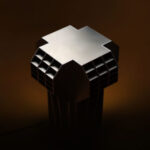
Kōtō – 光塔 – Floor Lamp in Aluminum
by BUREAU OF ENTROPY · Wuppertal, Germany

38x38x48cm (15x15x19")Aluminum

Kōtō (光塔) takes its silhouette from Kyoto’s five-tiered wooden pagodas, built entirely from raw, brushed aluminium with no screws, welds or adhesives — held together purely by interlocking geometry and weight, echoing ancient Japanese joinery.

Read more
9 others are viewing this
Certificate of authenticityAll pieces on ADORNO are authentic and studio-made. To verify that, a certificate, signed by the maker, is always included in the box.
Limited Edition
Only 12 identical pieces will ever exist. Yours will be numbered.
Made for you
You will get pictures of the final piece before shipping
Delivered between28 Dec – 4 Jan
We arrange insured delivery from door to door.
Buyers protection
  • Certificate of Authenticity A signed certificate from the maker is always included in the box.

  • Lowest price guaranteed Find a lower price from the seller, we'll match it.

  • Secure online transactions All personal information that you send to us is encrypted and cannot be viewed by others.

  • 100% insured global deliveries We arrange worldwide delivery, and every shipment no matter the price is fully insured against damages.

  • 14 days return policy In the rare event, you receive a piece that you are not fully satisfied with, you can return it within 14 days of receipt for a full refund except return shipping costs. Made-to-order items are not eligible for return.

Shipping and delivery
Ships fromWuppertal, Germany
Delivery toyour location
Estimated delivery dateDecember 28 - January 4
Custom Crate60x80x60cm, 20kg
  • Tracked from studio to doorstepYou receive a tracking link as soon as the piece leaves the studio, and can follow it through every carrier hand-off until it reaches your door.
  • 100% insured, door to doorEvery shipment is fully insured from pickup to delivery. If anything happens in transit, you are covered for the full purchase price.
  • All made to order purchases are finalThis piece is produced specifically for you once you order, so it cannot be returned or exchanged.
  • Duties and taxes may applyWe declare all pieces as original duty-free works, however, your local customs office makes the final decision. Learn more
Specifications
Dimensions LxWxH
Piece Weight (kg)

12

Production Year

2026

Material

Technique

Design Class

Limited Editions

Number Of Pieces Created

12

FAQ
Does the lamp come with a bulb, and is it dimmable?

Yes, it uses an E27 bulb rated 6W at 2200K with 360 lumens, and it is dimmable with an included dimmer switch.

What plug does it use and can it be adapted for my country?

It ships with a Type C/E (EU) plug for 220-240V, and adaptation to other plug types is available upon request.

How long is the cord?

The cord is 300 cm long.

How long does it take to receive this piece?

This lamp is made to order and usually ships within 12 weeks.

Can this piece be customized?

Yes, customization can be requested — use Chat with the maker on this page to discuss options.

What is it made of and how do I care for it?

It is built entirely from raw, brushed aluminum, assembled without screws, welds or adhesives, relying on interlocking geometry and weight.

Can I return this piece if I change my mind?

Made-to-order pieces like this one are excluded from the standard 14-day return policy.

Is this a limited edition?

Yes, it is part of a limited edition of 12 pieces, produced in 2026.

What are the different types of lamps?

Lamps are grouped by where they sit. Table lamps stand on a surface, including desk lamps for task light and bedside lamps for low, warm light. Floor lamps stand on the floor and include arc, tripod, torchiere and column forms. Wall lamps mount to a wall, sconces among them. Ceiling lamps hang or fix overhead as pendants, chandeliers or flush mounts. Everything else — cordless, outdoor, candle-lit — is a variation on one of those four positions.

What are the parts of a lamp?

A base or body, a socket that holds the bulb, a switch, a shade or diffuser, and the cord and plug. Traditional constructions add a harp — the wire frame arching over the bulb — and a finial that screws down to hold the shade on it. Contemporary and sculptural designs often merge base and diffuser into one form with the socket hidden inside, in which case there is no harp, no finial, and no removable shade.

What kinds of lamp shades are there?

By shape: drum, cylinder, empire, cone, coolie, globe and bell, plus irregular forms in handmade work. By material: fabric and linen for soft diffusion, paper for an even glow, glass for brightness with sparkle, metal and ceramic for directed light downward, and stone or alabaster for light that appears to come from within the material. Shape decides where the light goes; material decides how it feels.

How do I measure a lamp shade?

Four figures: the diameter across the top, the diameter across the bottom, the slant height down the side, and the fitting type. Measure the widest point for the bottom diameter and measure slant rather than vertical height on any sloping shade. If you are replacing a shade, measure the old one and check the fitting — a shade that fits the dimensions but not the fitting is no use.

How do I choose the right shade size for a lamp?

Two proportions work reliably. The shade should be roughly one third of the lamp's total height, and its width one and a half to two times the width of the base. It must also be deep enough to conceal the socket and bulb from anyone standing or sitting nearby. A shade narrower than the base looks top-heavy; one much wider swallows the lamp.

What is the best lamp for reading?

One that puts 400–800 lumens onto the page from beside or slightly behind your shoulder, with a shade deep or opaque enough that you never see the bulb. Position matters more than power: light coming over your shoulder onto the page beats a brighter lamp facing you. Add a second, dimmer source in the room to reduce the contrast between page and surroundings, which is what actually causes eye fatigue. Adjustable table and floor lamps suit reading best; translucent sculptural pieces are for atmosphere.

How do you clean a lamp shade?

Dry first, and gently. Dust fabric and paper shades with a soft brush or a lint roller, working from top to bottom, and never wet paper. Fabric shades tolerate a barely damp cloth on a small mark, tested somewhere hidden. Glass, ceramic and metal shades can be wiped with a damp cloth and dried at once. Always switch off and let the bulb cool first, and support the shade rather than pressing against it — handmade frames are not as rigid as they look.

How do I look after a brass or copper lamp?

Decide first whether you want patina, because most designers do. Unlacquered brass and copper darken over months into the finish the piece was designed to reach, and that process is not damage. If you prefer it bright, polish occasionally with a product made for the metal and dry thoroughly. If a piece is lacquered, do not polish it at all — dust it, since polish removes the lacquer unevenly. Ask us which finish a specific piece has.

How should I care for handmade ceramic, glass and paper lamps?

Dust dry, and often, since dust dulls a glaze faster than anything else. Use a barely damp cloth on glazed ceramic, stone and glass, drying immediately, and never spray liquid onto a fixture. Keep paper, textile and untreated wood dry, and out of direct sun where fading is a risk. On unglazed or raw surfaces, avoid solvents entirely. We can supply the maker's own care notes for any piece.

Do you sell lamp shades, bases or parts separately?

No. Everything here is sold as a complete designed object, because the shade and base are conceived together and are frequently one piece. If you need a replacement shade for a lamp you already own, an established shade maker is the right supplier — and if something on a piece bought from us needs attention, contact us and we will approach the studio.

Can I rewire an old lamp, or convert a vase into one?

Both are common projects, and neither is something we supply parts for. Rewiring is straightforward work for an electrician and legally restricted to one in some countries; conversion kits for vessels exist but require careful drilling and strain relief, and a poorly made conversion is a genuine fire risk. If the appeal is a one-off object with real material character, buying a finished piece from a maker gets you there without the risk.

Which lamp should I choose for which room?

Living rooms want several: a floor lamp beside the seating, one or two table lamps, and something overhead on a dimmer. Bedrooms want low, warm light at bedside height and little else. Home offices want directed task light plus a second source to soften screen contrast. Hallways want wall lamps, which take no floor space. Dining rooms want one considered piece over the table rather than several small ones.

Are the lamps dimmable, and what switches do they use?

It varies by piece, and switching is worth checking as carefully as the light itself. Lamps with standard E14 or E27 sockets can usually be dimmed with a compatible bulb and an inline or plug-in dimmer, even where the lamp itself has a simple on/off switch. You will also find pull chains, rotary dimmers, touch-sensitive bases and inline cord switches — a detail that matters most on a bedside or a hard-to-reach piece.

Are the lamps unique, and are they made to order?

Many are unique or produced in limited editions, and most are made after you order in the designer's studio, with lead times stated on the product page. A unique piece exists in one example, so once it sells it is not repeated. If you want a pair or a set, order in one batch so glazes, glass color and grain match, and tell us any fixed deadline before you buy.

Description

Kōtō (光塔) is a sculptural light object drawing on the iconic silhouette of Kyoto’s five-tiered wooden pagodas. Crafted entirely from raw, brushed aluminium, it’s built without screws, welds or adhesives — its construction relies solely on interlocking geometry and weight, a contemporary interpretation of ancient Japanese joinery where structure emerges from form itself.

A self-supporting framework sits hidden inside, revealed only on close inspection. Each part is manufactured with architectural precision, letting five floating plates rest in perfect alignment; together they diffuse a warm, indirect glow, producing a meditative rhythm of light, shadow and presence. The piece is scaled-down functional architecture: quiet yet forceful, minimal yet grounded in tradition, built for collectors who value clarity, construction and conceptual depth.

It’s produced in a limited edition of 8 plus 4 artist’s proofs, numbered and signed, and handmade in Germany. Fine scratches or slight distortions can occur as a natural result of the handcrafted process.

Dimensions LxWxH
Piece Weight (kg)

12

Production Year

2026

Material

Technique

Design Class

Limited Editions

Number Of Pieces Created

12

About BUREAU OF ENTROPY Visit Showroom →

STRUCTURAL NECESSITYBureau of Entropy treats construction as a form of thought. Its objects begin with forces rather than images: weight, pressure, resistance, balance, and the precise point at which separate elements become a stable whole. Components are cut, aligned, interlocked, and held through their own geometry. What carries the object is not hidden. Structure remains visible as both evidence and expression. This legibility is central to the practice. A connection does not merely solve an assembly problem; it determines proportion, rhythm, and presence. Material is not shaped around a predetermined silhouette. The silhouette emerges through the negotiation between material behavior, structural demand, and human use. Working across furniture, lighting, and functional sculpture, Bureau of Entropy returns to elemental typologies: the seat, the table, the source of light. These familiar forms are treated as unresolved structures rather than established designs. Their functions remain recognizable, while their construction is reconsidered from the ground up. The work draws on architecture, engineering, precision manufacturing, and the anonymous intelligence of objects refined across cultures and generations. Such references are not reproduced as styles. They are examined as accumulated responses to recurring conditions: how a body is supported, how weight is transferred, how light occupies space, and how an object establishes presence. Bureau of Entropy does not separate technical resolution from artistic expression. Precision produces character. Constraint generates form. An object reaches completion when its structure and presence can no longer be understood independently from one another.FOUNDATIONBureau of Entropy was founded in Wuppertal, Germany, in 2025 by Marvin Julian Freund and Matthias Figurowicz. Both founders trained as toolmakers, developing an early understanding of metal, tolerance, manufacturing, and assembly through direct physical practice. This shared technical foundation was later extended through different disciplines. Freund studied architecture and conceives the objects through proportion, spatial presence, cultural context, and the relationship between body and structure. He develops both their formal expression and their underlying construction, determining how each work is manufactured, joined, and assembled. For Freund, designing is also a way of thinking through what resists resolution in language. Through drawing, testing, and assembling, personal experience enters the work without becoming illustration or fixed narrative. It is held in the persistence of the process: remaining with a question until the object arrives at its precise form. Figurowicz studied mechanical engineering and contributes an understanding of forces, mechanisms, material performance, and functional systems. He supports the physical realization of the works through fabrication, assembly, and technical implementation. This continuity from conception to realization allows each object to emerge as a coherent structural whole. Construction is not added to form; it is the means through which form becomes necessary.
Question for the maker?
BUREAU OF ENTROPY
Photo BUREAU OF ENTROPY
· Wuppertal, Germany
We are here to make sure you get the answers you need - in time.
Member since 2025 · Expect a reply within 24 hoursReply in 24 hours
More Ways To Browse
Floor Lamps Lamps Table Lamps Ceiling Lamps Wall Lamps Battery Operated Lights Outdoor Lights