A mirror shows you the room. A rattan frame shows you the hand that made it.
A rattan mirror arrives with a reputation: beach houses, holiday rentals, a hundred lookalike sunbursts. Yet rattan is a climbing palm, not a wood, and its stems bend under steam and hold their curve once dry. In the right hands, then, a rattan mirror is less a coastal cliché than a study in line and tension.
This edit starts with rattan and widens to its relatives, wicker, rye straw, Mexican tule and carved wood, all from independent studios and available now or made to order.
What is a rattan mirror?
A rattan mirror is framed in the stems of climbing palms of the genus Calamus, native to Southeast Asia. Unlike bamboo, rattan is solid, so it can be steam-bent, split into strands for weaving or used whole as a rod. As a result, frames range from tightly wrapped rings to open latticework; our guide to the types of mirrors covers the wider family.
Wicker, by contrast, is a weaving technique rather than a material, and cane is rattan’s glossy outer skin. Notably, rattan caning took hold in England around 1660, long before the frame became shorthand for coastal and boho chic interiors.
How to choose a rattan mirror
- Start with scale. Above a console table or sideboard, aim for two-thirds to three-quarters of its width. A full-length mirror needs at least 48 in (122 cm) of glass to show a full figure.
- Next, decide on shape. Round frames soften straight lines, arches add height and wave-edged frames behave like wall sculpture.
- Then check weight. Sculptural frames can reach 99 lb (45 kg), so confirm the hardware and your wall type first.
- Lastly, consider climate. Natural fibers prefer ventilated rooms away from radiators; for damp spaces, see our edit of bathroom mirrors.
Materials and construction
Natural rattan
Steam-bent and left to dry, rattan holds its curve with real strength, which is why it also carries furniture such as the Barney Console Table in Hand-Woven Rattan. Over time, it deepens from pale straw to honey.
Wicker and willow
Wicker is a technique, usually worked in willow in European basketry. Accordingly, a wicker band is bound rather than glued, so it can be rewoven if it loosens.
Tule and other woven plant fibers
Tule is a bulrush from Mexico’s lakes and wetlands, woven into dense, cushioned rims that ripple around the glass. Moreover, it is renewable, part of the shift we explored in studios rethinking our objects’ life cycles; browse more design from Mexico.
Straw
Split and flattened, rye straw lies like a veneer with a golden sheen, a staple of rural French furniture. However, its edges are delicate, so it suits table mirrors and quiet walls.
Solid and carved wood
Walnut and mahogany give a mirror the density of furniture, and carving adds shadow, as in the Brancusi Mirror, Sapele Mahogany Wood. Keep wooden mirrors in a stable climate, since wood moves with humidity.
Stone and plaster
Dense and cool, stone suits freestanding mirrors. By contrast, fiber-reinforced plaster, as in the sand-patterned Mirror O, offers a mineral surface at a fraction of the weight.
8 rattan and natural-material mirrors by independent designers
Arranged from woven rattan and plant fibers to carved wood, every piece below is available now or made to order.
Hannah Mirror by Heaps & Woods
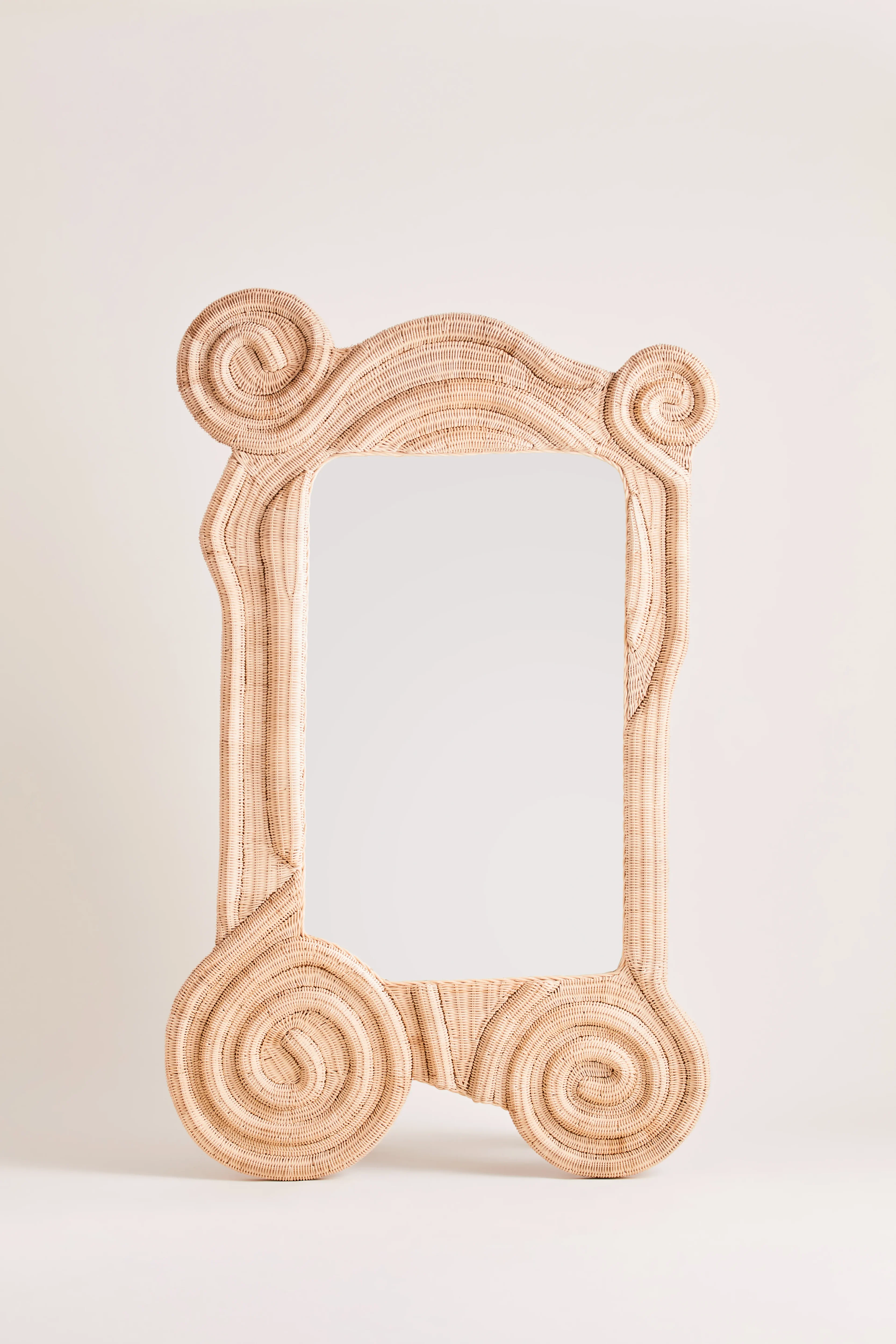
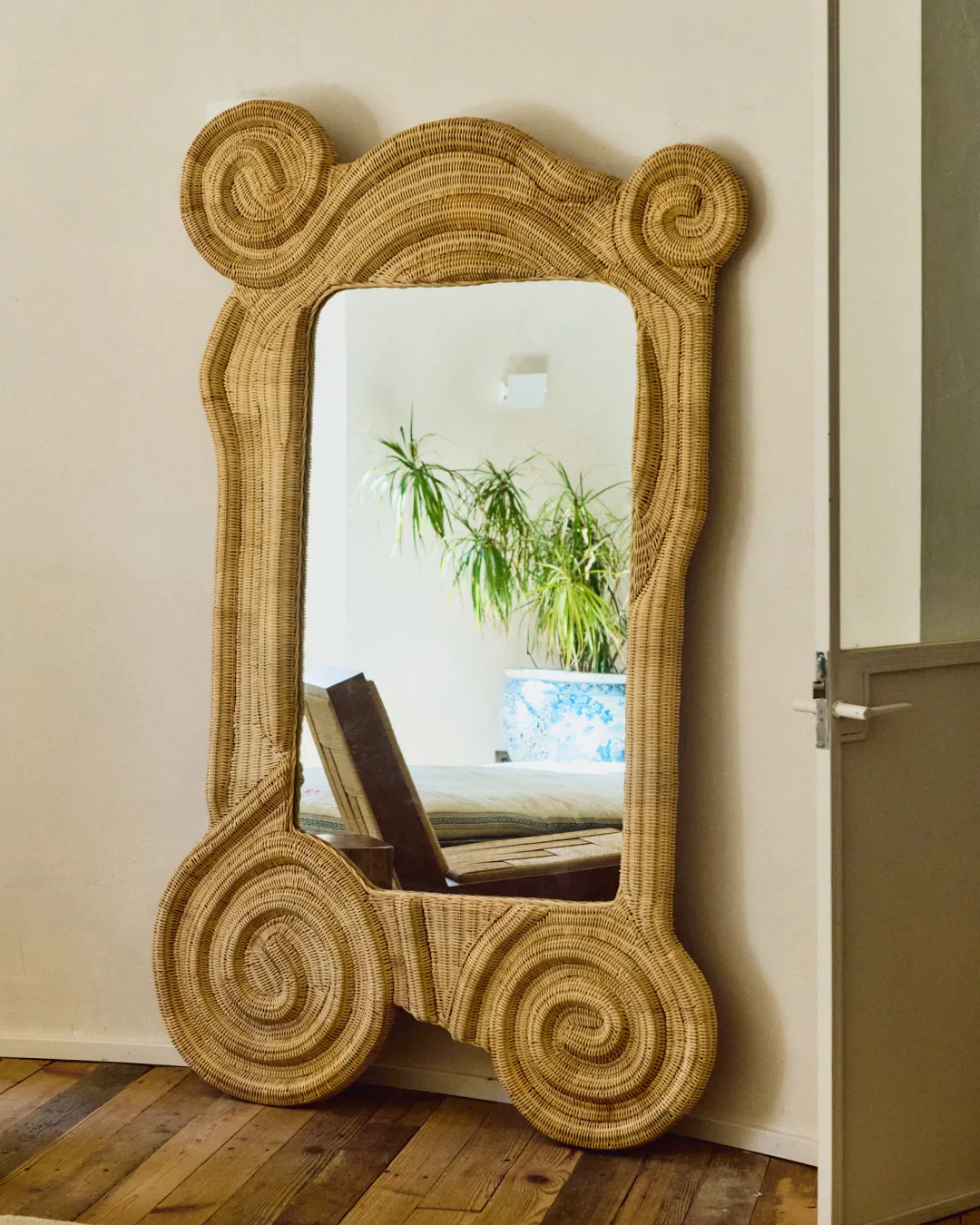
Shaped in natural rattan with a natural finish, the Hannah Mirror belongs to a series that began on a walk along an Asian beach and was developed with teams of artisans. Its frame swells and loops around the glass like driftwood and tide lines, so the piece reads as sculpture first and mirror second. Indeed, at roughly 73 in (186 cm) tall and 44.5 in (113 cm) wide, it anchors a bedroom or entry on its own, and the studio rates it for indoor or protected outdoor use.
€3.000 incl. tax
Sofia Mirror by Heaps & Woods
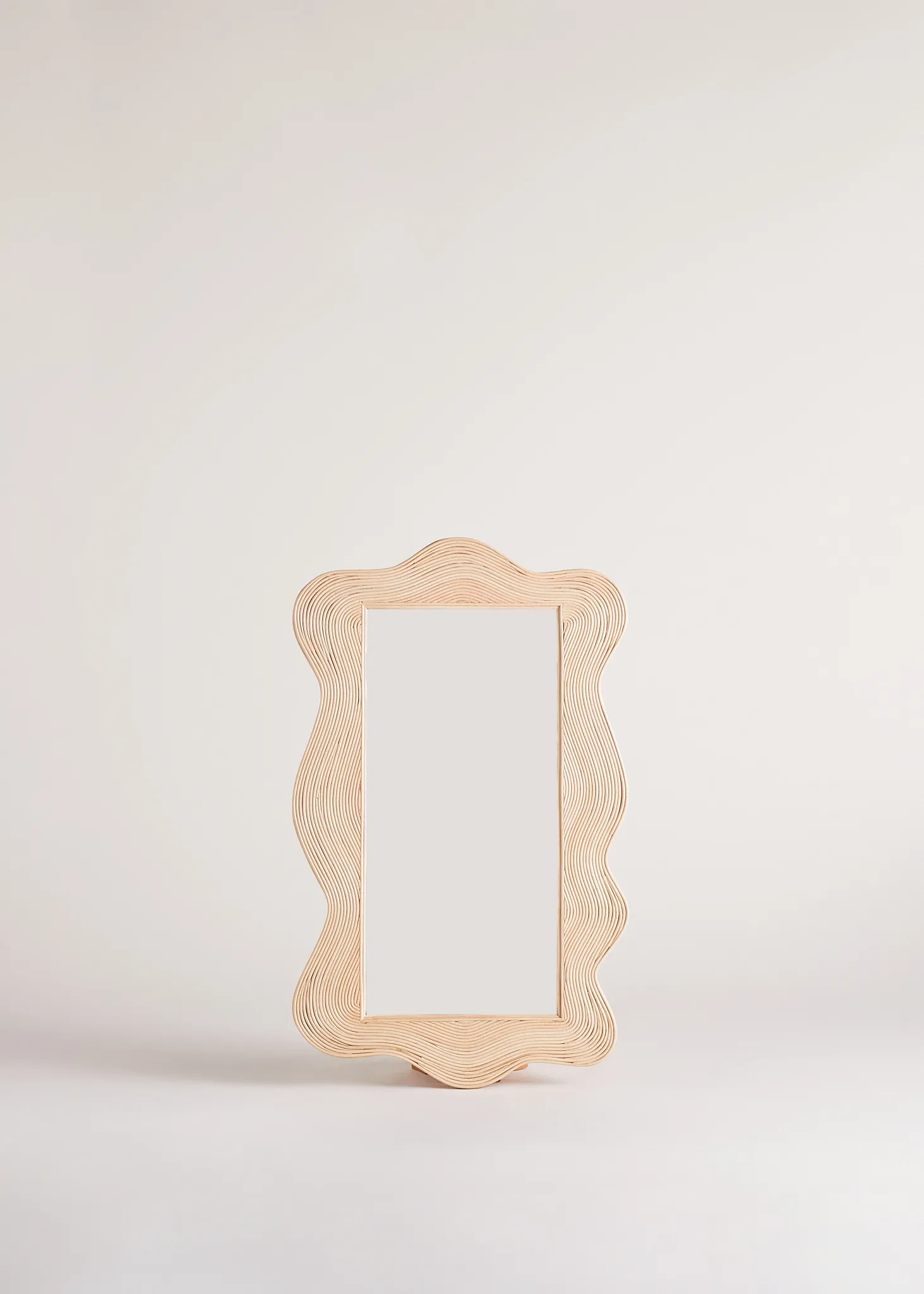
Framed in natural rattan worked into a continuous wave, Sofia nods to the bold geometry of the 1980s and the Memphis Group. The material keeps that daring outline light: the rim rises and falls around the glass without ever feeling heavy. Moreover, it comes in two sizes, the medium standing about 43 in (110 cm) tall and 27 in (68 cm) wide, so it works above a console as readily as in a hallway.
€1.375 – €2.000 incl. tax
Gabarit – Wicker & Aluminum Wall Mirror by Sacha Parent & Valentine Tiraboschi

Made in Burgundy with basket weaver Christine Berthet, Gabarit starts as a block of aluminum, machined and engraved with a spiral, then bound with a band of wicker. Its form borrows from the wooden templates basket makers use to produce basket bottoms in series, with metal standing in for the wood. Notably, the engraving follows the spiral of the weave and breaks the reflection, so the surface behaves like a reflector rather than a clear mirror, and the wicker binding can be repaired.
By Sacha Parent & Valentine Tiraboschi
€6.000 incl. tax
Rye Straw & Stainless Steel Table Mirror by Sacha Parent & Valentine Tiraboschi

Rye straw from a farm in Saône-et-Loire meets stainless steel in this table mirror, a contemporary reading of a material long used in rural French furniture. The straw lies flat and glows softly against the cool metal, a quiet tension between field and workshop. Furthermore, it comes in naturally colored straw as well as orange, blue and teal, which makes it the most accessible way into natural-fiber mirrors in this edit.
By Sacha Parent & Valentine Tiraboschi
€700 incl. tax
La Celebración – Handwoven Fiber Mirror by Joyful Objects, Yes!

Handwoven from natural fibers by artisans in Mexico, La Celebración takes its form from sensual, kinetic movement: the frame ripples around the glass as though caught mid-dance. Its dense weave turns every curve into a play of light and shadow, so the piece changes as daylight moves across the room. Consequently, it is the boldest woven frame in this edit, a full-length statement that sits between mirror and wall sculpture, and it ships with a signed certificate from the maker.
€6.000 incl. tax
Meadows Mirror by BOTHI

Built by hand in Amsterdam from solid mahogany, the Meadows Mirror carries the weight of furniture rather than decoration. Floral inlays, set into the front with restraint, suggest meadow flowers without illustrating them. Open it, and the piece reveals a double mirrored interior that lets you see yourself from several angles, which makes it a natural fit for a dressing area. Closed, it measures about 31.5 x 12 in (80 x 30 cm), opening to 23.5 in (60 cm) wide.
By BOTHI
€700 incl. tax
Acid Mirror, Carved Walnut Veneer by Josh Page Studio
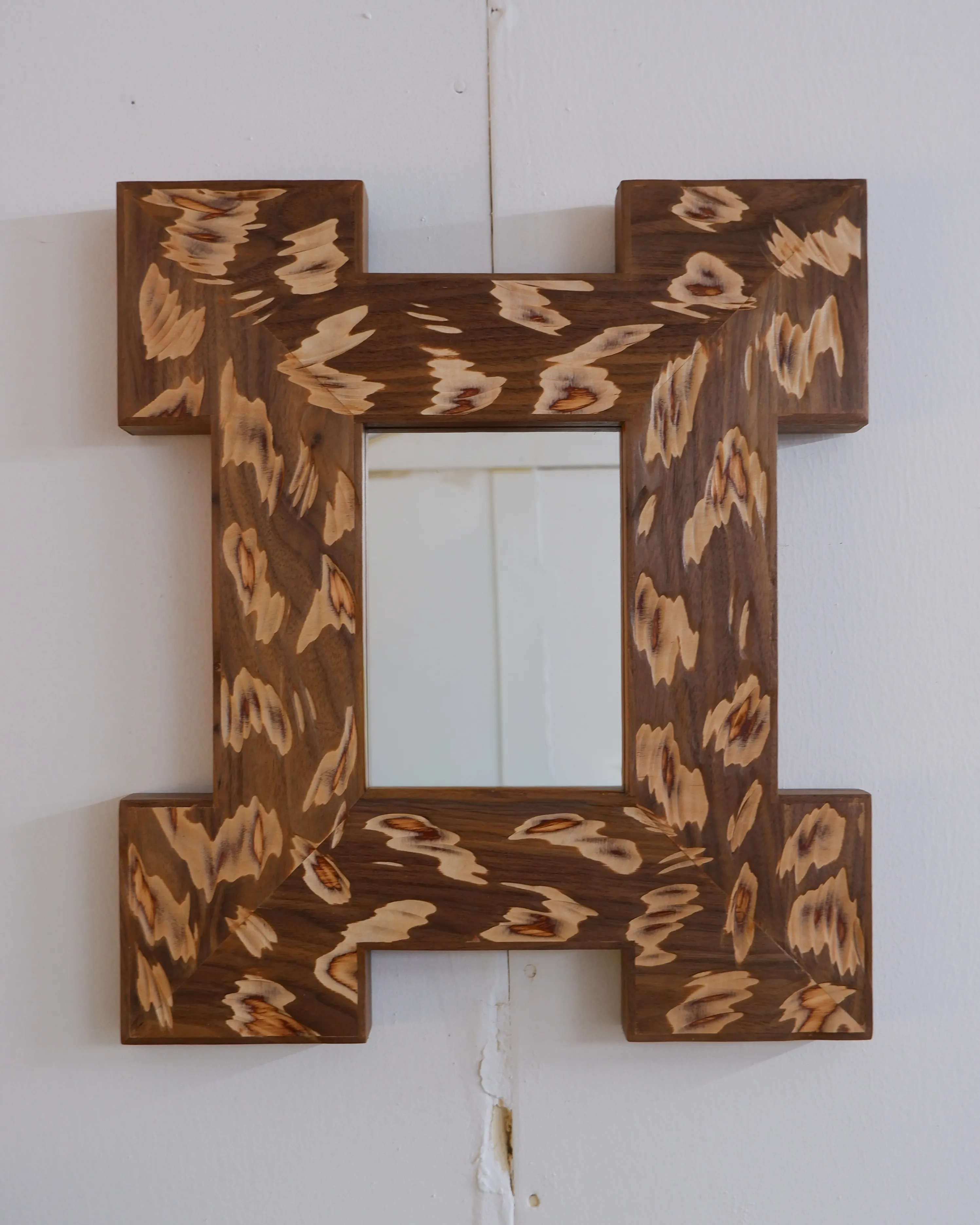
Carved in walnut and finished with the studio’s signature Acid texture, this mirror takes its outline from 18th-century Spanish and Dutch picture frames at the National Gallery in London. The silhouette is old; the surface is not, and that gap is what makes it interesting. Because it is made by hand, each frame varies slightly, in three sizes from 18 x 16 in (46 x 40 cm) to 31.5 x 23.5 in (80 x 60 cm).
€430 – €610 incl. tax
La Celebración Natural Mirror by Joyful Objects, Yes!

The smaller version of La Celebración is handwoven in tule fiber in Mexico, keeping the same rippling, kinetic outline at a scale that fits above a console or beside a bed. Woven in its natural tone, the tule reads soft and matte against the glass, closer in spirit to rattan than to any carved frame. Therefore, it is the easiest way to bring the design into a smaller room, and it, too, arrives with a signed certificate from the maker.
€1.500 incl. tax
Rattan mirrors room by room
Entryway and hallway
Hang the mirror 6 to 10 in (15 to 25 cm) above an entryway table, centered at 57 to 60 in (145 to 152 cm) from the floor. A bench below completes the arrangement; see our edit of entryway benches.
Bedroom and dressing area
A full-length frame belongs here, leaned against a wall or fixed beside a wardrobe. Between two nightstands, meanwhile, a smaller wave-edged frame softens the bed’s straight lines.
Living room
Over a sofa, choose a mirror about two-thirds of its width, with the bottom edge 8 to 10 in (20 to 25 cm) above the backrest. For more ideas, see wall decor ideas and how to create a cozy living room.
Bathroom and powder room
Choose a powder room or a well-ventilated bathroom, and keep natural fibers at least 3 ft (91 cm) from the shower. Where moisture is constant, sealed wall mirrors are the safer choice.
Troubleshooting rattan and natural-frame mirrors
Secure mounting and anchors for weight
Fix the mirror at two points, with hardware rated for twice its weight. Under 20 lb (9 kg), quality drywall anchors suffice; heavier pieces need studs, and anything over 50 lb (23 kg) a French cleat.
Cleaning the glass without soaking the frame
Spray cleaner onto a microfiber cloth, never onto the mirror, and dust the weave with a soft brush.
Keeping rattan and straw from drying out
Keep natural fibers 3 ft (91 cm) from radiators and out of direct sun, ideally at 40 to 60 percent humidity. If a binding loosens, contact the maker rather than gluing it.
Preventing black spots on the silvering
Desilvering starts when moisture or ammonia-based cleaners reach the backing. Therefore, keep the edges dry and leave a small air gap behind the glass.
Leaning versus fixing safely
Set a leaning mirror’s base 4 to 6 in (10 to 15 cm) from the wall, add non-slip pads and tether the top, especially around children and pets.
Frequently asked questions
Are rattan mirrors still in style?
The mass-produced sunburst has peaked, but rattan has not. Sculptural, one-off frames by independent makers now carry it well beyond the coastal look.
What is the difference between rattan and wicker?
Rattan is a material, the stem of a climbing palm. Wicker is a weaving technique that can use rattan, willow, reed or synthetic fiber.
How do you clean a rattan mirror?
Dust the frame with a soft brush, then clean the glass with cleaner sprayed onto a cloth. Never soak the rattan.
Can you put a rattan mirror in a bathroom?
Yes, in a powder room or a well-ventilated bathroom, at least 3 ft (91 cm) from the shower.
How high should you hang a rattan mirror?
Center it at 57 to 60 in (145 to 152 cm) from the floor, or 6 to 10 in (15 to 25 cm) above furniture.
Should a full-length mirror lean or be mounted?
Both work. Leaning suits bedrooms with a wall tether; mounting is safer for heavy frames and homes with children.
Why rattan mirrors earn their place
A natural frame ages with the house: rattan honeys, tule softens, walnut deepens. Choose scale first, material second and placement third, then let the frame do the talking. For a wider room in natural materials, browse our upcycling and reuse collection and wall decoration.