You look at your bathroom mirror more often than any other object you own.
The bathroom is the one room where a mirror stops being a decorative choice and becomes a fixture. It goes up once, at eye height, above a sink, and then it quietly absorbs a decade of mornings. Most of what the market offers for that position is interchangeable: a rectangle of float glass, a thin aluminum surround, a price low enough that nobody thinks twice. Consequently, the object you spend the most time looking at ends up the least considered thing in the room.
ADORNO takes the opposite position. The pieces below come from independent studios working in cast aluminum, hand-poured silver, natural rattan, carved wood and fiber-reinforced plaster, and they run from a small poured circle to a rattan form close to two meters tall. Notably, not all of them belong in a steam-filled wet room, and this guide is direct about which do. Specifically, some are built for a powder room or a well-ventilated en-suite, while others will hold up above a shower for years. Furthermore, the selection spans round, rectangular, arched and irregular profiles, framed and frameless, including one piece that carries its own shelf. For a wider view of the category, our complete guide to the types of mirrors covers the ground beyond the bathroom door.
How to choose a bathroom mirror
Start with the vanity, not the wall. Work through the seven steps below in order, since each one narrows what is left to decide.
- Measure the clear wall space. Take the full width you have, then subtract for any sconce, shelf or cabinet edge that will crowd the frame. What is left is your real ceiling, not the wall’s total width.
- Size the mirror to the counter. A mirror reads as deliberate when it sits narrower than the vanity beneath it, usually by two to four inches on each side. Match the two widths exactly and it reads as an accident.
- Let the sink count decide the shape. Above a single sink, a round or arched profile softens the hard geometry of tiling and faucets. Above a double vanity, two matched mirrors hung on the sink center lines almost always beat one long panel, because the pairing tells the eye where each person stands.
- Set the orientation from the room, not the trend. A tall profile lifts a low ceiling and suits a narrow powder room. A wide profile bounces light across a galley bathroom and makes it feel less like a corridor.
- Position it for the light you actually have. A bathroom with one small window needs a mirror placed to catch and return whatever daylight arrives, which usually means facing or adjoining the window rather than sitting opposite a blank wall.
- Match the frame finish to your existing hardware. Brass against chrome fights; brass against brass settles. The finish you already own in taps, handles and towel rails sets the constraint.
- Filter for moisture last. This is the step most buyers skip, and it rules out more pieces than taste ever does. The materials section below covers which surfaces survive a wet room and which belong in a powder room.
Materials and construction
Mirror glass and silvering
Every mirror is glass with a metallic layer bonded to the back, and that layer decides how long a piece survives humidity. Industrial mirrors use sprayed silver sealed under copper and paint. Studio pieces are often hand-poured instead, so the coating drifts into irregular pools and the reflection carries texture rather than a flat optical copy. Low-iron glass removes the faint green cast that thick standard glass shows at the edges.
Framed, frameless, and the edge between them
A frame does two jobs: it shields the fragile silvered edge from water and gives the mirror presence on the wall. Frameless pieces sit flatter and recede, which suits a bathroom already carrying tile pattern and visible plumbing. Between the two sits a third approach, where the glass is held in exposed hardware or left with a raw cut edge — a maker’s signature, though it needs a sealed or well-ventilated position.
Cast aluminum and metal frames
Cast aluminum is the most forgiving material here for a wet room. It does not rot or swell, and it forms a self-protecting oxide the moment it meets air, so steam has almost nothing to work on. Casting also reaches shapes that milled or folded metal cannot. Expect real weight, which makes the fixings matter, and choose brushed over polished since it hides water spotting.
Brass, steel and mounting hardware
Unlacquered brass develops a patina that deepens with humidity, moving from bright yellow toward warm brown — which some buyers chase and others resist. Patinated brass starts there already, so it changes more slowly and more evenly. Where springs or fixings are visible as part of the design, check they are stainless rather than mild steel before hanging the piece opposite a shower.
Plaster and mineral composites
Fiber-reinforced plaster gives a matte, chalk-soft surface that no metal or wood imitates, and it takes ornament harder materials cannot. Its weakness is porosity: repeated wet-dry cycles eventually soften the surface or lift a decorative layer. Consequently plaster belongs in a powder room or a well-ventilated en-suite rather than above a bath, and it wants a position away from door swings, since it chips.
Wood, rattan and natural fiber
Solid wood moves with humidity, and good joinery accounts for that — which is why a solid frame outlasts veneered board, where water reaching the core causes swelling and delamination. Oiled finishes breathe and can be refreshed at home; lacquer seals harder but fails badly once it cracks. Rattan and woven fiber tolerate a ventilated bathroom but not a sealed wet room.
10 Bathroom mirrors from independent studios
Umbra Wall Mirror by Hasik Design Studio
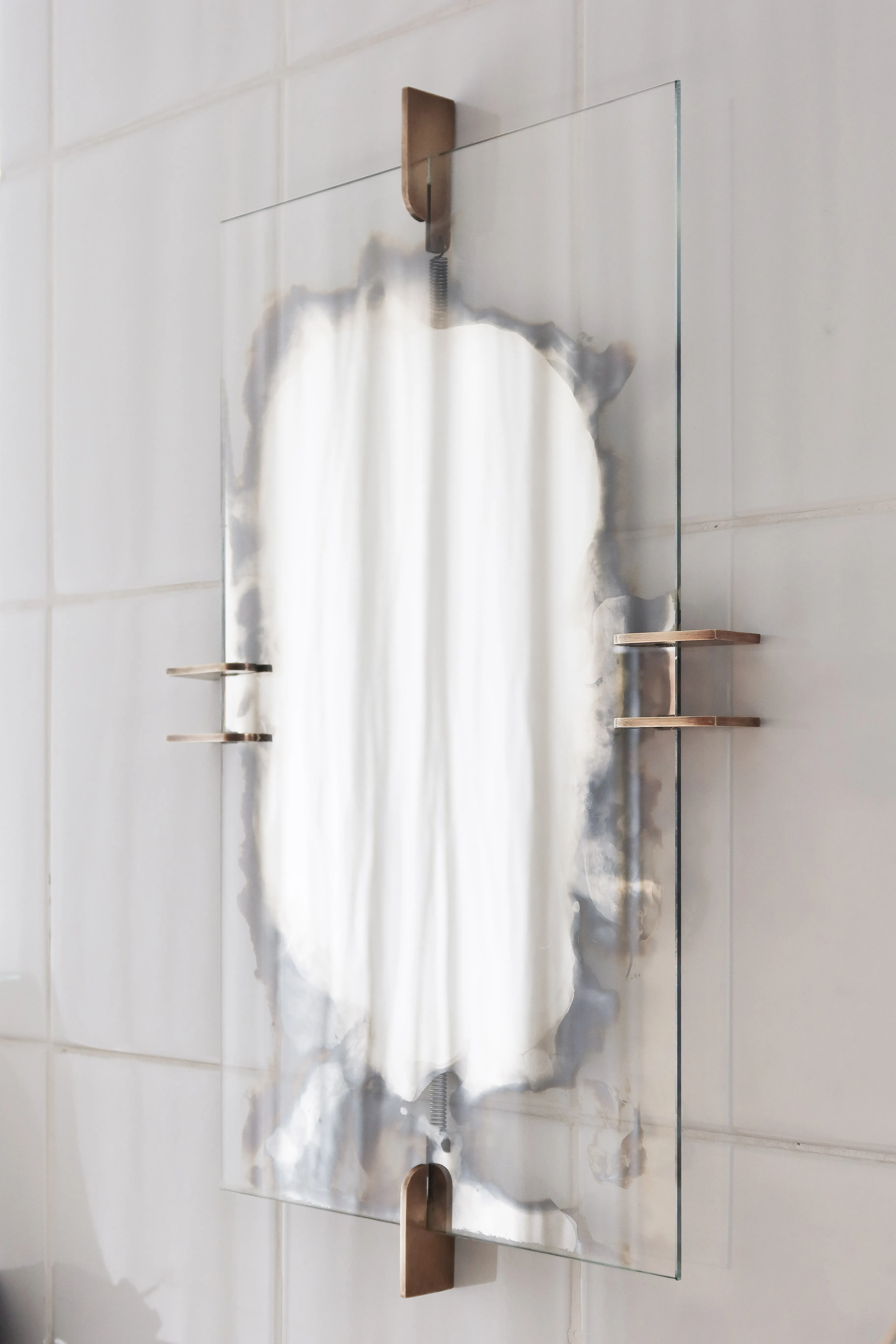
A four-millimeter pane sits in patinated brass holders, drawn tight by exposed steel springs that carry the whole suspension. The hand-worked process leaves an irregular edge, so the boundary between the glass and what it returns never quite resolves. Notably, the hardware is the design rather than a concealed afterthought, which makes this one of the few pieces here that reads as convincingly above a sink as it does in a hallway. It premiered at Milan Design Week 2026.
€1.500 incl. tax
Float Mirror Transparent #t_40 – Liquid Silver / Glass by Studio Speculo
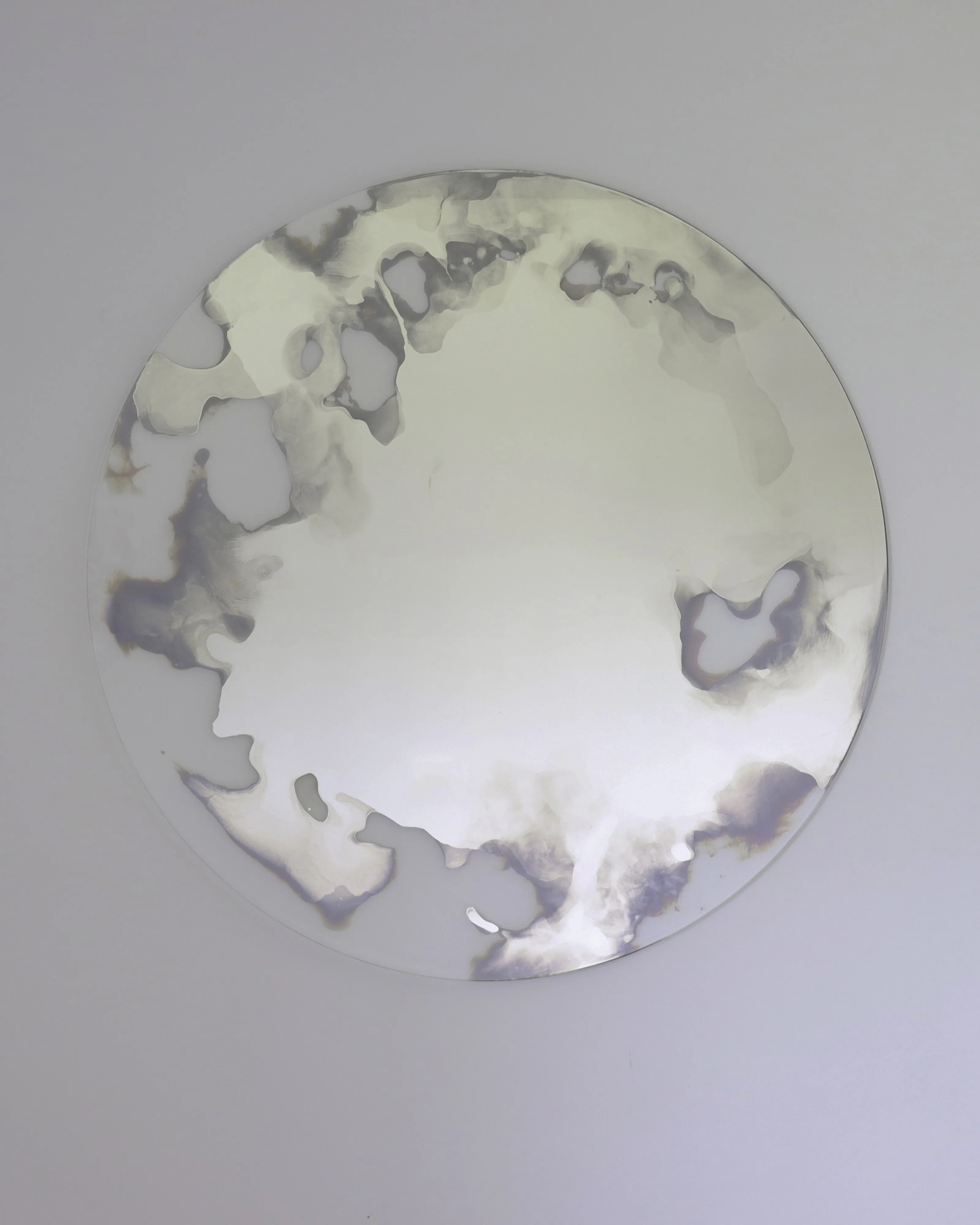
Liquid silver is poured by hand onto Opti White glass, following a silvering recipe refined from early nineteenth-century workshop practice. The metal settles into organic, drifting patterns that leave parts of the pane transparent and others fully reflective. Consequently, the mirror works twice over, holding a clear reflection where you need one and behaving as wall art everywhere else. A central hanger lets you rotate the pane and choose where the silver stain falls.
€465 incl. tax
Hannah Mirror by Heaps & Woods
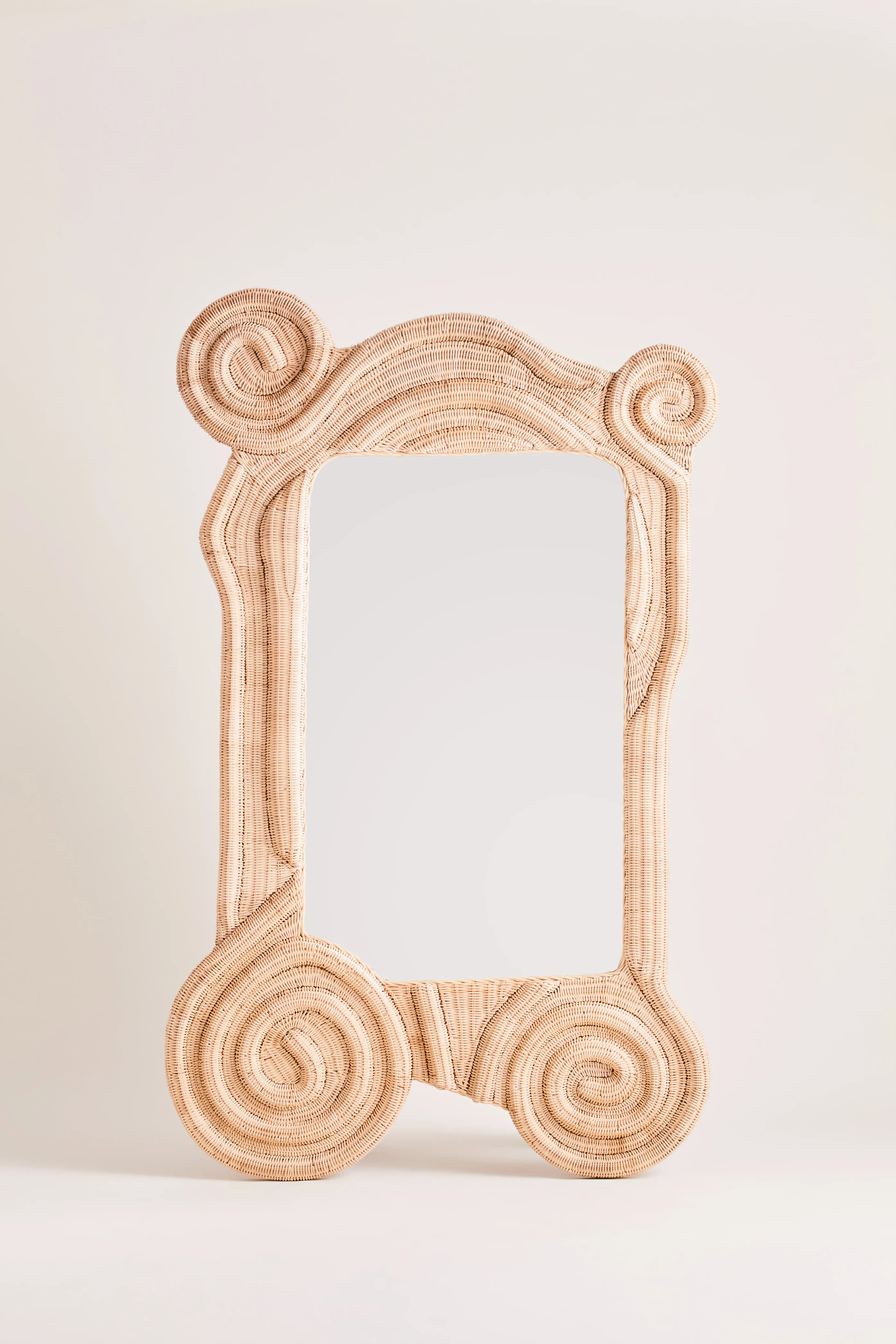
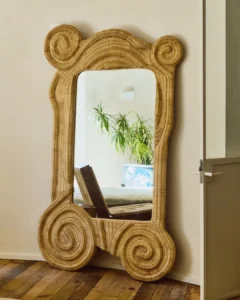
Natural rattan is worked into an organic, undulating form that stands 186 centimeters tall and weighs 45 kilograms. The piece came out of a series conceived on an Asian beach walk, and the techniques behind it were developed with artisan teams rather than adapted from a catalog. Moreover, its scale changes the brief entirely: this is a full-height mirror for a generous en-suite or dressing area, not a vanity fitting. Rattan asks for ventilation and protection, so keep it clear of direct spray.
€3.000 incl. tax
Trama Mirror by Joana Teixeira
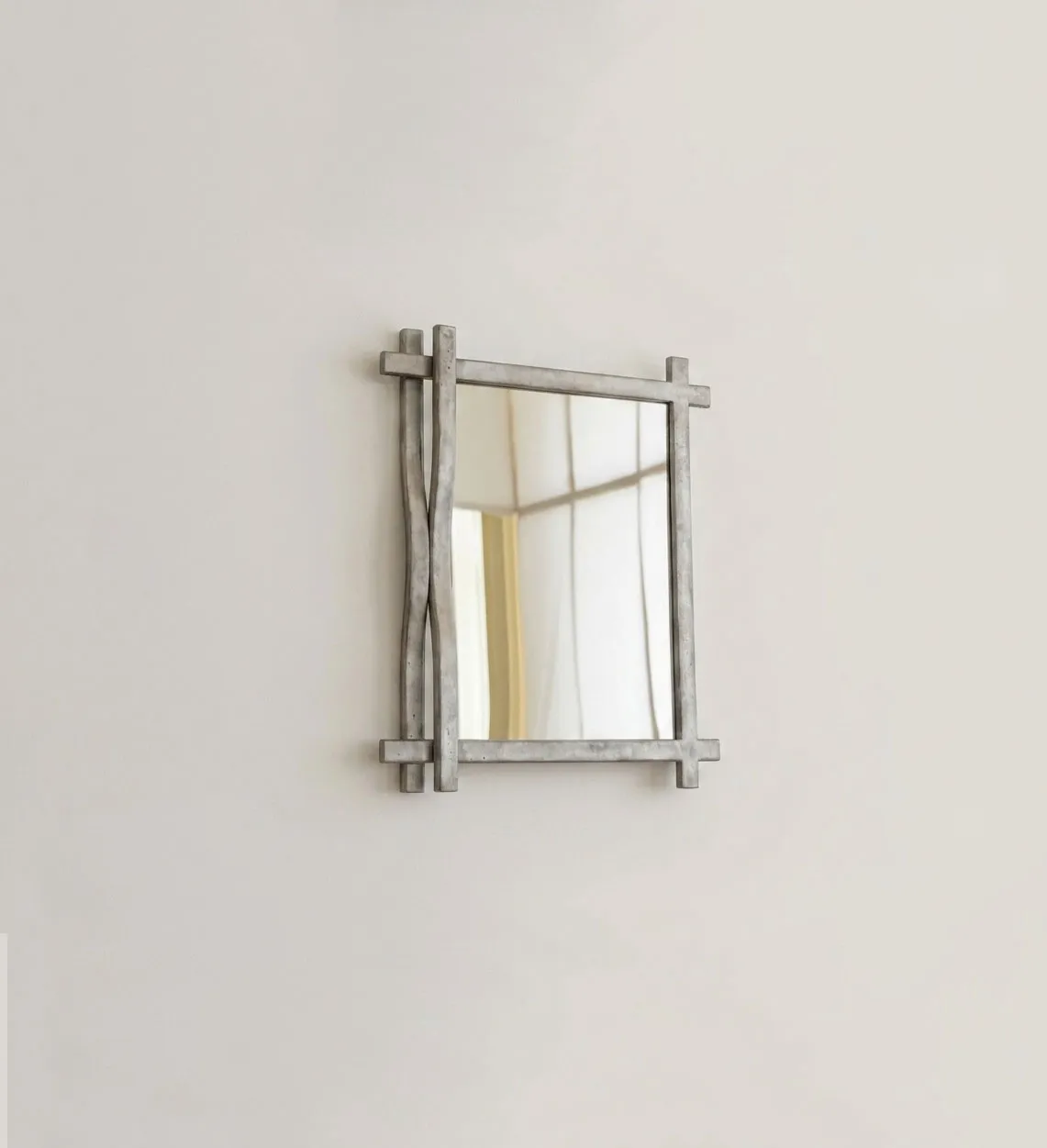
Cast aluminum is worked into intertwining lines that hold the glass in a structure closer to weaving than joinery. The piece sets movement against the rigidity the material usually implies, subverting the geometry you expect from cast metal. As a result, it carries artistic weight without sacrificing the one material property a bathroom actually demands, since aluminum neither swells nor corrodes in steam. Of everything here, this is the safest choice for a genuinely wet room.
€1.270 incl. tax
Mirror O – Sand Decor & Plaster by Sacha Parent & Valentine Tiraboschi

Fiber-reinforced plaster carries an ornamental pattern generated by flows of sand, a technique that won the Jury’s Grand Prize at Villa Noailles Design Parade 2024. The surface holds a matte, mineral softness that reads as ancient and newly made at once. Designed and hand-finished in France from locally sourced materials, it ships with a hook already fitted to the back. Given the porosity of plaster, however, place this one in a powder room or a well-ventilated en-suite rather than above a bath.
By Sacha Parent & Valentine Tiraboschi
€1.350 incl. tax
Hi Beauty! Wall Mirror by please touch studio
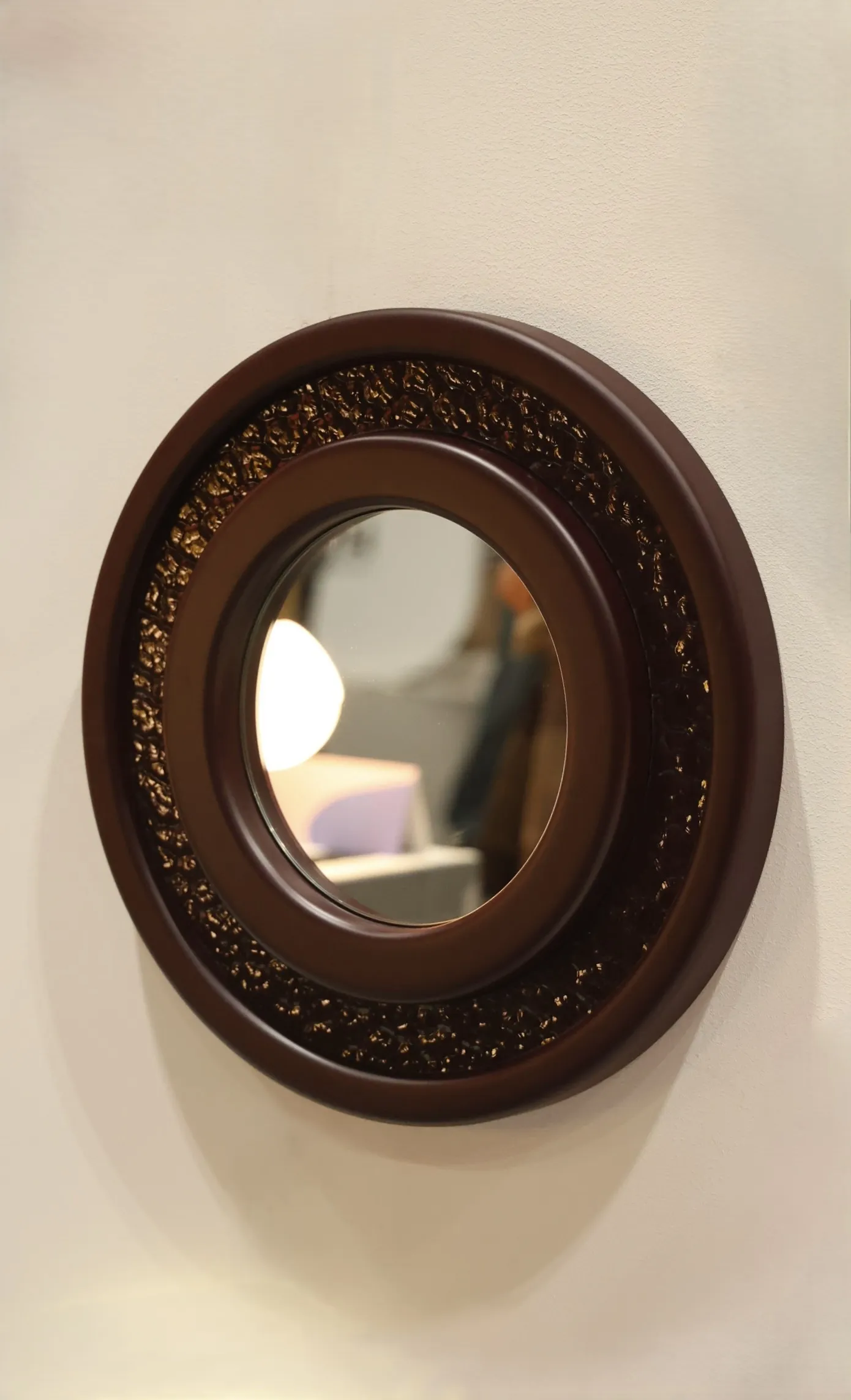
A circular frame in solid board carries a deep burgundy matte lacquer, set against an ornamental glass detail woven into the form. The contrast of a velvet-flat surface with a small, glinting inlay gives the piece more depth than its simple outline suggests. Furthermore, the round profile does exactly what a square vanity wall needs, breaking the grid of tile and cabinetry. Burgundy is the presented finish, though the studio offers a range of other colors.
€500 incl. tax
Meadows Mirror by BOTHI
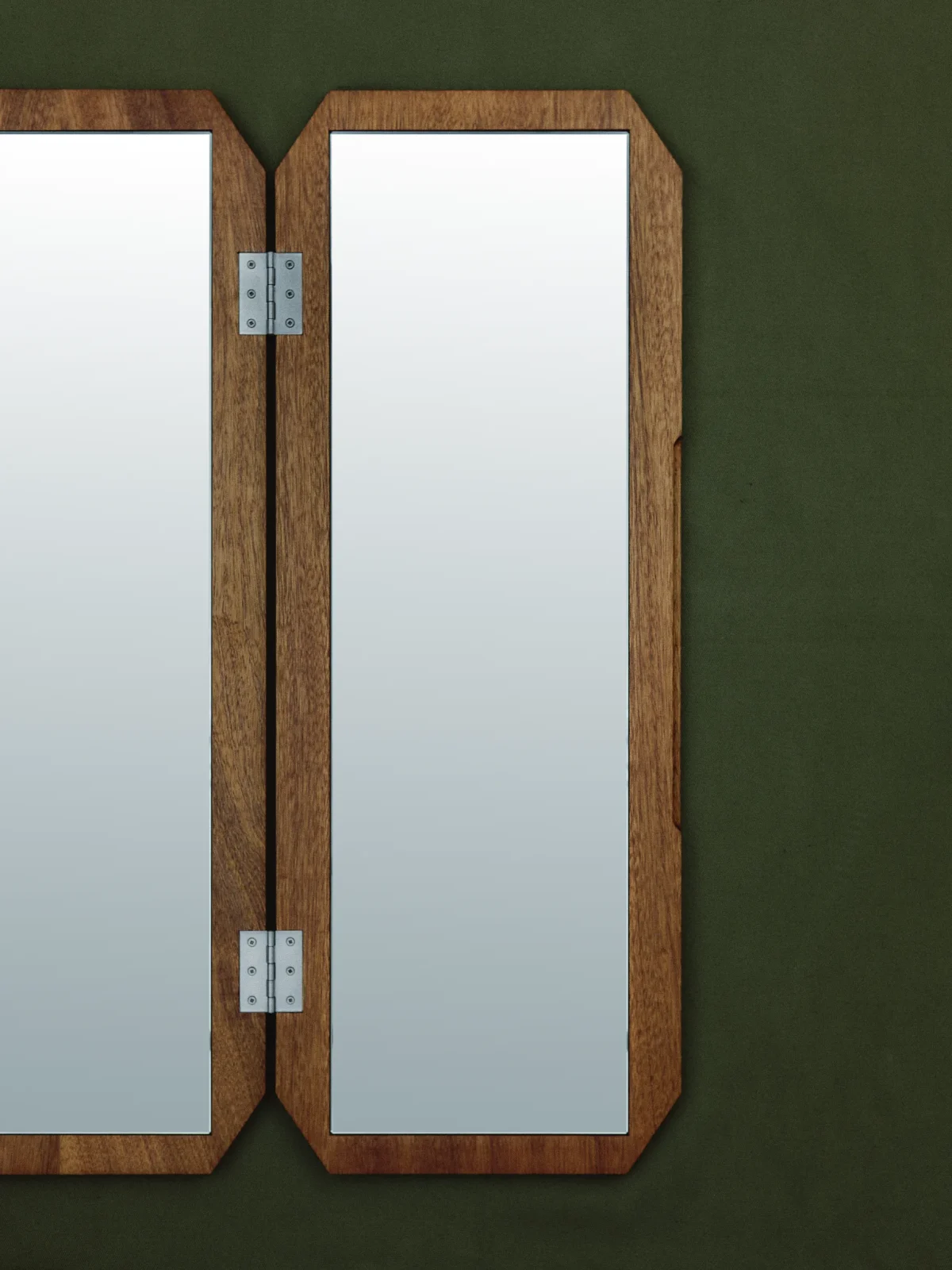
Solid mahogany is built up as a volume rather than a frame, with floral inlays set into the front face in a botanical rhythm that stays suggestive rather than illustrative. The body opens to a second mirrored interior, so the piece gives a fuller view when you are dressing and turns reflection back on itself. Notably, solid timber is the right specification for a ventilated bathroom, since there is no veneer core to swell or lift. Made by hand in Amsterdam to order, 80 by 30 centimeters.
By BOTHI
€700 incl. tax
Avivé Mirror – Maple by Vital Lainé
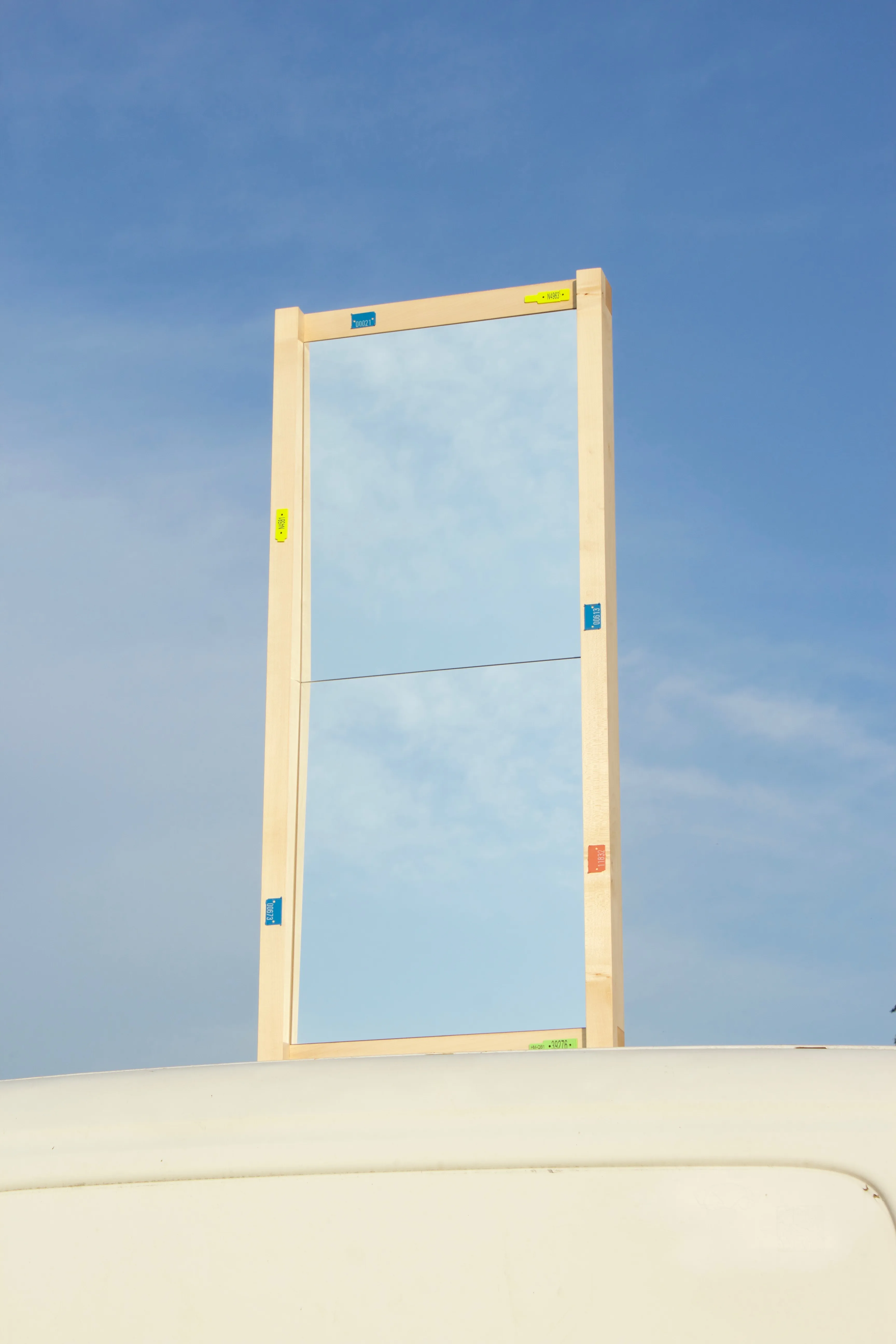
Maple with an oiled finish keeps the sawmill inscriptions, classification codes and transport markings that most makers sand away. The result is a 140-centimeter panel that traces the history of the logs it came from, treating traceability as ornament rather than an inconvenience. Consequently, the tension sits between fine joinery and industrial residue, and it rewards a close look. Produced in a limited edition of eight; the oiled surface can be refreshed at home, which suits a wood piece living in a humid room.
By Vital Lainé
€1.000 incl. tax
Toothpaste Mirror by Ryan Mercer

A hand-worked frame ripples around all four sides in soft, extruded peaks, taking its cue from something squeezed into shape. The matte lilac finish has a velvety pull to it, punctuated by studs set at irregular intervals along the outer edge. Meanwhile, the rectangular pane sits flush and stays quiet, a flat counterpoint to the motion around it. At 18 kilograms it hangs on a cleat, so this one needs a properly anchored fixing rather than a single screw.
By Ryan Mercer
€1.458,95 incl. tax
Babadeira – Wall Mirror & Shelf by atelier PASSARELLI
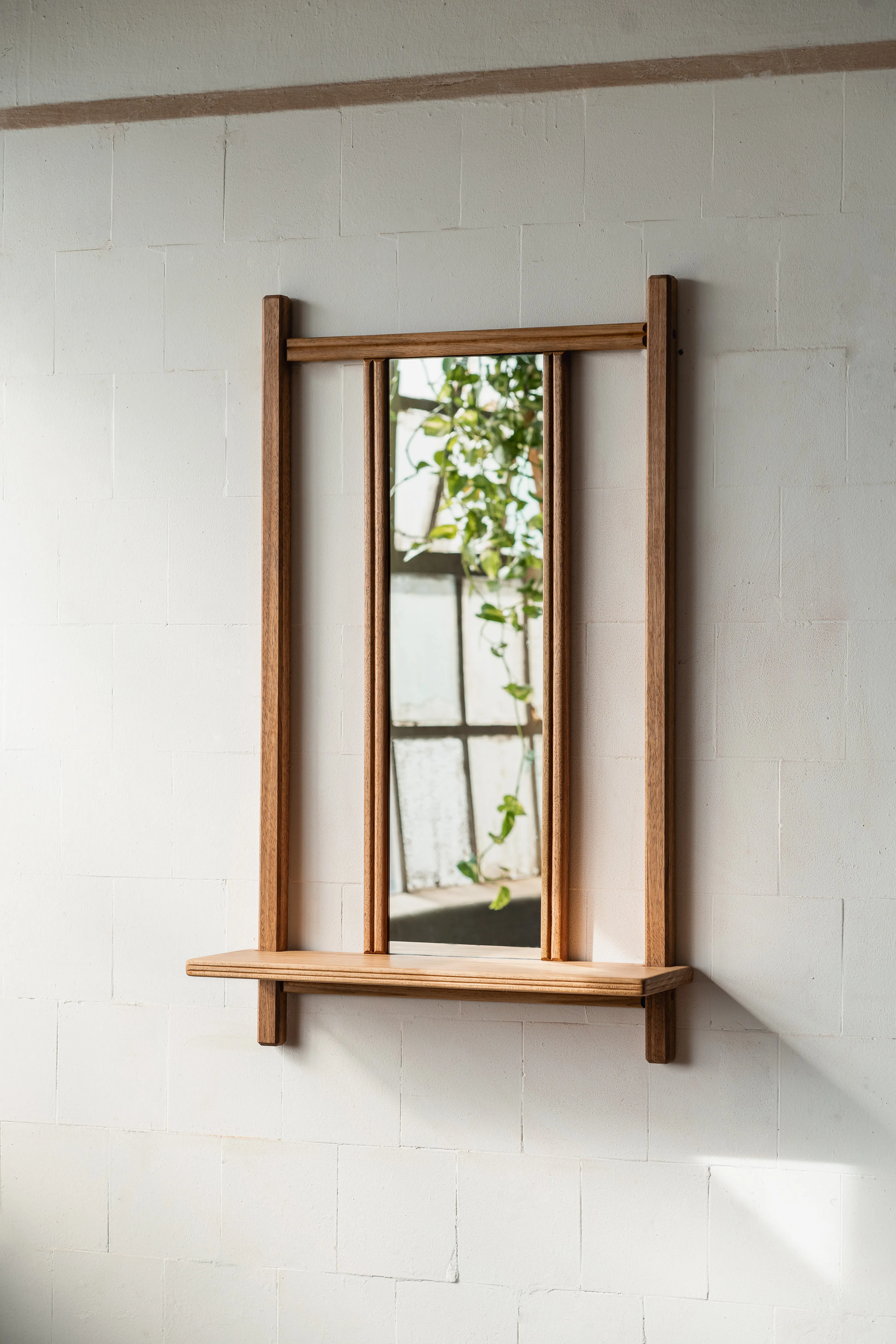
Certified solid wood carries both the glass and a shelf in a single carved body, built to keep the few things you reach for daily within arm’s length. The carved detailing redraws classical references with a tighter, more contemporary line, and it is the studio’s signature move. Notably, solid timber handles bathroom humidity far better than the veneered board most shelf-mirrors are built from, since there is no core to swell. Offered in Freijó, Imbuia and Jequitibá, and the atelier takes made-to-order commissions.
€875 incl. tax
Bathroom mirrors, room by room
Above the vanity
This is the position that decides everything. Center the mirror on the sink rather than the wall, because plumbing rarely sits where the room’s midpoint is, and an off-center sink with a centered mirror looks wrong in a way most people feel before they can name it. Hang so the center of the glass falls near eye level for the household average, generally 155 to 165 centimeters from the floor, leaving 15 to 20 centimeters of clear wall between the counter or backsplash and the frame’s lower edge. A round or irregular profile pairs well here, since the vanity below already supplies all the straight lines the eye needs.
The powder room
A powder room carries no bath and no shower, which means no steam, which in turn means the material restrictions above largely fall away. Plaster, lacquered board, rattan and unsealed timber all belong here. Moreover, a powder room is small, windowless and seen by guests, so it rewards the boldest piece in your budget rather than the safest. Specifically, a strongly colored or sculptural frame turns a room people expect nothing from into the one they mention afterward.
Shared walls and double vanities
Two mirrors over two sinks almost always beat one wide panel, and matched pieces hung on each sink’s center line give both users a proper sightline. Leave enough gap between them that they read as a pair rather than a broken run, usually a third of a mirror’s width. On the other hand, deliberately mismatched pieces work too, provided they share a material or a finish so the wall still holds together. Sconces, where present, belong between or beside the mirrors at roughly 165 centimeters, never directly above, since overhead light casts the shadows that make shaving and makeup harder.
Mirrors with a shelf or storage
A mirror that carries its own shelf solves the problem every small bathroom has, which is that the counter fills with the six things you use daily and never fully clears. A narrow integrated ledge holds a toothbrush glass, a bar of soap and a bottle without turning into a dumping ground, largely because its depth forbids it. By contrast, a deep cabinet stores more but pushes the glass farther off the wall and casts a shadow over the sink. For a fuller treatment of the problem, our guide to bathroom storage ideas works through the alternatives, and our notes on decorating small rooms cover the proportions involved.
Beyond the bathroom door
Several pieces here outgrow the brief. A full-height rattan or glass form belongs in a dressing area or a bedroom corner where it can be seen whole, and a hand-silvered pane with a drifting stain earns a hallway wall where people pass it slowly. Consequently, it is worth asking whether the mirror you want is really a bathroom mirror or a wall piece you are trying to fit into a bathroom. Both answers are legitimate. Sculptural wall lighting follows similar placement logic.
Troubleshooting bathroom mirrors
Secure mounting and anchors for the weight
A cast aluminum or solid timber mirror runs 18 to 45 kilograms, which no drywall plug holds on its own. Fix into studs wherever possible; between them, use heavy-duty toggle anchors rated well above the load, spread across two fixings. A French cleat is the right answer for anything heavy, since it carries the load along a full rail and lets you slide the piece level. Drill tile slowly, masonry bit, hammer action off.
Humidity, ventilation and what survives a wet room
Ventilation decides which of these pieces you can own. An exhaust fan run for twenty minutes after a shower returns the room to ambient humidity and makes almost every material here viable. Without one, plaster, rattan and veneered board show it within a season. Therefore, match the piece to the room: glass and cast aluminum anywhere, brass and solid timber in a ventilated bathroom, plaster and natural fiber in a powder room.
Cleaning glass without streaks
Streaks come from residue, not technique. Spray the cloth rather than the glass, so nothing runs into the frame joint or the silvered edge, then follow with a dry microfiber. Avoid ammonia entirely on a studio piece, since it attacks the backing and the seal. Warm water with a drop of dish soap handles daily film; diluted white vinegar lifts hard-water spotting, on the glass only.
Preventing foxing and black spots on the silvering
Foxing is the silver layer oxidizing where moisture has reached behind the glass, advancing inward from the edges, where the backing is most exposed. It cannot be reversed once established. Keep cleaning fluid off the rim, make sure the frame shelters the edge, and ventilate the room. Notably, deliberately irregular hand-poured silvering is not foxing — intentional stain sits within the pane rather than creeping in from the edge.
Leveling and alignment above a vanity
An organic frame has no true horizontal, so a bubble level is useless against its outer edge. Level the fixing rail instead, then align by eye against the strongest reference line in the room — a tile course or the vanity top, rarely the ceiling. Over a double vanity, measure both mirrors down from one chalk line. Felt pads at the lower corners stop a heavy frame rocking against tile.
Frequently asked questions
What size mirror should sit above a vanity?
Aim for a mirror narrower than the vanity by roughly two to four inches on each side. Over a 90-centimeter single vanity that puts you near 70 to 80 centimeters of mirror width. Height is more flexible, though leaving 15 to 20 centimeters of clear wall above the backsplash keeps the composition from feeling crowded.
What are the most common bathroom mirror shapes?
Rectangular, round, oval and arched cover most of the market, and each does something different to the room. Round and oval soften the grid of tile and cabinetry, rectangular maximizes usable reflection for the wall space, and arched splits the difference. Irregular and organic profiles, common in studio pieces, behave as sculpture that happens to reflect.
How high should a bathroom mirror hang?
Set the center of the glass at roughly 155 to 165 centimeters from the floor, adjusted to the eye level of whoever uses the room most. The mirror should be centered on the sink rather than the wall. Where a household’s heights differ sharply, a taller piece serves everyone better than compromising on the center point.
Can a wood or rattan mirror go in a bathroom?
Yes, with ventilation. Solid timber and rattan handle a bathroom that has a working exhaust fan or an opening window, and solid wood outlasts veneered board considerably because there is no core to swell or delaminate. Avoid placing either directly in the path of shower spray, and refresh oiled finishes when the surface starts to look dry.
How do I stop a bathroom mirror fogging?
Fogging is condensation on cold glass, so the fixes are ventilation and warmth rather than anything applied to the mirror. Run an exhaust fan during and after showering, and leave a small air gap behind the frame so the glass tracks room temperature more closely. Heated defogger pads exist, though they require wiring and suit fitted installations rather than hung studio pieces.
What causes the black spots on an old mirror?
That is foxing, the silvered backing oxidizing where moisture has worked in behind the glass, and it typically advances inward from the edges. It cannot be reversed at home; resilvering is a job for a specialist. Keeping liquid away from the rim, sealing or sheltering the edge within a frame, and ventilating the room prevent it in the first place.
Why bathroom mirrors earn their place
A bathroom mirror is the closest thing a home has to a daily appointment. You stand in front of it before the day starts and again before it ends, at a distance of about forty centimeters, with nothing else competing for attention. Almost no other object in a house gets that much sustained, close-range looking. Therefore, the argument for treating it as a considered piece rather than a fitting is not really about decoration; it is about what you want in front of you during the two moments of the day when you are alone with yourself.
The studios represented here work in small runs, limited editions and one-off pieces, which means a mirror collected from ADORNO carries a maker’s hand rather than a factory’s tolerance. Hand-poured silver drifts where it will, inlay follows the grain it is set into, and sand-flow ornament never repeats. Consequently, no two are identical, and the piece on your wall is a record of how it was made. Notably, the shift runs wider than one marketplace, with independent studios across the field now treating mirrors as design objects rather than fittings.