A wall shelf is a piece of furniture that has to be trusted before it can be used.
A shelf hangs off the wall, which means the wall becomes part of the design whether or not anyone planned for it. That single structural fact explains why most wall shelves sold today look the way they do — thin, white, rectangular, engineered to disappear. The brief was never presence. The brief was to hold a few objects without falling down.
Consequently the category has been quietly emptied of ideas. A shelf can carry weight and still be shaped by someone with a point of view: folded from two millimeters of stainless steel, turned from birch, embedded in a slab of Portuguese cork. The nine pieces below were chosen from ADORNO’s wall-mounted catalogue, and every one of them treats the blank wall as a surface worth answering rather than a problem to solve invisibly.
How to choose a wall shelf
Start with load, not looks. A shelf holding paperbacks and a shelf holding a stack of ceramics are different engineering problems, and the difference shows up in span rather than thickness. Specifically, a shelf sags in the middle of its run, so a 150 cm shelf with two fixings will bow where a 75 cm shelf with the same fixings will not. Depth matters in the opposite direction: every extra centimeter of depth increases the leverage pulling the bracket out of the wall. Fifteen to twenty centimeters suits objects and small books. Twenty-five to thirty is needed for anything approaching a full-size hardback or a plate.
Then decide what the shelf is for, because the answer changes the piece entirely. A display shelf like the Kloss Shelf asks to be seen half-empty, holding three objects with space between them. A working shelf in a kitchen or a bathroom, by contrast, is judged on how much it absorbs — the argument made at length in our guide to bathroom storage. Finally, check the wall itself before anything else. Solid brick or concrete will take almost any fixing. Plasterboard will take far less than people assume, and that single constraint has ruled out more shelves than taste ever has.
Materials and construction
Material determines how a shelf fails, how it ages and how much of it you see. A wall shelf is viewed from below and from the side far more often than from above, so the edge profile and the underside carry most of the visual load.
Stainless steel
Steel gives the thinnest possible profile for a given load, which is why nearly every shelf that appears to float is steel somewhere inside it. A folded sheet of two to three millimetres will carry more than a twenty-millimetre timber plank of the same span, because the fold does the structural work. Moreover, a brushed finish reflects light along the grain rather than throwing it back, so the shelf reads as a line rather than a slab. Steel is also indifferent to humidity, which makes it the default in kitchens and bathrooms.
Solid wood
Oak, walnut and ash carry weight well and age better than any other shelf material. The trade-off is movement: solid timber expands and contracts with humidity, so a long run fixed rigidly at both ends can cup or split over years. Notably, this is why good wooden shelves use hidden keyhole or rod mounting rather than rigid brackets — the timber is allowed to move fractionally. A piece like the Lxv walnut shelf shows what the material does when the grain is treated as the subject rather than the finish.
Cork
Cork is the outlier and the most interesting one. It is light, warm to the touch and quiet — objects set down on cork make almost no sound, which matters more than it sounds like it should on a bedside or entryway shelf. It also compresses slightly under load and recovers, so it resists denting in a way thin timber does not. Furthermore, cork bark regenerates roughly every nine years without the tree being felled, which gives the material a rare position among shelf materials on the question of what it costs to produce.
Aluminium
Aluminum sits between steel and wood. It is roughly a third the weight of steel, takes a fold cleanly, and does not corrode, which suits it to wet rooms and to pieces that are hand-bent in small workshops rather than pressed at scale. Meanwhile, it is softer than steel and will mark, so an aluminum shelf tends to acquire a record of its use. Pieces such as the Foret aluminum shelf and the Steel Wave show the two ends of that behavior.
Acrylic and glass
Transparent materials solve a specific problem: a shelf that holds objects without adding visual mass to the wall. Acrylic at fifteen millimeters or more is genuinely structural, and unlike glass it does not shatter. In other words, it is the right answer in a small room where a solid horizontal band would cut the wall in half. The compromise is surface — acrylic scratches, and every scratch catches light.
Ceramic and fired surfaces
Fired and hand-finished surfaces show up mostly in small display shelves, where load is low and the piece is closer to sculpture than storage. Accordingly they are specified for texture rather than capacity: a glazed or hand-marked surface changes across its length in a way no machined material does. Pieces in this family, like the Toasted Shelves, work best holding one or two objects at eye level.
Modular systems and made-to-measure shelving
A single shelf answers a fixed need. A modular system answers a need that has not happened yet, which is usually the more honest description of a wall. Modular wall shelving works on a vertical spine or rail fixed to the wall, with horizontal planes that clamp, hook or slot on at any height along it. Consequently the arrangement can be reset in an afternoon without a single new hole — shelves moved closer together for paperbacks, further apart for a run of vases.
The trade-off is visual. A rail system always shows its structure, so the wall reads as a piece of equipment rather than a surface with objects on it. Systems like the Gate modular shelving system and the Sens Shelving System resolve this by making the frame itself worth looking at. By contrast, made-to-measure is the other route to the same flexibility: many studios on ADORNO will cut a shelf to a specified length or build it in a different wood species, which suits alcoves and awkward spans where no standard size fits. The Hedera collection is built around exactly this idea, designed to be added to one shelf at a time.
9 Floating Shelves from independent studios
Ticka – Fungi Wall Shelf by Olle Sahlqvist
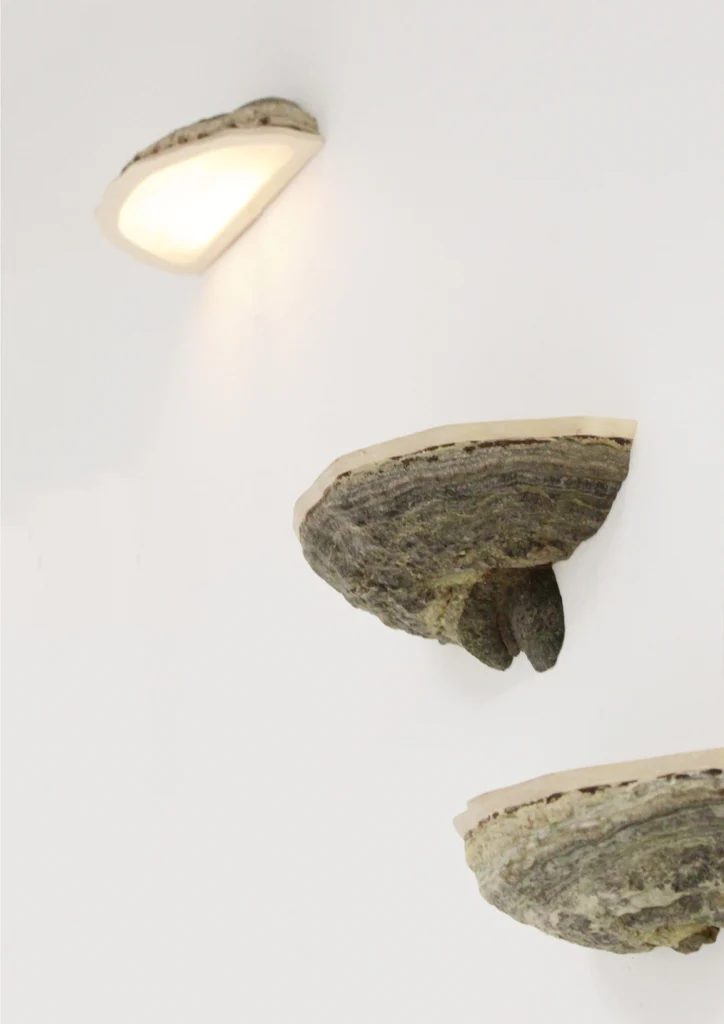
Turned from birch and mounted on a block of the same wood, Ticka borrows its form from the bracket fungi that grow sideways out of living trunks. The shelf reads as something that arrived rather than something installed — a small horizontal plane pushing out of the wall at an angle nature would recognize. Notably, the studio will also build it as a lamp on request, which tells you how little the piece thinks of itself as storage.
€250 – €450 incl. tax
Ju – Modular Wall Shelf by PROSA
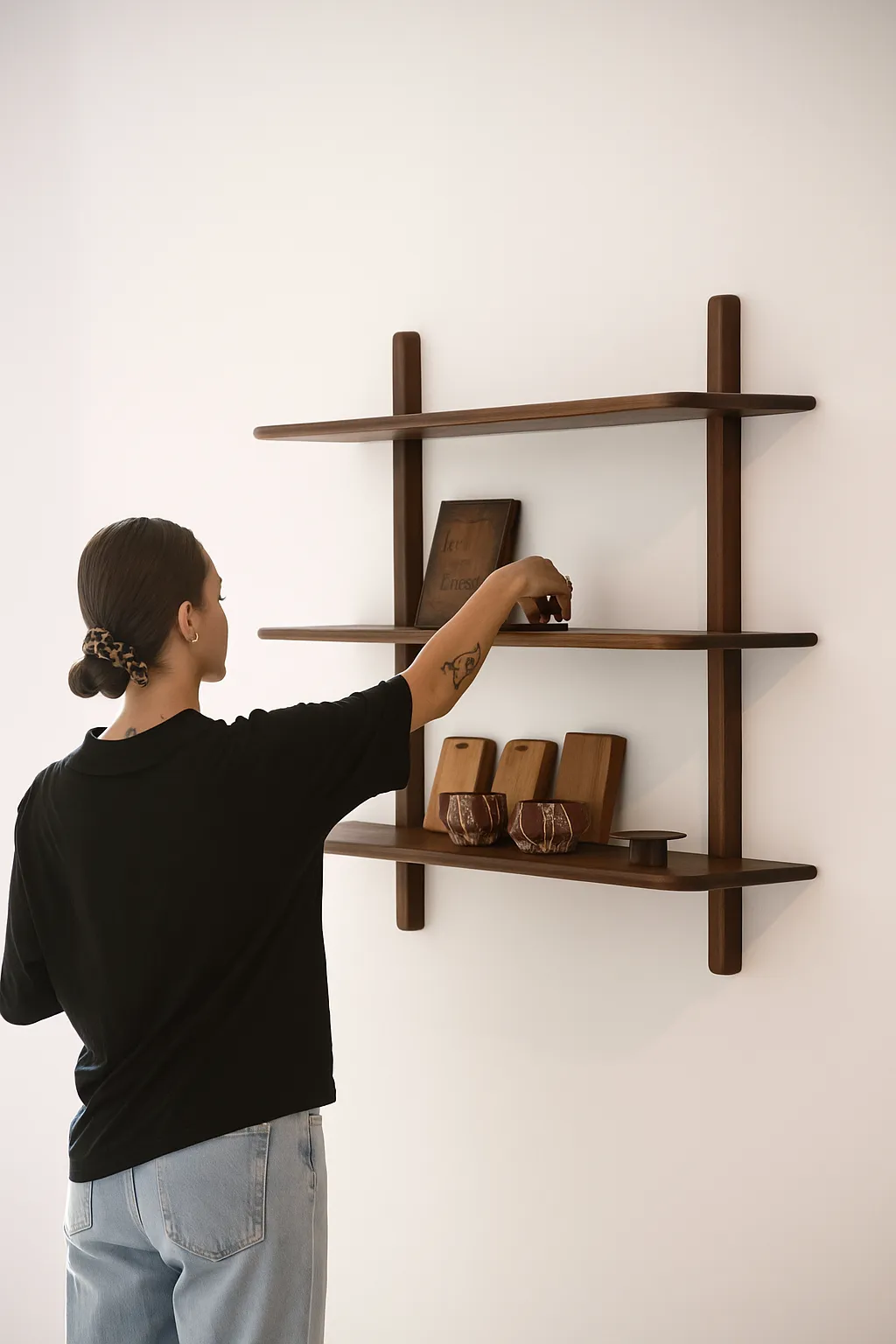
Three wood shelves hang from a single vertical spine, each one positioned along its length. Consequently the piece behaves less like a shelf than a frame that can be reset as its contents change — books one year, ceramics the next. At ninety by ninety centimetres it claims a wall without dominating it, and PROSA will build the set in other wood species on request.
By PROSA
€1.285 incl. tax
Mortaise Shelf – Cork by Clemence Birot
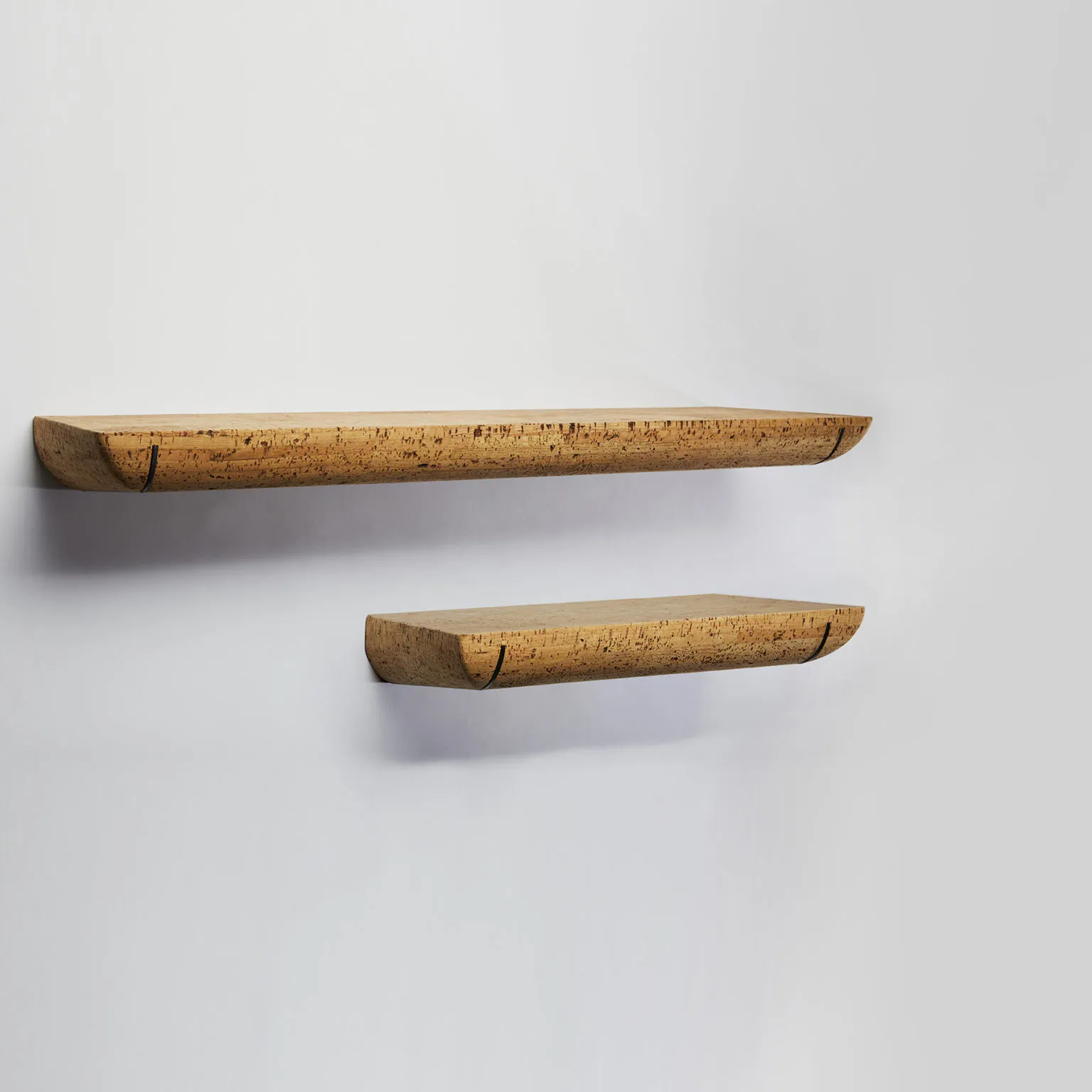
A folded metal frame is embedded directly into a slab of cork, assembled without a drop of glue. The joint borrows from mortise and tenon woodworking, so the two materials hold each other by geometry alone and come apart again at the end of the piece’s life. Furthermore, cork is warm under the hand and quiet under objects, absorbing the small sounds a hard shelf amplifies. Made in Portugal.
€384 – €509 incl. tax
Aluminum Wave Shelf by Six Dots Design

Bent by hand from aluminum in a North London workshop, the Wave is sized for the things that collect around a sink or a countertop. Its curve is structural rather than decorative — the fold is what stops a thin sheet of metal flexing under load. Meanwhile the raw finish takes water without complaint, which is why it sits as naturally in a bathroom as above a run of kitchen tiles.
€84 – €420 incl. tax
The Front – Stainless Steel Shelf by COSEINCORSO
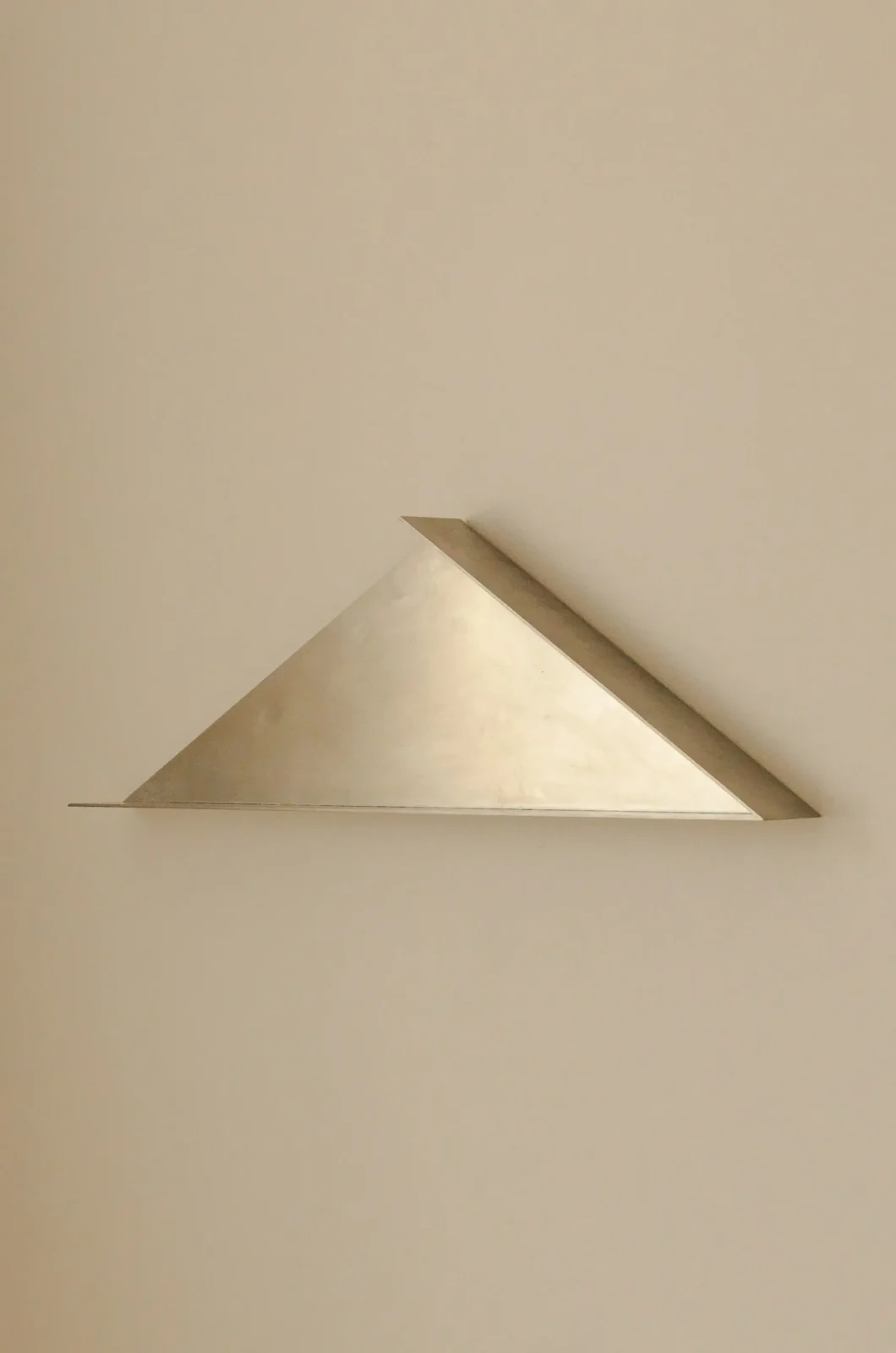
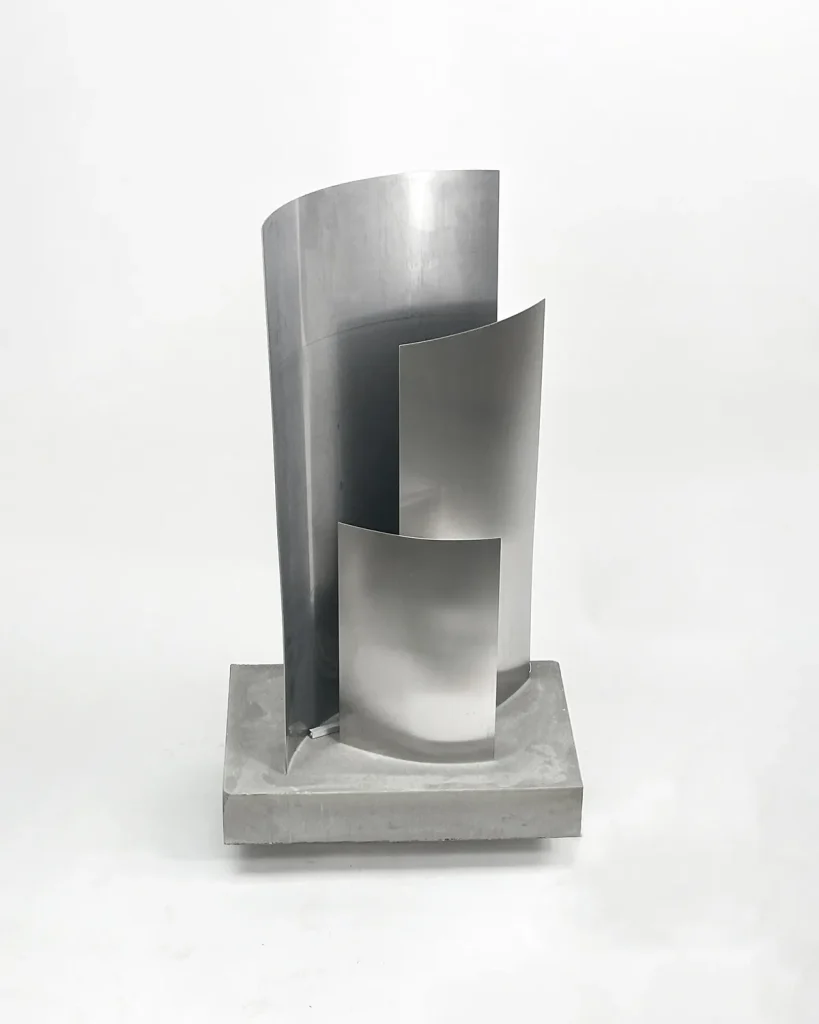
Stainless steel folded into the profile of a temple pediment, produced in Italy in an edition of twenty-four. The piece works as a shelf and as a fragment of architecture fixed to the wall, and it is not especially interested in which reading you settle on. Indeed, at this scale it holds almost nothing — a single vase, a stack of postcards — and that restraint is the argument.
By COSEINCORSO
€1.410 incl. tax
Acrilar – Acrylic Shelf by Luiz Solano
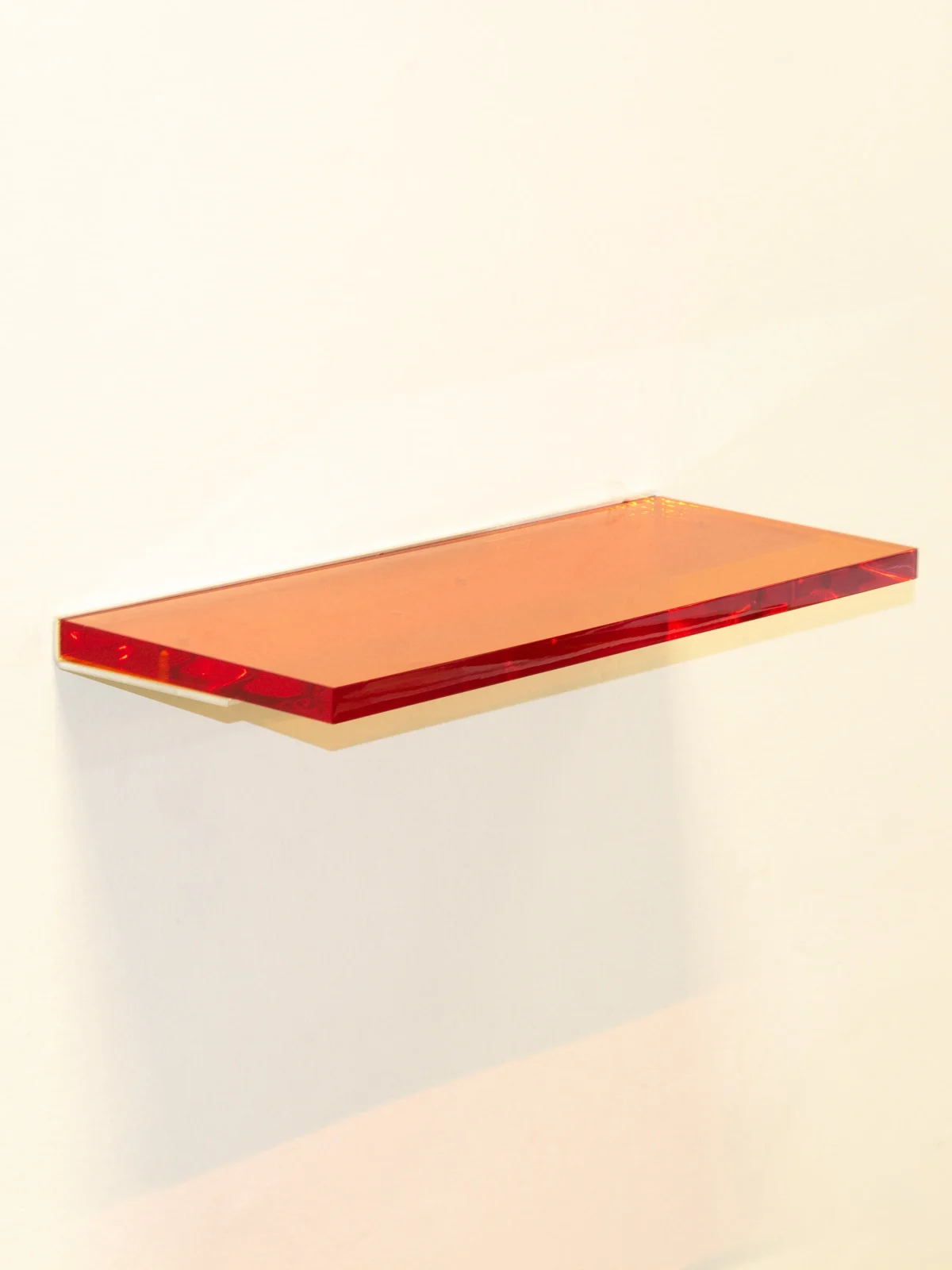
Acrylic at least fifteen millimeters thick rests on natural aluminum profiles, in either a transparent or an opaque finish. The run is modular and stretches to two meters, so the same language covers a short shelf beside a door and a long horizontal band across a living room wall. By contrast with wood or steel, transparent acrylic gives back almost no visual weight — the objects appear to rest on nothing at all.
By Luiz Solano
€300 – €700 incl. tax
“Teteia” Wall Shelf by Cultivado em Casa
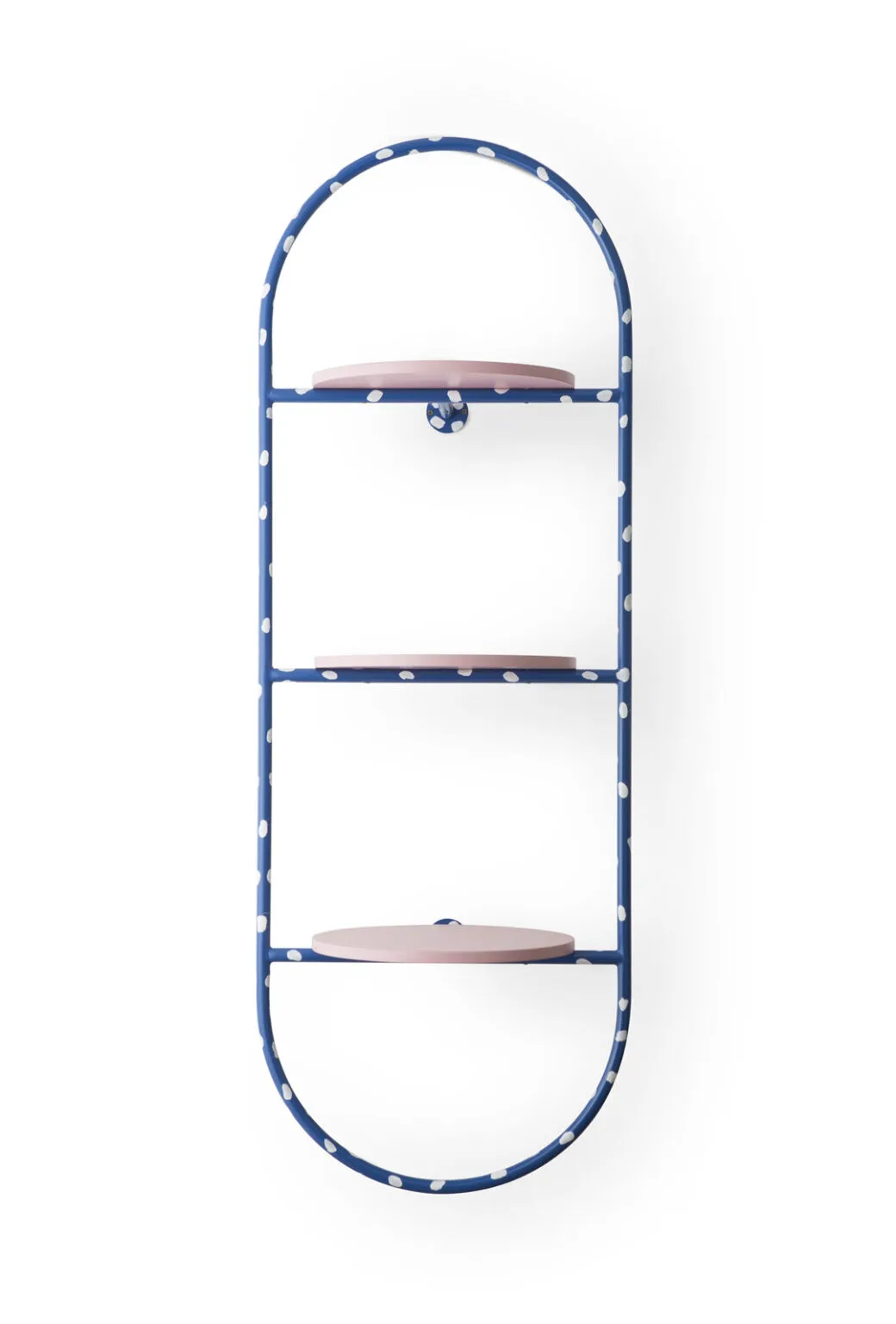
Teteia hangs from the wall in a series of soft curves, its white spots applied by hand so no two pieces carry the same pattern. The form has no straight edge to align to, which makes it forgiving in rooms where nothing else is quite square. As a result it works best alone, on a stretch of wall left deliberately empty around it.
€1.281 incl. tax
Hedera – Oak Wood Medium Wall Shelf by Studio Onno Adriaanse
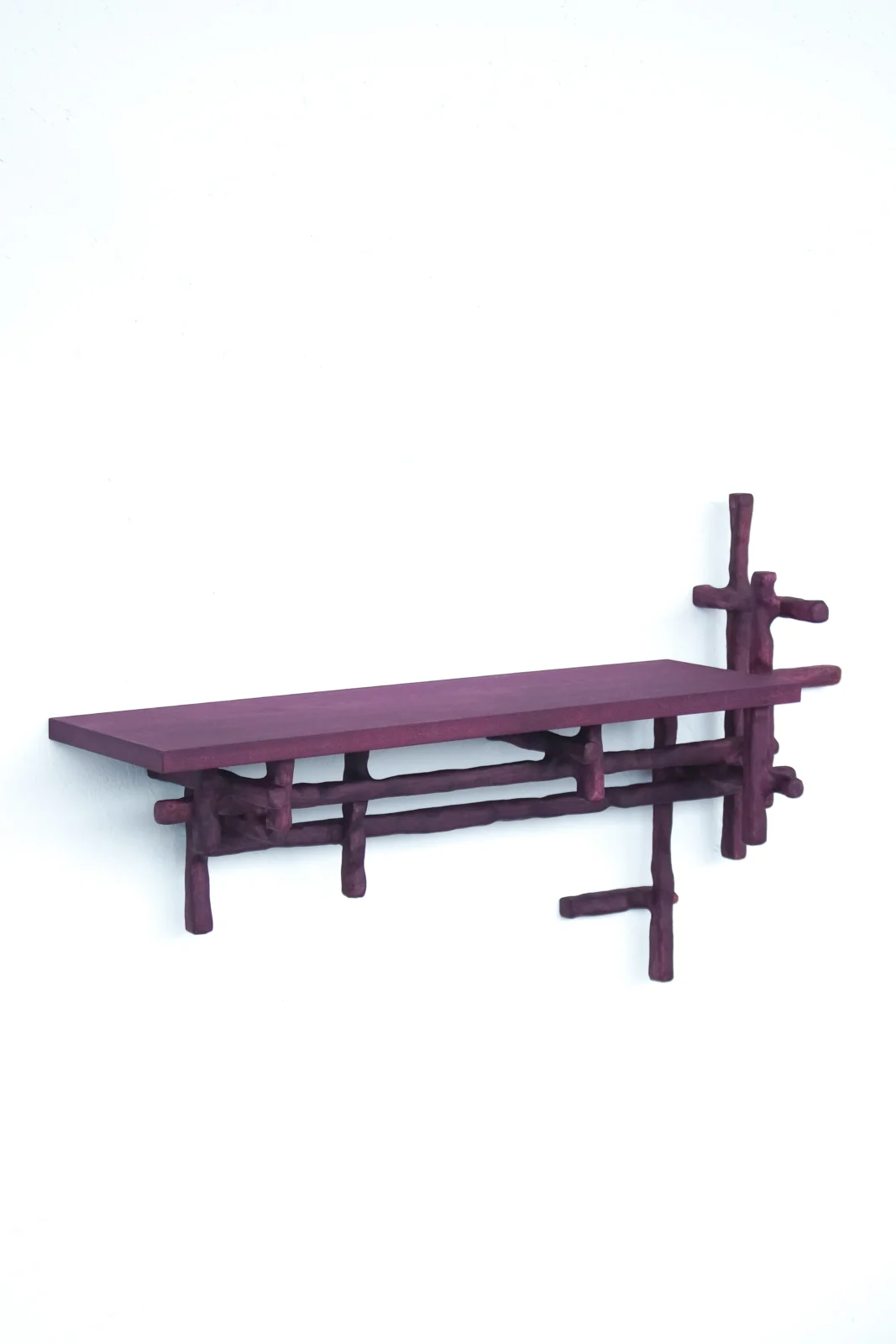
Solid oak, shaped after the way ivy clings and thickens as it matures — slender where it attaches, sturdier where it carries load. A hidden mounting system comes with the piece, so nothing interrupts the line of the wood once it is on the wall. Moreover, the collection is built to be added to, which means a single shelf can become an arrangement climbing a whole wall later on.
€1.440 incl. tax
Bent Wall Shelf by form & eisen
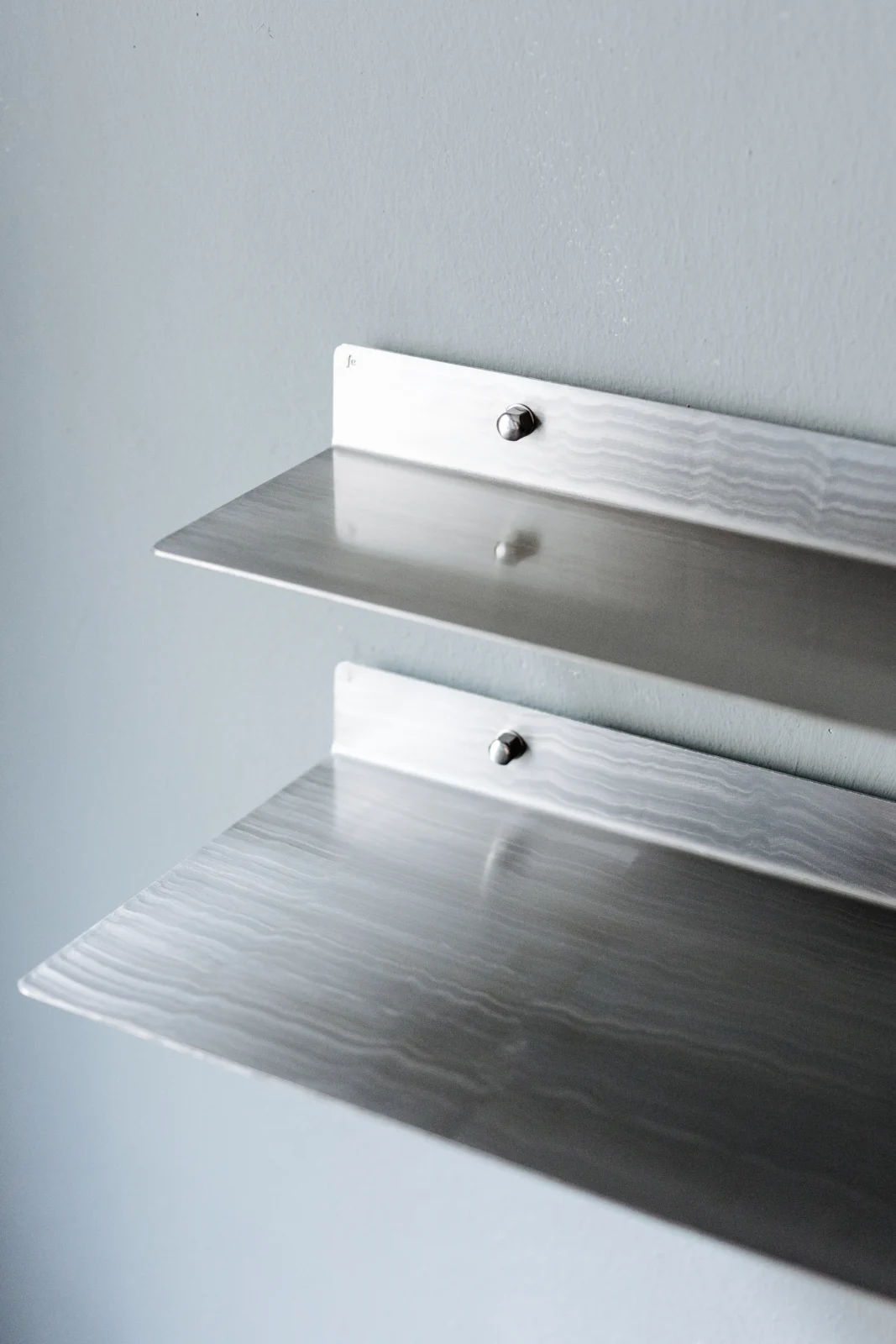
Two millimeters of brushed stainless steel, folded and finished by hand in the studio’s workshop. Solid steel spacers hold it clear of the plaster, so the shelf appears to float in front of the wall rather than sit against it, and the brushed grain carries light along its length. Available from seventy-five centimeters to two meters, with a deeper Ultron version for heavier runs.
By form & eisen
€158 – €300 incl. tax
Wall shelves room by room
Living room: above and beside the seating
The wall above a sofa is the most contested surface in the house and usually the worst place for a shelf — anything mounted there hangs over the heads of the people using the room. Hang it to the side instead, on the return wall or in the gap beside a window, at roughly 140 to 150 cm from the floor so it reads at standing eye level. A long low run works differently: fixed at around 110 cm it becomes a horizontal line that anchors the seating rather than floating above it.
Kitchen and dining: open storage that has to work
Kitchen shelving is the one application where the contents are in constant motion, so reach governs everything. Mount the lowest shelf around 45 to 50 cm above the countertop — high enough to work beneath, low enough to reach without a stretch. Steel and aluminum dominate here for a practical reason: they take steam and grease and wipe clean. In a dining room the calculation changes entirely, since a shelf on a dining wall is display rather than storage, and it competes directly with a sideboard for the same job.
Bedroom and hallway: the narrow walls
A shallow shelf beside a bed replaces a nightstand and frees the floor, which matters in a small room. Fifteen centimeters of depth at mattress height plus twenty is enough for a book, a glass and a lamp. Hallways ask for the same restraint for a different reason — anything deeper than twenty centimeters in a corridor gets caught by shoulders and bags. Consequently the hallway shelf is often the smallest piece in the house and the hardest working, sitting above the entryway bench and catching keys and post.
Bathroom and small rooms: wet walls and tight spans
Bathrooms punish the wrong material. Untreated timber will swell and lift its finish above a shower, while aluminum, stainless steel and sealed ceramic are indifferent. Tiled walls also change the fixing problem, because drilling through tile requires the right bit and a slow start to avoid cracking the glaze. Finally, in any small room the transparent or thin-profile shelf earns its place: the less wall it visually removes, the larger the room stays. A wall cabinet solves the opposite problem, hiding contents rather than showing them.
Mounting and troubleshooting wall shelves
Matching the fixing to your wall type
Almost every shelf failure is a fixing failure rather than a shelf failure. Solid brick, block or concrete takes a plugged screw and will hold far more than the shelf itself. Plasterboard is the problem case: a screw driven into board alone holds a few kilograms at best. Therefore find the studs — usually at 40 or 60 cm centers — and fix into timber wherever possible. Where a stud is not available, heavy-duty toggle or spring anchors spread the load behind the board and carry substantially more than plastic plugs. Lath and plaster in older buildings should be treated as plasterboard until proven otherwise.
Hanging height and spacing
A single display shelf sits comfortably between 140 and 150 cm from the floor, which puts its contents near standing eye level. Above furniture, leave 25 to 30 cm of clearance from the top of a sofa back or a countertop so the shelf does not crowd what sits below it. For stacked runs, 30 to 35 cm between shelves suits books and objects, while 40 cm or more is needed for anything tall. Notably, uneven spacing usually looks more considered than even spacing — a wider gap at the bottom gives the arrangement a base.
Weight rating and load distribution
Published weight ratings assume a load spread evenly across the shelf and fixings into solid substrate. In practice load concentrates: a stack of books in the center of a span does far more damage than the same weight spread across it. Accordingly, put heavier objects near the fixings rather than mid-span, and treat a long unsupported run as a lower-capacity shelf than its rating suggests. A shelf that has begun to bow will not recover — the deflection is permanent once the material has taken a set.
Levelling and alignment
A shelf that is a degree off reads as an error in a way a crooked picture does not, because the horizontal line is uninterrupted. Mark and drill from a level line rather than measuring down from a ceiling, since ceilings in older buildings are rarely true. For multiple shelves, measure every one from the same floor reference rather than from the shelf above it, which stops small errors accumulating down the wall. Where a wall itself bows, shim behind the bracket rather than forcing the fixing.
Cleaning and caring for the surface
Brushed steel should be wiped along the grain, not across it, or the cloth leaves visible marks. Oiled wood wants an occasional re-oil and nothing wet left standing on it. Cork takes a barely damp cloth and no solvent. Acrylic scratches easily, so dust it with a soft cloth rather than paper, which is abrasive enough to haze the surface over time. Meanwhile powder-coated aluminum needs nothing beyond soap and water, though the coating will chip if struck at an edge. Pieces like the Pop wood and steel shelf combine materials with different needs, so treat each surface on its own terms.
Frequently asked questions
How much weight can a wall shelf hold?
It depends almost entirely on the wall and the fixing rather than the shelf. Fixed into studs or solid masonry, a well-made shelf will typically carry 20 to 35 kg across a standard span. Fixed into plasterboard with plastic plugs, the realistic figure is a few kilograms. Always treat the fixing as the weakest link and rate the shelf accordingly.
Do floating shelves need to go into studs?
On plasterboard, yes for anything carrying meaningful weight. Floating shelves conceal their brackets, which means the entire load passes through a small number of hidden fixings with significant leverage against the wall. Where studs do not fall in the right place, heavy-duty toggle anchors are the alternative, though capacity drops.
How high should a wall shelf be hung?
Around 140 to 150 cm from the floor for a display shelf on an open wall. Above a sofa or countertop, measure up 25 to 30 cm from the furniture instead, since the relationship to what sits below matters more than the absolute height.
How deep should a wall shelf be?
Fifteen to twenty centimeters handles objects, small books and bathroom items. Twenty-five to thirty is needed for hardbacks, plates or anything approaching dinnerware. Remember that depth increases the leverage on the fixing, so a deep shelf needs a stronger fixing than a long one.
How far apart should stacked shelves be?
Thirty to thirty-five centimeters suits books and mixed objects, and forty or more is needed for tall pieces. Uneven spacing, with the largest gap at the bottom, tends to look more deliberate than a perfectly regular grid.
Can a wall shelf go in a bathroom?
Yes, provided the material tolerates humidity. Stainless steel, aluminum, sealed ceramic and treated cork all perform well. Untreated or oiled timber directly above a shower or bath will lift and swell over time. Drilling into tile requires a tile bit and a slow start to protect the glaze.
Why wall shelves earn their place
A wall shelf is the cheapest structural change available to most homes. It adds usable surface without taking floor area, which is why it appears first in small apartments and last in large ones. Yet the reason to choose a considered piece over a plain plank is not capacity. It is that the shelf is visible constantly and used occasionally — the opposite ratio to most furniture, and an argument for treating it as something closer to a mantel than to storage.
The pieces above come from studios working in birch, cork, oak, acrylic, aluminum and stainless steel, each treating the same structural problem differently. Some hold almost nothing and are better for it. Others, like the modular systems, are built to be rearranged for years. Altogether they suggest that the blank wall is not a gap to be filled but a surface that can be answered. A shelf is one of the few objects in a home that has to be trusted, and trust is easier to give to something made with attention. Pair one with a vase worth looking at and the wall stops being a leftover.