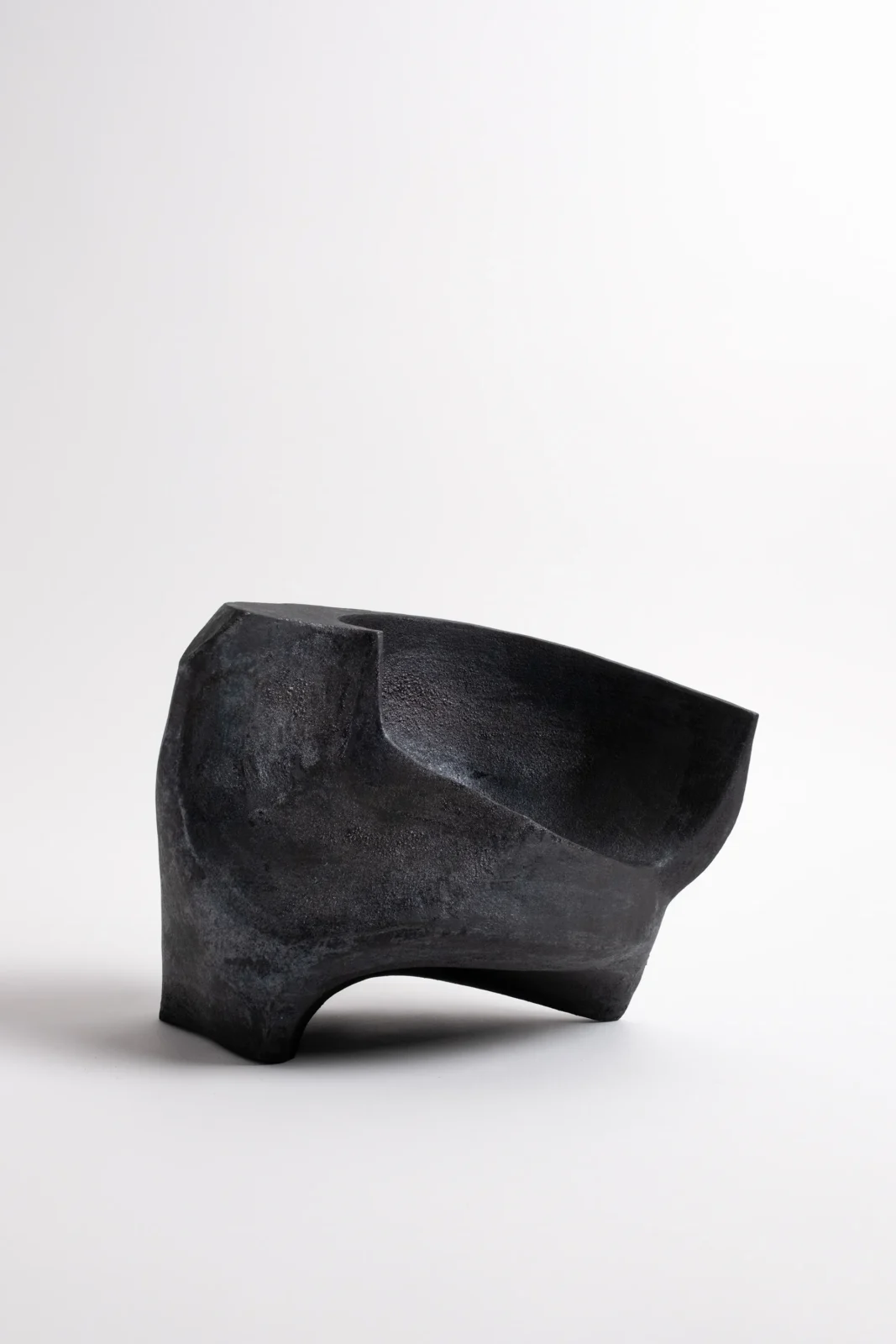
A sideboard runs the length of a wall and asks to be noticed.
The sideboard is one of the oldest pieces of furniture still doing the job it was invented for. It began as a serving board set to the side of the dining table — a surface for carving, plating and holding what the table could not. Storage came later, and with it the doors, drawers and the low horizontal mass we now recognize. The form has survived three centuries of shifting taste because the problem it solves has never gone away: a room that eats, drinks and entertains needs a surface at hip height and somewhere to put everything that surface displaces.
Every piece below comes from an independent studio, in solid stone, carved oak, brushed steel or teak, and each was chosen on real interest from people browsing designer storage on ADORNO. Consequently what follows is less a shopping list than an argument: a sideboard occupies more wall than almost anything else in a home, and that much surface should be worth looking at.
How to choose a sideboard cabinet
Start with measurements, because a sideboard fails on proportion long before it fails on taste.
- Height: Most sit between 75 and 90 cm high — roughly 30 to 36 inches. This keeps the top usable for serving without crowding the sightline across a room.
- Depth: Generally 40 to 50 cm, deep enough for platters and stacked plates, but shallow enough to pass behind a pulled-out dining chair.
- Length: This is the decision that matters most. As a rule, leave the piece shorter than the wall it sits against and shorter than the dining table it serves. A sideboard that runs wall to wall stops reading as furniture and starts reading as joinery.
- Clearance: Allow 90 cm of space in front if chairs will be pushed back past it.
Then look at how it is built.
- Solid timber moves with the seasons and can be refinished indefinitely.
- Veneer over a stable core holds flatter across a long span, but cannot be sanded back more than once.
- Hinges: Open the doors and check the action. Soft-close hinges on a heavy door are the difference between a piece that ages well and one that sags within a year.
Interior configuration also deserves more attention than it usually gets:
- Fixed shelves suit plates and glassware.
- Drawers are the only sensible answer for linen and cutlery.
Finally, weigh the piece against your floor. A stone or steel sideboard can pass 100 kg empty, and that load needs a level base. On a suspended timber floor, it also pays to think about where the joists run.
For a wider view of how everyday cabinets divide across a home, our storage overview covers the rest of the category.
Materials and construction
Solid oak and ash
Oak and ash carry the weight of the category. Both are dense, open-grained hardwoods that take carving cleanly and hold a joint under load, which is why the majority of wooden credenzas are built from one or the other. Ash runs paler and straighter, with a grain that reads almost linear under a matte finish. White oak is warmer and more figured, and it darkens gently with light exposure rather than yellowing. Furthermore both respond to hand work — a carved surface in ash holds crisp detail for decades, where a softer timber would round off under use.
Onyx and stone
Stone turns a sideboard into something closer to architecture. Onyx in particular is translucent, so light entering the surface travels a few millimetres before scattering, and the veining appears to sit below the polish rather than on it. As a result the material changes through the day in a way opaque marble does not. The trade-offs are real: onyx is softer than granite, reactive to acid, and heavy enough that placement is a one-time decision. Consequently a stone piece asks for a sealed surface and a level floor before anything is set on it.
Brushed stainless steel
Stainless steel entered domestic furniture through the kitchen and the workshop, and it still carries some of that directness. A K240 brushed finish scatters light along the grain of the abrasion, which keeps a large flat panel from behaving like a mirror. Laser cutting allows tolerances to the millimeter, so steel bodies can be built as modular systems that assemble without visible fixings — an approach that recalls the exposed logic of brutalist storage while staying far more precise. Meanwhile the surface marks easily with fingerprints and needs wiping along the grain, never across it.
Teak and brass
Teak holds a high natural oil content, which makes it dimensionally stable and unusually forgiving of humidity swings. Paired with brass, it produces the warm metal-and-timber contrast that defined mid-century storage and has never really left. Brass patinates rather than corrodes, moving from bright yellow toward a deeper brown over years. Therefore the pairing ages as a unit — both materials darken, and the contrast between them softens instead of breaking down.
Lacquer and veneer
Lacquer is the finish to choose when the form should read as a single volume rather than a set of surfaces. Sprayed over a veneered core, it fills the grain and returns an even plane that holds colour precisely, which suits curved and cylindrical bodies where a visible grain direction would fight the geometry. In addition, veneer allows a figured timber to be laid across a two-metre span without the movement solid boards would bring. The limitation is repair: a chipped lacquer edge is refinished as a panel, not spot-sanded.
Concrete and mixed material
Concrete arrives in sideboards as a counterweight — a block, a column, a base that grounds lighter elements above it. Stained rather than pigmented, it takes on a gradient that reads closer to stone than to construction. Specifically, mixed-material construction lets a studio place mass where it is structurally useful and lightness where it is visually useful, which is the same logic behind modular design. Altogether these combinations are where the category has moved furthest from the four-finish norm, and where storage begins to behave like sculpture.
8 sideboard cabinets from independent studios
Mast – Walnut / Stainless Steel Sideboard by Formatter
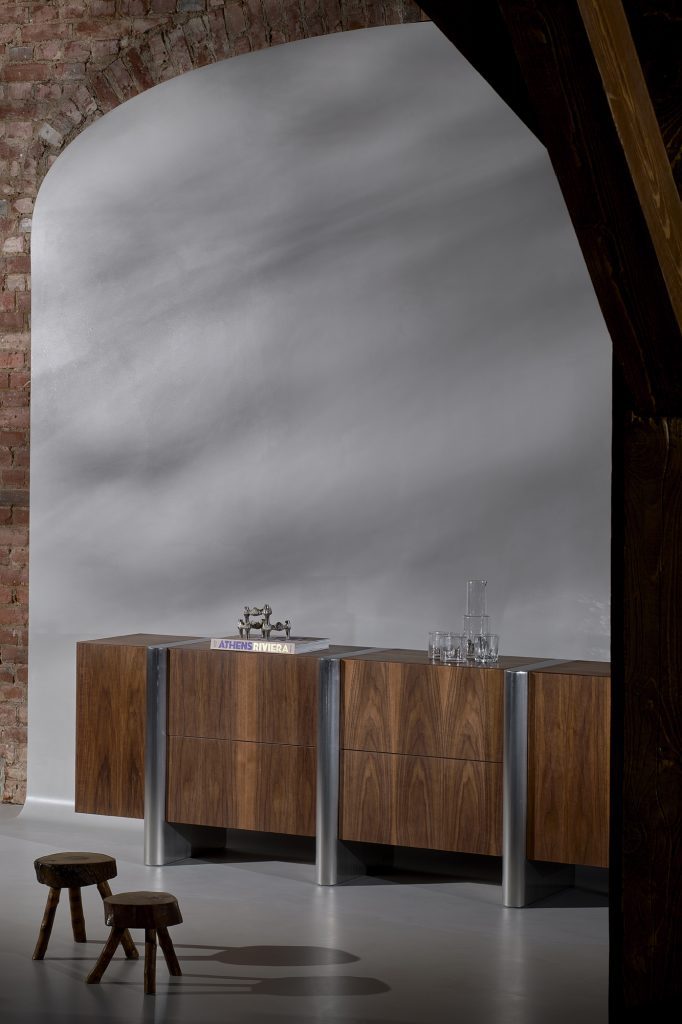
Walnut veneer and stainless steel meet in a body that steps rather than sits, the volume broken into stacked tiers that read like a section drawing. Notably the contrast is handled quietly — warm grain against cool metal, soft radii against flat plane. As a result Mast anchors a wall without competing for it, which is harder to achieve at this scale than the more theatrical storage pieces suggest.
By Formatter
€5.850 incl. tax
Eoli Credenza In White Onyx, Sideboard/cabinet by Panorammma Atelier
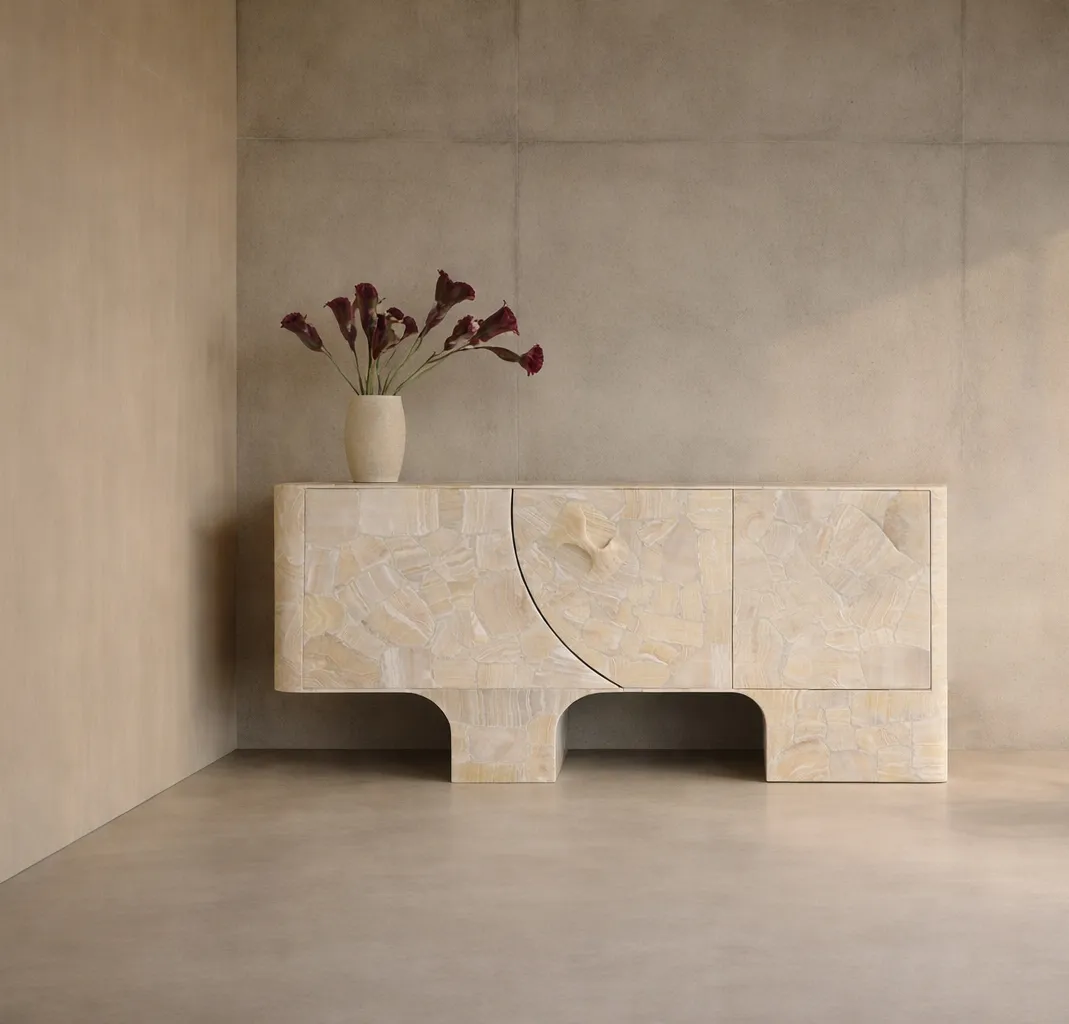
Carved from solid white onyx, Eoli takes its form from wind — erosion and flow held still in stone. Light travels through the veined translucency, so the surface shifts depth across the day rather than staying fixed. Consequently the piece sits at the edge of furniture and object, holding a dining room’s serving ware inside something closer to geology than cabinetry.
€24.900 incl. tax
[moduline] Stainless Steel Sideboard by case studios
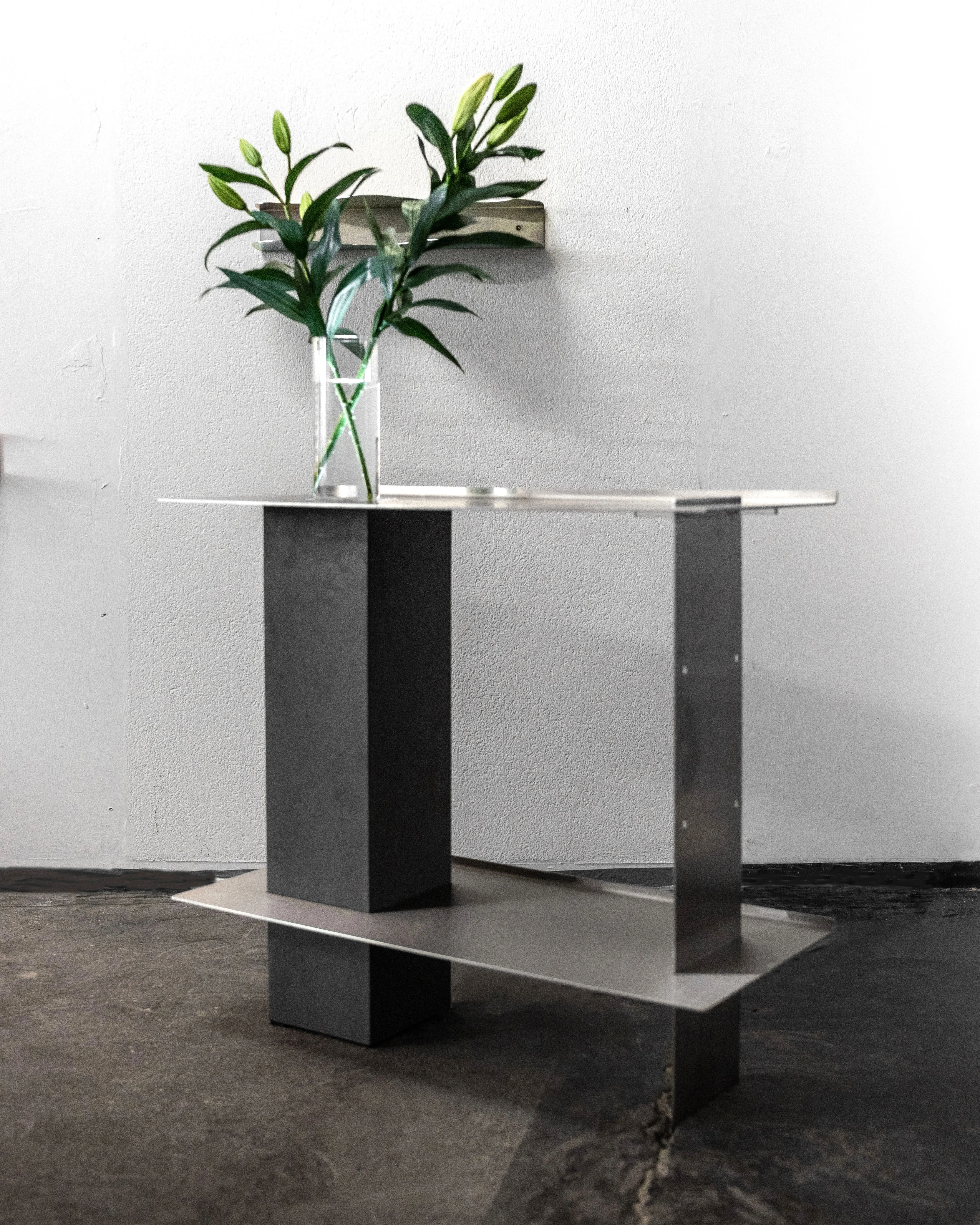
Cut from 3mm K240 brushed stainless steel by laser to millimeter tolerance, this sideboard assembles as a system rather than a single body. A stained concrete block carries an integrated light beneath a semi-translucent mirror, giving the underside a low glow instead of a shadow line. Furthermore the shelf count and overall length are specified to the room, so the piece adapts to the wall it is given.
By case studios
€1.370 incl. tax
Rima Credenza by Peca Mobiliario

Beech wood slats wrap a smooth wooden top in a closed oval, each one bent to hold the curve. The rhythm is the point — the name borrows from rhyme, and the repetition reads as cadence rather than construction. Consequently Rima sits close to the line between a working cabinet and an object, and stays on the useful side of it.
€5.455 incl. tax
Wood – Sideboard Cabinet by Donna Maria Feghali
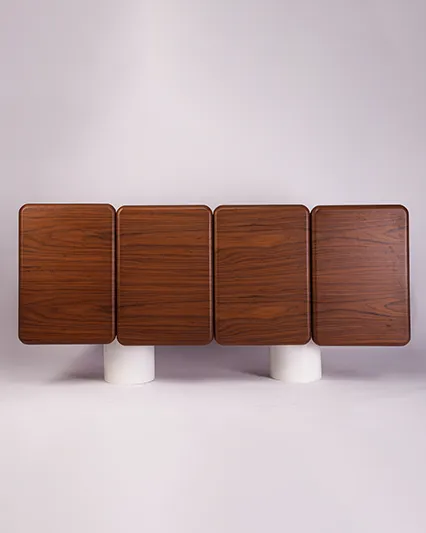
Lacquer and veneer wrap two shelved compartments, raised on a cylinder base that lifts the mass clear of the floor. The edges are turned rather than cut square, which softens a long horizontal into something less architectural. Moreover the paint and veneer finishes are specified to order, so the piece can either recede into a wall or hold against it.
€3.745 incl. tax
Phloem, Parota Wood Carved Credenza – Cabinet by CMX | Furniture
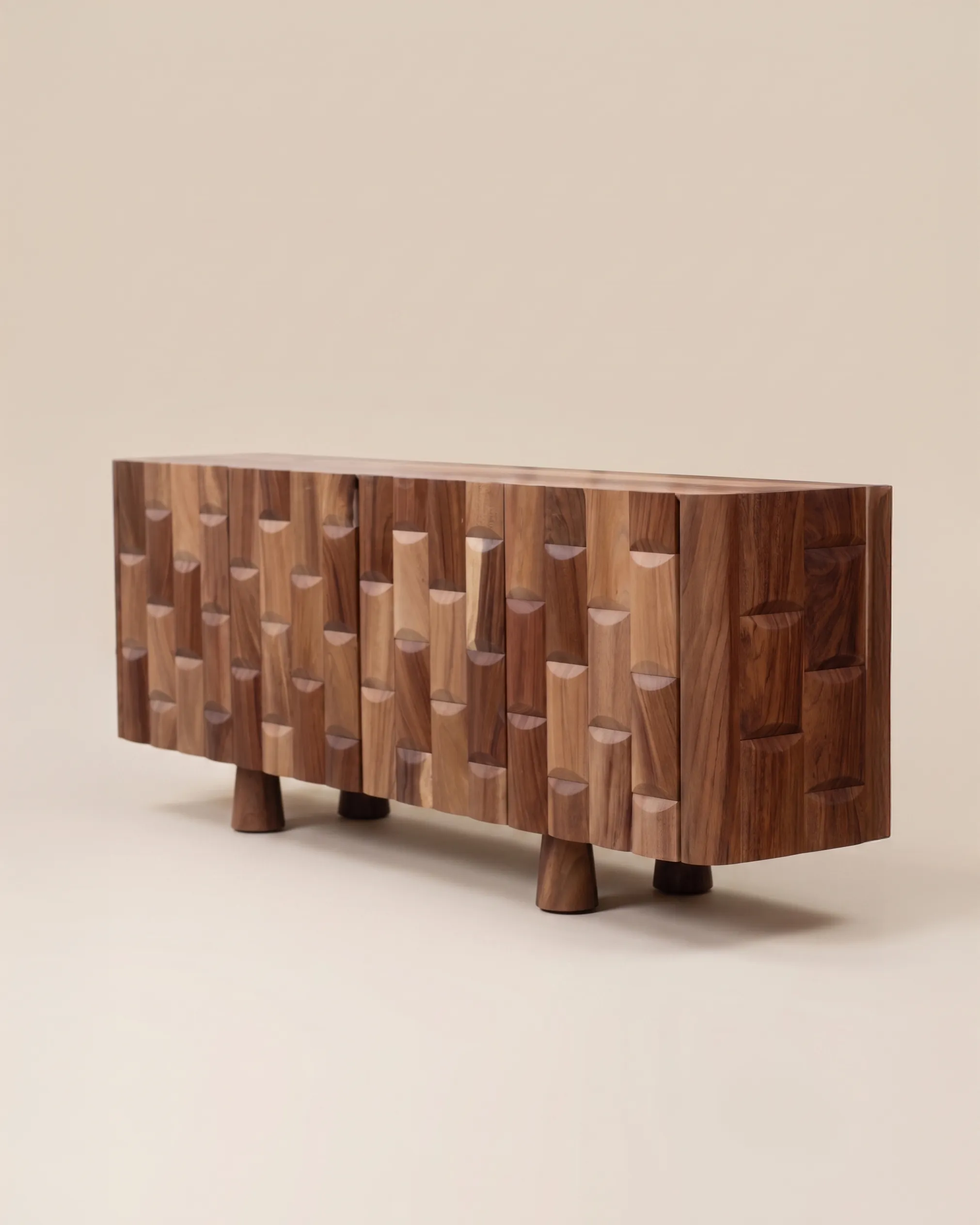
Parota wood, carved into a sequence of geometries that translate the structural logic of a plant stem into a façade. The pattern generates real depth rather than surface texture, so shadow shifts across the front as the light moves through the day. Handworked in Mexico with precision joinery, the piece carries storage and sculptural mass in the same body.
€15.086 incl. tax
Practice Semi-open Credenza by Studio Fabius Clovis
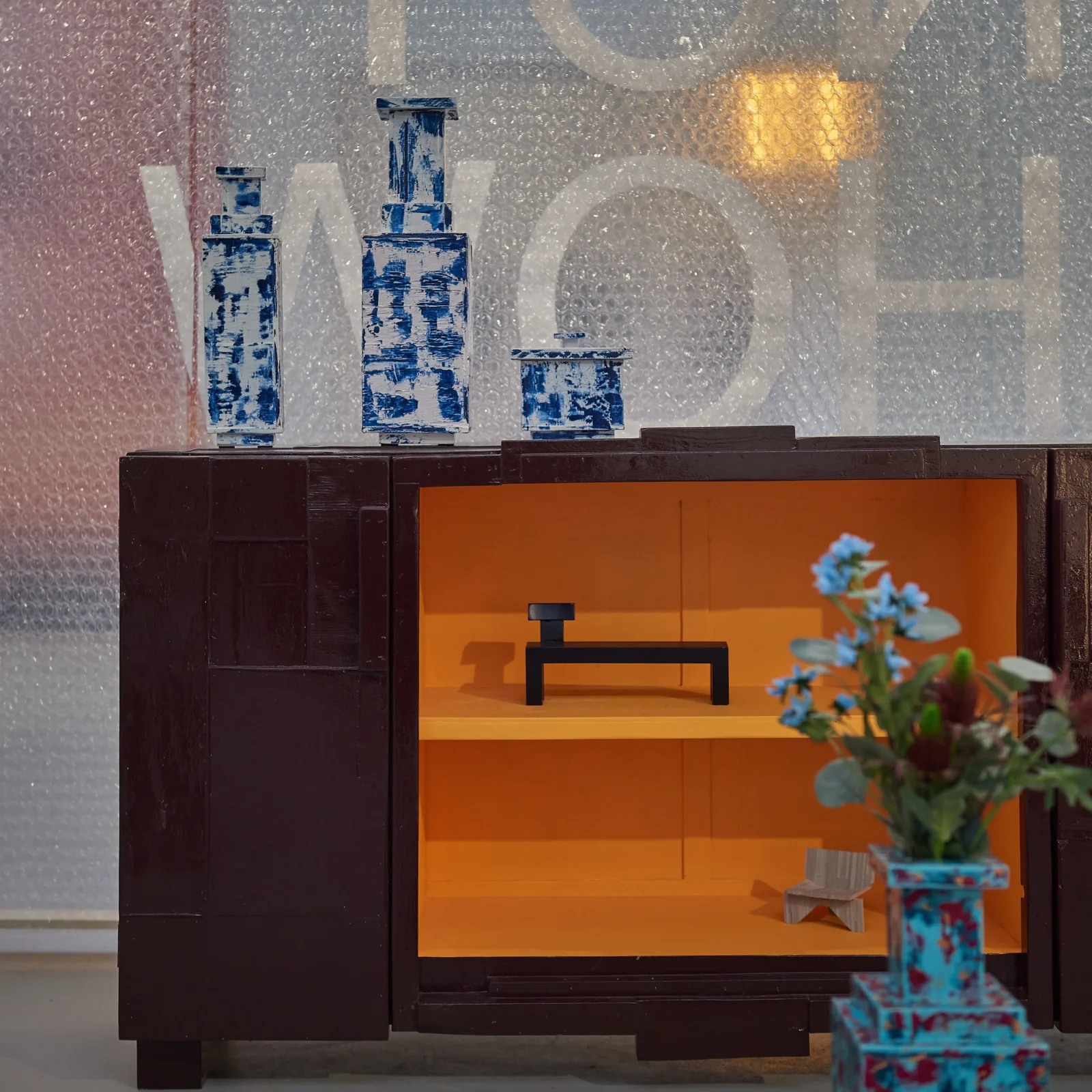
Discarded wooden offcuts, reassembled and finished in high-gloss lacquer until the joins read as pattern rather than repair. The semi-open configuration leaves part of the interior in view, which asks rather more of whatever goes inside it. Notably this one is a one-off — the studio treats restraint as an ethical position rather than a style, and builds bespoke variations instead of repeats.
€8.900 incl. tax
Timujin Wenge Wood Cabinet by Brett Paulin

Wenge, dark and dense, worked into a checkerboard relief that wraps the case and holds light and shadow in alternation. Inside, an adjustable shelf sits above a solid wood drawer lined in leather. Moreover the cabinet hangs on a French cleat rather than standing on legs, so the mass reads as suspended clear of the floor.
By Brett Paulin
€11.366 incl. tax
Sideboard cabinets room by room
Dining room
The dining room is where the sideboard began and where it still works hardest. Place it on the longest uninterrupted wall, ideally within reach of the table but far enough back that a seated guest is not brushing it. The top becomes a serving line during a meal, which means keeping it clear of permanent objects — a single vessel and a lamp is usually the limit. Consequently the interior does most of the work: plates and glassware on fixed shelves, linen and cutlery in drawers. Notably this is the one room where length genuinely matters, because a sideboard shorter than the table looks apologetic beside it. For the wider question of how the room assembles, our dining room guide covers circulation and seating.
Living room
In a living room the sideboard changes job. Here it functions as a low horizontal counterweight to seating, absorbing the clutter that accumulates around a sofa — cables, remotes, books, glassware. Placed behind a sofa it defines a boundary in an open plan; placed opposite, it takes the media equipment and keeps it behind doors. Furthermore the top offers the best display surface in the room, at the height where objects read properly rather than being looked down on. A mirror or artwork above it completes the composition, and the wall above a sideboard is worth deciding deliberately rather than by default.
Entryway and hallway
An entryway rewards a shallower piece. Depth is the constraint rather than length, and 35 to 40 cm is often the practical ceiling in a corridor where two people need to pass. The sideboard here handles the daily churn of keys, post and gloves, so drawers matter more than shelves. Meanwhile the surface takes the first and last look at the house every day, which argues for a material that can carry that attention — stone, brushed steel, or a carved timber face. As a result the entryway is where a sculptural piece earns its keep fastest, since it is seen constantly and asked to hold very little.
Bedroom and home office
A sideboard in a bedroom replaces the chest of drawers with something lower and longer, which suits a room where the bed already supplies the vertical mass. Along a wall opposite the bed it becomes a dressing surface; beneath a window it holds folded textiles without blocking light. In a home office the same proportions absorb files, printers and paper behind doors, keeping the desk itself clear. Therefore the choice comes down to interior fit rather than appearance — measure a ream box or a hanging file before committing, because a shallow decorative piece will not take either. Pieces built to dismantle, or on the modular principle, adapt best when the room’s function changes again.
Troubleshooting sideboard cabinets
Leveling on uneven floors
A long, low body exaggerates any fall in a floor, and the first symptom is doors that will not stay shut. Check across the top with a spirit level in two directions before blaming the hinges. Most pieces with legs accept adjustable glides or thin hardwood shims under the low corner; on a plinth base, shim the full length of the plinth rather than one point, or the case will twist. Notably, older timber floors near a wall often drop several millimetres over a two-metre span, so expect to shim rather than treating it as a fault in the piece.
Adjusting doors, hinges and soft-close
Concealed European hinges adjust on three axes — side to side, depth, and height — usually via two cross-head screws per hinge. Work on one door at a time and aim for an even shadow gap down the centre before worrying about alignment with the case. If a soft-close mechanism has stopped damping, it is more often a clogged piston than a failed one; a wipe and a drop of light machine oil restores most of them. Meanwhile a door that drags at the bottom corner is usually a leveling problem, not a hinge problem, so return to the spirit level first.
Protecting the top surface
The top of a sideboard takes drinks, serving dishes and lamp bases, which is a harder life than most dining tables. On stone, seal annually and use coasters without fail — onyx and marble etch on contact with wine, citrus and vinegar, and etching is a surface loss rather than a stain. On steel, felt pads under any ceramic base prevent the fine scratching that shows badly on a brushed finish. Furthermore, heat is the risk people forget: a serving dish straight from the oven will mark lacquer and can crack a stone slab that is already under tension.
Caring for wood, veneer and lacquer
Solid oak and ash want a damp cloth and very little else; oiled surfaces benefit from a refresh once or twice a year, applied thinly and buffed back. Avoid silicone polishes, which build a film that later resists any oil or wax. On veneer, keep water away from edges and joints, where the glue line sits closest to the surface. Consequently spills should be lifted rather than wiped across a seam. Lacquer takes a mild soap solution and nothing abrasive — a magic sponge will dull the sheen in a single pass.
Humidity and warping
Timber moves across the grain with changing humidity, and a two-metre sideboard has a lot of grain to move. Keep the piece clear of radiators, underfloor heating outlets and direct afternoon sun, all of which dry one face faster than the other and cup a door. A stable range of roughly 40 to 60 percent relative humidity suits most hardwoods. Therefore in a dry heated winter a room humidifier does more for a solid timber piece than any surface treatment. Teak, with its natural oil content, tolerates swings better than oak or ash, which is part of why it survived so well in mid-century production.
Frequently asked questions
What is the difference between a sideboard and a buffet cabinet?
In practice the terms are used interchangeably, and most retailers list the same piece under both. Historically a buffet sat in the dining room specifically for serving food, often taller and with a higher top; a sideboard was the broader storage piece and could sit anywhere in the house. Today the distinction has largely collapsed, so read the dimensions rather than the label.
Are a credenza and a sideboard the same thing?
Nearly. A credenza traditionally sits lower and longer, often on short legs or flush to the floor, and came into wide use through mid-century office furniture. A sideboard tends to stand slightly taller on visible legs. Notably the words are now applied to the same objects by most studios, and several pieces in this selection are described either way.
What else is a sideboard cabinet called?
Buffet, credenza, server, dining cabinet and console cabinet all refer to broadly the same form. A console is the exception worth knowing: it is usually shallower and often has no enclosed storage at all, which makes it a hallway piece rather than a dining one.
What is the standard sideboard height?
Between 75 and 90 cm, or roughly 30 to 36 inches. That range puts the top at comfortable serving height for most adults and keeps it below the eye line of someone standing. Depth typically runs 40 to 50 cm, and length is the variable to fit to the wall.
How do I level a sideboard on an uneven floor?
Use a spirit level across the top in both directions, then shim the low corner. On legs, adjustable glides or hardwood shims work; on a plinth, shim along the whole length so the case is not twisted. Doors that swing open on their own are almost always a leveling issue rather than a hinge fault.
How much weight does a sideboard cabinet hold?
A well-built solid timber or steel piece will carry substantial load on the top — a stone lamp base, a stacked service, a television — but shelf capacity is the real limit and varies with span. Long unsupported shelves in veneered board will bow under a full set of dinnerware over time. Ask the studio for a shelf rating before loading glassware the full width.
Why sideboard cabinets earn their place
A sideboard is a commitment of wall. Two meters of it, at hip height, in the room where people gather — there is no discreet version of that decision. Consequently the question is not whether a sideboard fits, but whether it deserves the attention it will inevitably receive. The pieces above answer that in different registers: onyx that holds light, steel cut to the millimeter, oak carved sixty-four times over. None of them hides.
What they share is the reason storage has become one of the more interesting categories in contemporary design. Utility stopped being an excuse for indifference. A cabinet still has to hold plates, level itself on an old floor and close quietly — and it can do all of that while being the piece a room organizes itself around. Altogether that is a better argument for collecting than any finish option, and it applies equally to storage, open shelving and the benches that sit alongside them.