-
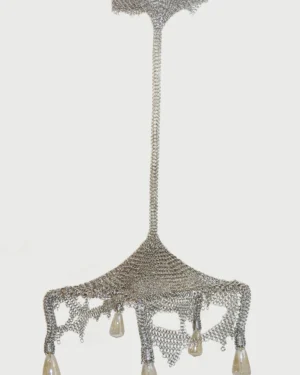
Chainmail Cobweb Chandelier in Glass and Steel
By Panorammma Atelier
€4.250 -

GP033 Chandelier in Brass and Blown Glass
By Naama Hofman
€4.200 -
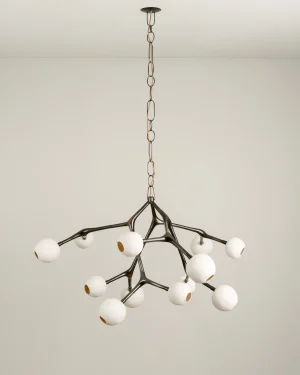
Maratus Chandelier in Bronze and Glass
By Isabel Moncada
€31.005 - €35.655 -
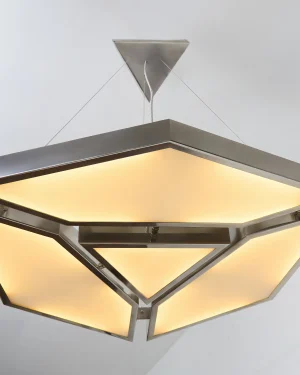
Alban Chandelier in Stainless Steel and Glass
By Nathan Chintala
€5.066 -

GP032 Chandelier in Brass and Blown Glass
By Naama Hofman
€6.500 -
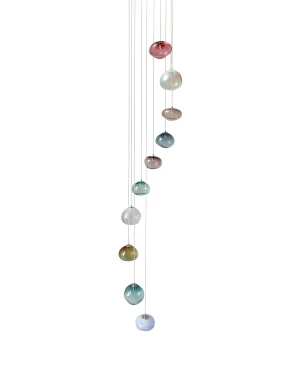
Starglow Spiral Chandelier In Blown Glass
By ELOA - Unique Lights
€12.980 - €13.270 -
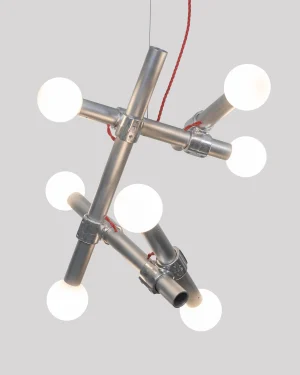
Pipe Dream Chandelier in Aluminum and Glass
By Luft Tanaka Studio
€3.655 -
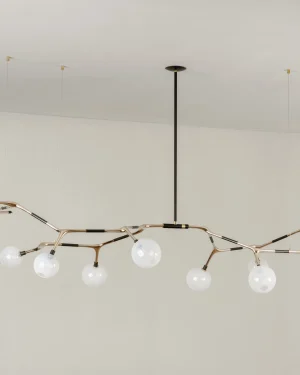
Mantis 13-Piece Chandelier in Bronze and Glass
By Isabel Moncada
Price Upon Request - -

Mantis 9-Piece Chandelier in Bronze and Glass
By Isabel Moncada
Price Upon Request - -
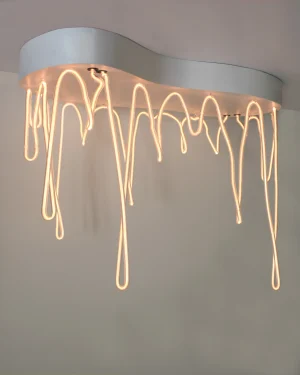
Vertical Fractal Helium Chandelier in Glass and Metal
By Dace Sūna
Price Upon Request
Glass chandeliers gather light rather than simply casting it, bending it through blown or cast forms that studios shape by hand or by mold. The pieces found here range from clusters of hand-blown globes to single cast forms suspended from slender metal frames, each built around the way glass catches and scatters illumination. Makers working in this material pair it with brass, bronze, nickel-plated steel or chrome, letting the metal carry the glass and ground the fixture structurally.
What defines glass in a chandelier
Glass began as a worked material in ancient Mesopotamia, and glassblowing remains close to its oldest techniques: a gather of molten material is shaped by breath and tooling while still hot. Lampworking refines smaller elements, melting rods or tubes of glass over a flame to build finer, more intricate shapes. Both methods leave traces, small variations in thickness or faint bubbles, that read as the hand of the maker rather than a flaw.
Color in glass comes from metal oxides added to the batch before it is worked: amber, aubergine, scarlet and olive tones sit within the glass itself rather than on its surface, so they hold without fading. Lighter tones such as sand or light gray diffuse light more evenly, while deeper colors such as bronze or aubergine pool it, throwing shadow and tint across a room.
The range on ADORNO
Glass chandeliers on ADORNO span a number of making traditions and finishes. Studios set blown or lampworked glass against metalwork in brass, bronze, nickel-plated steel or chrome, often finished by hand assembly or powder coating. Styles move from Art Deco symmetry and Space Age curves to Brutalist weight and Neo-Industrial restraint, with contemporary and futuristic forms sitting alongside them. Editions range from open runs to limited editions and unique pieces, each produced in the quantities a studio sets for that form.
For a wider view of the material, every glass piece on ADORNO sits together in one place, spanning lighting, tableware and decor. Those drawn to a different weight of light can look across the full range of chandeliers on ADORNO, including forms worked entirely in steel, or browse glass lighting more broadly for table and floor forms in the same material.
How to choose a glass chandelier
Scale matters first: a chandelier should read as a presence in a room without crowding it, so measure ceiling height and the diameter of the space it will hang over before choosing a form. Hanging height follows the ceiling: in a room with standard ceilings, the lowest point of the fixture should sit well above head height, while taller rooms allow more drop and a larger silhouette.
Finish and color decide how much light a piece gives off versus how much it withholds. A clear or lightly tinted chandelier spreads light through a room, while amber, bronze or aubergine glass casts a warmer, more directional glow. Consider too the metal it hangs from, since brass and bronze read warm against most wall colors, while chrome and nickel-plated steel sit cooler and more neutral.
Where glass chandeliers work and how to care for them
Dining rooms and entry halls suit glass chandeliers particularly well, giving the fixture room to be seen from several angles and height to hang without obstruction. Living rooms with high ceilings and stairwells also carry them, where their scale and the play of shadow can be appreciated across a full elevation.
Glass holds up well with little intervention: dust with a soft, dry cloth and avoid abrasive cleaners that can dull a blown surface or scratch lampworked detail. Check fittings periodically, since the metal components, not the glass, are what wear with time.
How do I choose a glass chandelier?
Start with the frame material, often brass, bronze or nickel plated steel, since it sets the finish and weight. Then consider how the glass catches light, blown forms scatter it softly, cut or pressed glass throws sharper reflections.
How do you clean and care for a glass chandelier?
Dust with a soft, dry cloth and avoid ammonia-based cleaners, which can dull metal fittings. Let glass cool before cleaning if it was recently lit, and support each piece while wiping to avoid stress on the fixings.
What size chandelier do I need and how high should it hang?
Leave at least seven feet of clearance from the floor to the lowest point of the fixture in a walkway, and lower it over a table so it sits a foot or two above eye level.
Which rooms suit a glass chandelier?
Dining rooms and entryways benefit most, where the fixture hangs clear of foot traffic and catches light from multiple angles. Living rooms with higher ceilings also suit larger, multi-arm forms.
Do ADORNO glass chandeliers come with a certificate of authenticity?
Yes, every piece includes a certificate of authenticity, confirming its origin and maker.
What are ADORNO's shipping and return policies?
Shipping is insured and worldwide. Returns are accepted within 14 days, except for made-to-order pieces, and ADORNO offers a lowest-price guarantee.