
Knitted Art: How Knitting Became a Textile Art Form
Updated on: August 4, 2026
Two needles, one continuous thread. Everything else is consequence.
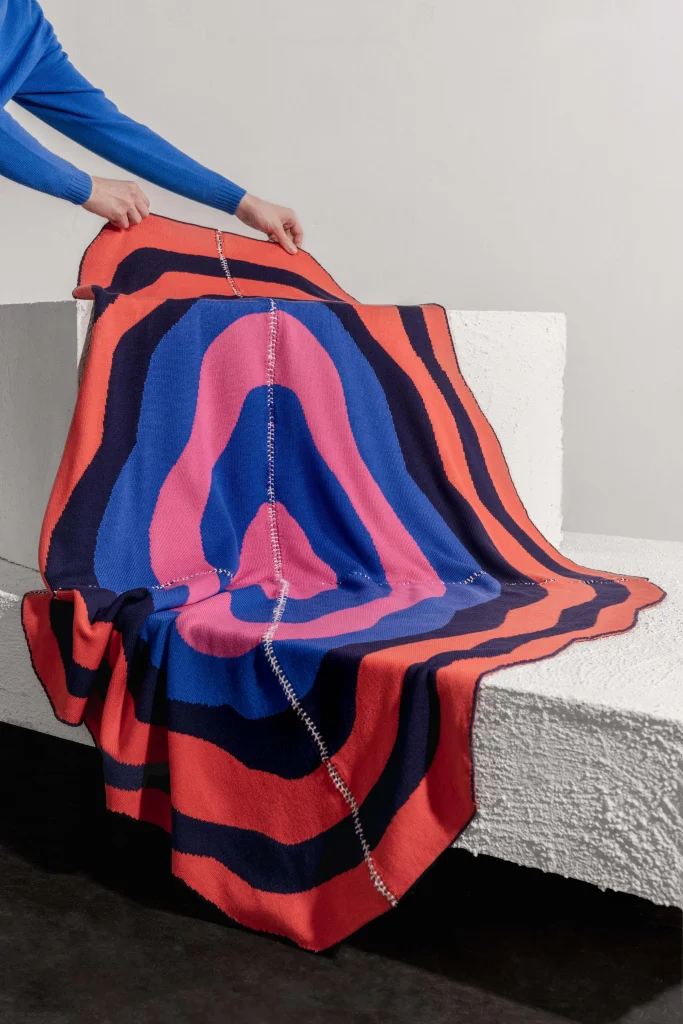
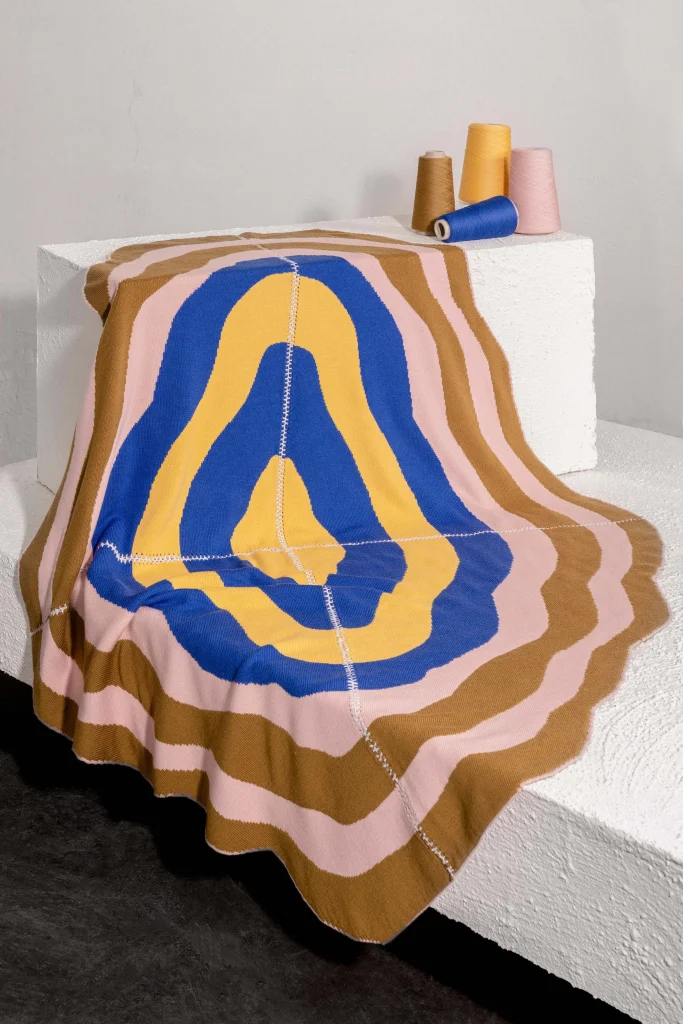
Knitted art occupies an odd position. Knitting is among the most widely practised handcrafts in the world, taught in living rooms and school halls, and that ubiquity has worked against it — a technique everyone’s grandmother used is rarely read as a serious medium. Yet the same structural logic that makes a sweater stretch also makes knit an unusually expressive material for wall pieces, seating and acoustic panels. It holds volume, it recovers its shape, and it can be shaped without a single cut.
This guide covers what knitting actually is, how it differs from crochet and from weaving, the stitch structures worth knowing, how yarn choice changes the outcome, and the designers treating the knitting machine as a studio tool rather than a production line.
What is knitting?
Knitting builds fabric by pulling loops of a single continuous yarn through other loops, row after row, using needles to hold the active stitches. That is the whole mechanism. Because one thread runs through the entire structure, a knitted fabric is a chain of interlocking loops rather than a grid — and that difference governs everything about how it behaves.
Consequently knitted cloth stretches in both directions, recovers when released, and adds loft. It also runs if a loop breaks, since every stitch depends on its neighbours. Weaving, by contrast, interlaces two separate thread systems at right angles, which produces a stable fabric that resists stretch and holds a cut edge. Neither is better; they solve different problems.
Knitted versus woven fabric
Stretch a knit sideways and it gives, then springs back. Do the same to a woven and it barely moves. Look closely and the difference is visible: knits show rows of interlocking V shapes or loops, while wovens show a crosshatch grid. In practice this means knit suits anything that needs to flex, compress or wrap — cushions, upholstery, textile vessels — while woven suits anything that needs to hold flat and taut.
Knitting vs crochet: what actually differs
The two are constantly confused, and the distinction is genuinely simple once you know where to look. Knitting keeps many live stitches open at once, held across two needles. Crochet keeps exactly one live stitch open at a time, held on a single hook, and completes each stitch before moving on.
The structural difference
Because crochet finishes each stitch as it goes, its loops are knotted into place rather than left hanging. As a result crochet is denser, stiffer and thicker for the same yarn, and it will not run if cut. Knitting, holding its stitches live, produces a thinner and far more elastic fabric with better drape. Therefore garments that need to move tend to be knitted, while crochet excels at structural, sculptural and openwork forms.
The tools
Knitting uses two or more needles — straight, circular or double-pointed. Crochet uses one hook. That single difference explains much of the rest: two needles can hold hundreds of stitches in suspension, a hook cannot.
How to tell them apart in a finished piece
Look for the stitch shape. Knitting reads as rows of interlocking Vs, orderly and directional. Crochet reads as clusters of small knots or visible rings, often with more texture and more obvious gaps. Knits also tend to curl at a raw edge; crochet lies flat. Notably, crochet cannot currently be machine-produced at scale, so a mass-market “crochet-look” garment is almost always knitted in imitation.
Which is easier to learn?
Most people find crochet quicker to start, because only one stitch is ever at risk and mistakes are easier to unpick. Knitting has the steeper opening but a lower ceiling of effort for large flat pieces, since the fabric grows faster per stitch. Neither is objectively harder.
A short history of knitting
Knitting is younger than weaving by several thousand years. The earliest true knitted fragments — worked in the round, in cotton, with patterned colourwork — come from Egypt around the 11th century CE, and earlier looped textiles found elsewhere were made by nålbinding, a single-needle technique that predates knitting proper and is often mistaken for it.
From the Mediterranean the technique moved north into Europe, where by the Middle Ages it had become an organised trade. Knitting guilds set standards and controlled training, and the master’s qualification could take years. The Renaissance then brought fine silk knitted stockings into elite dress, which raised the craft’s status considerably and drove demand for finer gauges.
Mechanisation arrived early. William Lee’s stocking frame of 1589 predates the power loom by nearly two centuries, making knitting one of the first textile processes to be automated at all. Industrial circular and flat-bed machines followed, and the computerised flat-bed knitting machines used today descend directly from that line. Even so, hand knitting never disappeared, and the two now coexist rather than compete.
Knitting techniques and stitch structures
Knit and purl
Every structure below is built from two stitches. A knit stitch pulls the yarn through from the back; a purl pulls it through from the front. All knitting is a sequence of those two decisions. Alternating them in columns gives rib, which is why cuffs grip; alternating in blocks gives basketweave and seed stitch.
Cable knit
Cable knit crosses one group of stitches over another, producing the raised rope that runs down an Aran sweater. Those crossings pull the fabric inward, so cable is denser and warmer than plain knitting at the same gauge — and it consumes noticeably more yarn. The structure carries relief well, which makes it a favourite where knit is used as surface rather than garment.
Lace knitting
Lace works by deliberate omission: stitches are increased and decreased to open planned holes in the fabric. The result is light, airy and reliant on blocking to hold its geometry. Because the pattern lives in the gaps, lace shows best in smooth, crisp yarn that does not fuzz the outline.
Fair Isle and intarsia
Both are colourwork, and the difference is what happens on the reverse. Fair Isle carries unused colours across the back as floats, which doubles thickness and limits how far a colour can travel. Intarsia uses a separate yarn for each colour block with no floats, so it stays single-thickness and suits large areas of flat colour.
Waffle, rib and textured knits
Waffle knit builds a raised grid that traps air, which is why it insulates well at low weight. Rib alternates knit and purl columns for lengthwise elasticity. Both are structural rather than decorative choices: the texture is doing thermal or mechanical work, and the look follows from that.
Double knitting and entrelac
Double knitting produces two connected layers at once, giving a reversible fabric with a different colour on each face and no wrong side. Entrelac builds small worked rectangles at angles to one another, so the surface reads as interlaced strips despite being knitted throughout.
Circular and fully-fashion machine knitting
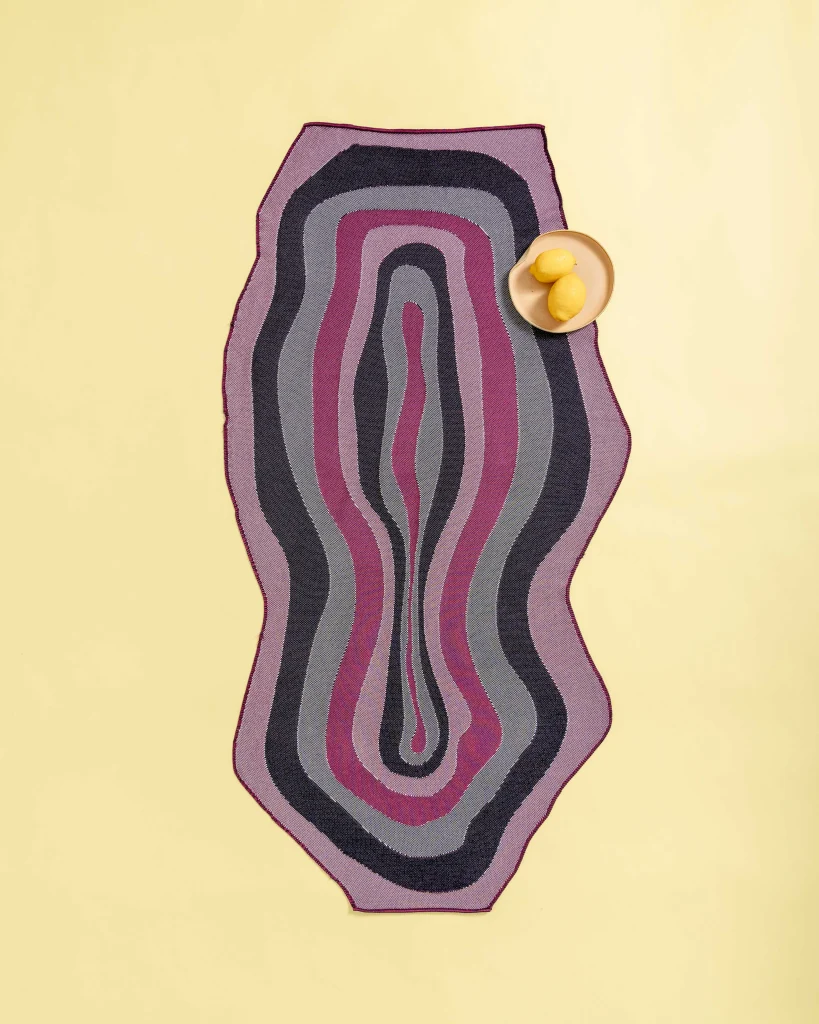
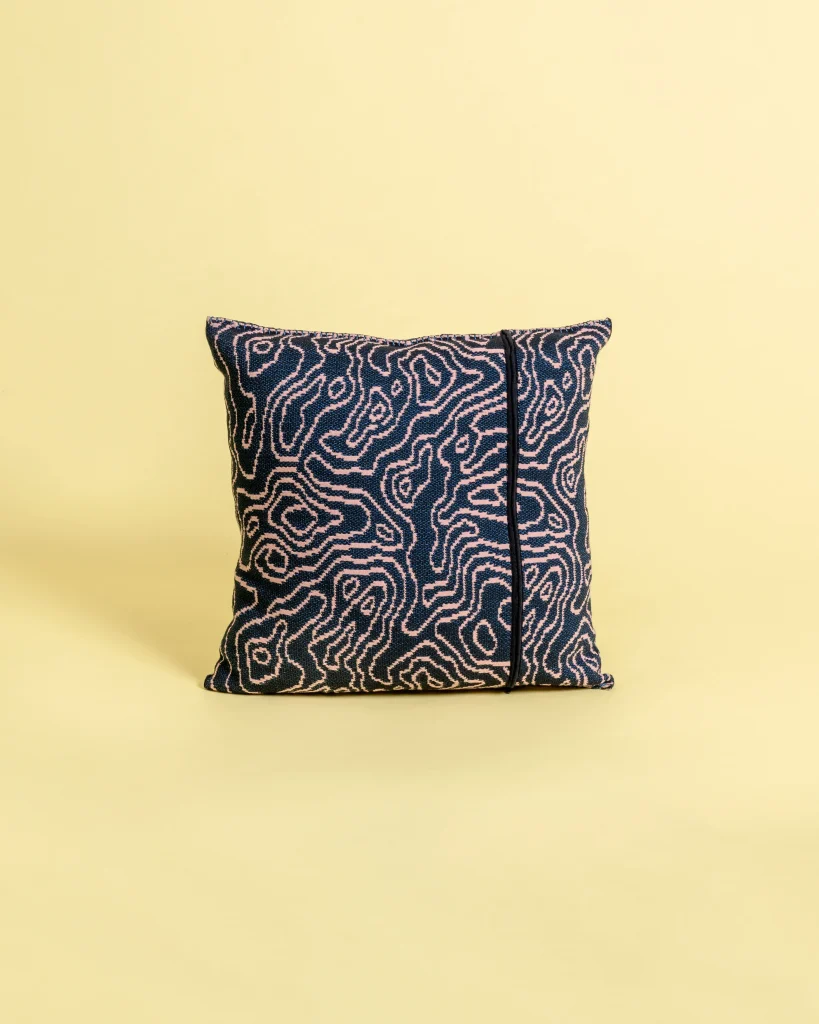
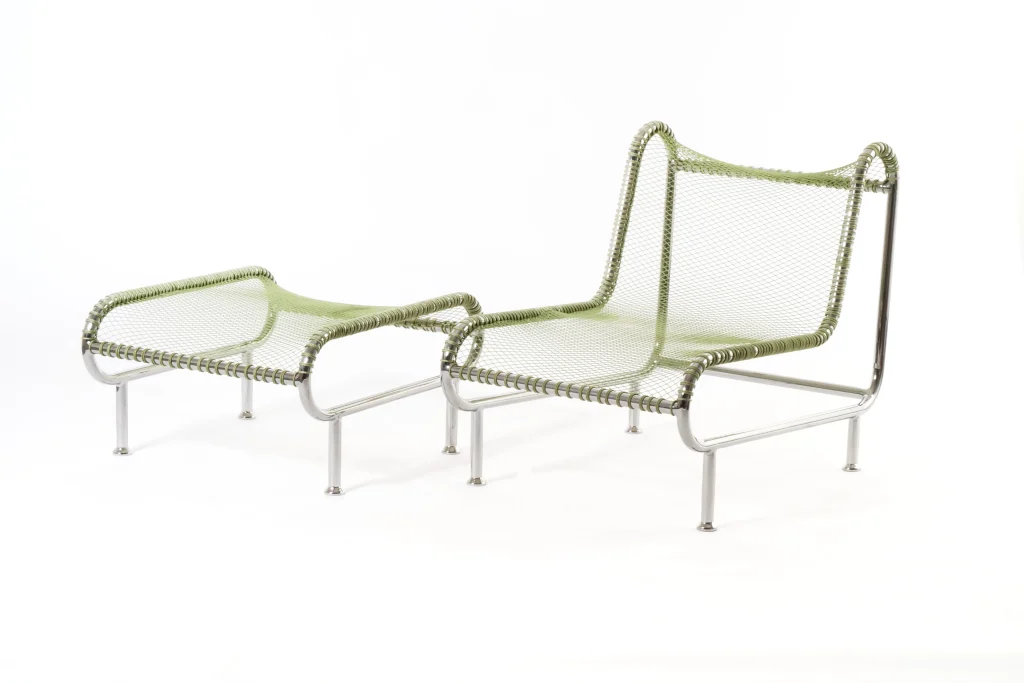
Knitting in the round on circular or double-pointed needles produces a seamless tube, useful for anything that would otherwise need joining. Industrially, the same logic scales into fully-fashion knitting, where each panel is shaped to its final dimensions on the machine rather than cut from a larger piece. Consequently cutting waste falls close to zero — BOI reports under 1% material waste using the method, and repurposes what remains as cushion filling.
Choosing yarn: wool, cotton and blends
Yarn choice does more to determine the outcome than the stitch pattern does. The relevant properties are crimp, elasticity, memory and how the fibre handles moisture.
Wool has natural crimp, so it springs back and holds loft. That memory is what keeps cable definition sharp and rib elastic over years of use, and it makes wool the default for structural knitting, seating and anything that must retain its shape. It also blocks well, meaning a piece can be persuaded into its final geometry with moisture and left to dry. Our guide to wool in design goes further into the fibre itself.
Cotton has almost no crimp and very little memory. As a result cotton knits drape heavily, grow under their own weight, and hold an open lace pattern crisply without fuzzing the edges of the holes. It takes dye evenly and washes hard, which suits tableware, cushion covers and anything handled daily — see our piece on cotton in art and design.
Blends split the difference deliberately. A little wool restores memory to cotton; a little cotton or linen calms wool’s spring and adds weight. Above all, gauge matters as much as fibre: the same yarn knitted loose or tight produces two materials with different drape, opacity and durability.
Knitted art: figures who moved the craft forward
Several practitioners shifted knitting from technique to medium, largely by treating colour and structure as subject matter rather than decoration.
Kaffe Fassett came to knitting from painting, and it shows in the work: dozens of colours held in a single garment, handled as a palette rather than a scheme. His influence on colourwork knitting is difficult to overstate, and it reframed the discipline as compositional.
Alice Starmore worked in the opposite direction, going deep into the Fair Isle and Aran traditions of her native Hebrides and documenting their vocabulary with rigour. Her patterns read as scholarship as much as design.
Brandon Mably, who trained with Fassett, pushed colour further toward the unresolved and the deliberately awkward. Meanwhile Stephen West built a large contemporary following on asymmetry, clashing colour and a refusal of the tidy — proof that the medium still has room for provocation.
Knit in contemporary interiors
Knit has moved off the body and onto the wall and the floor. Its loft makes it genuinely useful acoustically: a thick knitted panel absorbs mid-range sound in a way a flat woven hanging does not. Jeanett Knipschildt’s WoolWalls work in exactly that register, functioning as insulation, sound treatment and surface at once.
Elsewhere the appeal is structural. Because knit compresses and recovers, it upholsters curves without darts or seams, which opens up forms that woven fabric fights. Studios working across textile design increasingly treat the knitting machine as a way to shape volume directly rather than to produce cloth for cutting.
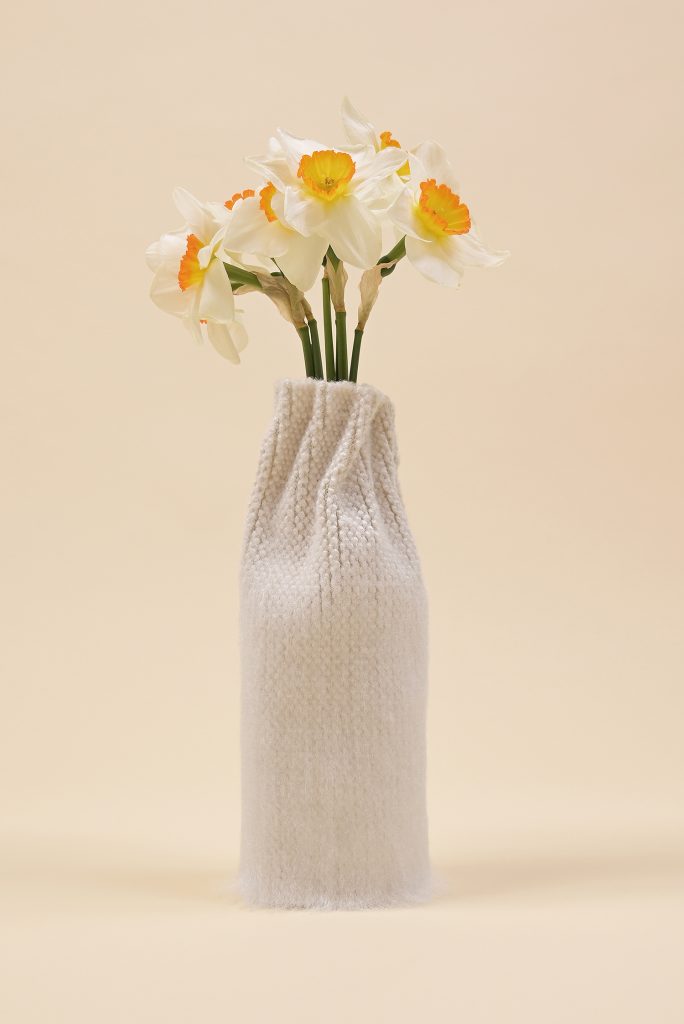
by BOI

by WKND Lab
Where the knitting market sits now
Two things are happening simultaneously. Hand knitting has grown as a practice, driven by online communities and a broader appetite for slow, tactile work. At the same time industrial knitting has become more capable and less wasteful, with fully-fashion and 3D knitting reducing offcuts to near nothing.
Those two currents are not in opposition, which is the more interesting development. A studio can now design on a machine and finish by hand, or prototype by hand and produce by machine. Meanwhile pressure toward material reuse favours knit specifically, because shaping panels to size sidesteps the cutting waste that dogs woven production.
Frequently asked questions
What is the difference between knitting and crochet?
Knitting holds many live stitches across two needles; crochet holds one live stitch on a single hook and completes each before moving on. That makes knitted fabric thinner, stretchier and better draping, while crochet is denser, stiffer and will not run if cut.
Is knitting or crochet easier for a beginner?
Crochet is usually faster to pick up, since only one stitch is live and errors are simple to undo. Knitting takes longer to start but covers large flat areas more quickly once the two basic stitches are secure.
What is the difference between knitted and woven fabric?
Knitting loops one continuous yarn; weaving interlaces two separate thread systems at right angles. Knits stretch and recover in both directions. Wovens resist stretch, hold a cut edge and drape according to their structure.
What is a chunky knit blanket?
A blanket knitted at very low gauge using thick yarn or multiple strands held together, producing large visible stitches and high loft. The scale traps air, so it insulates well for its weight, though the long floats between stitches snag more readily than a fine knit.
Can knitting be done by machine?
Yes, and it has been since 1589. Contemporary computerised flat-bed machines shape each panel to final size, and 3D knitting produces whole forms without seams. Crochet, by contrast, still cannot be genuinely mechanised.
How do you care for knitted wool pieces?
Air rather than wash where possible, and spot-clean with cool water and a wool-safe detergent. Never wring or tumble wool — agitation and heat felt the fibres irreversibly. Dry flat rather than hung, since a wet knit stretches under its own weight, and store folded to avoid shoulder distortion.
