Updated on: August 3, 2026
Weaving is a technology. We simply stopped calling it one.
Weaving is one of the oldest human crafts, integral to the development of societies around the globe. From rudimentary looms to the machinery of the Industrial Revolution and the computerised looms running today, the history of weaving has shaped human life more profoundly than we tend to recognise. Contemporary conversation confines weaving to fashion and clothing. Zoom out, however, and the introduction and industrialisation of weaving tools and techniques reads as one of the earliest tech booms on record.
Take the advent of woven sails, an innovation that accelerated international trade and exploration and catalysed the early phases of globalisation. Sails could suddenly be produced quickly and in bulk, which made weaving efficiency instrumental in outfitting fleets through the Age of Exploration. Industrialised weaving expanded global trade, established trade routes, and carried cultural exchange between continents. Notably, that is one example involving a single large piece of fabric. On a smaller scale, the same industrialisation transformed flour sacks, medical bandages and bedding. Almost nothing went untouched.
This guide covers what weaving is, how the loom evolved, the three fundamental weave structures, the traditional techniques still worked by hand, and why any of it matters in a fast fashion economy.


What is weaving?
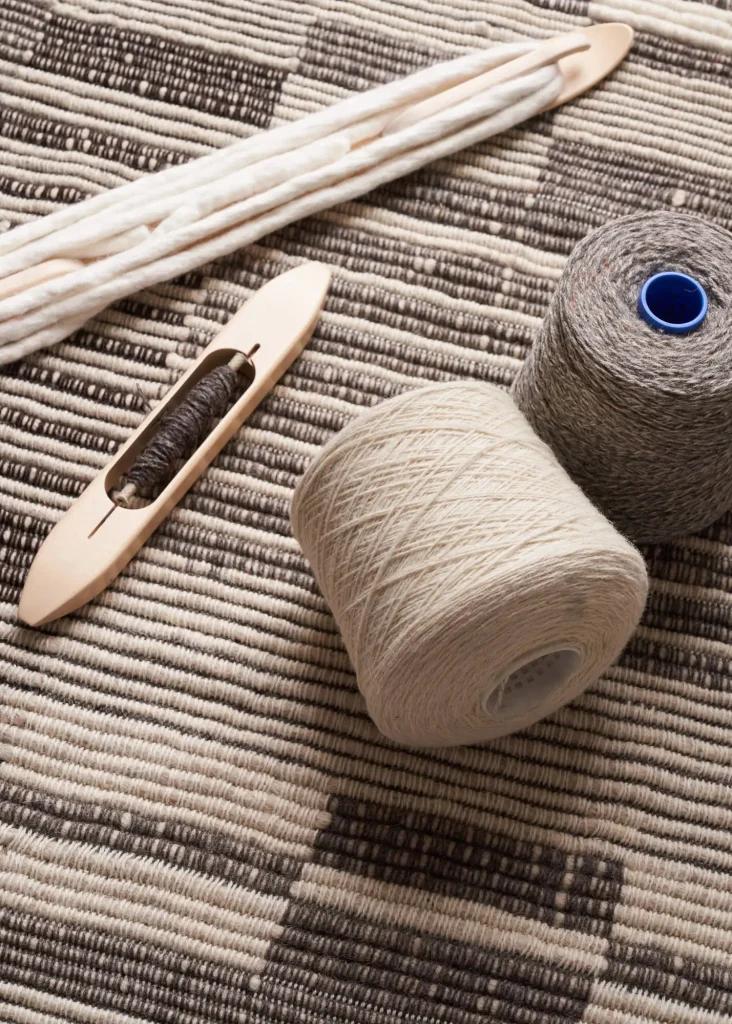
Weaving is the process of interlacing two sets of threads at right angles to produce cloth. One set is held under tension on a frame; the other passes over and under it. That single mechanical idea, repeated at scale, underpins most fabric in existence. Weaving differs from knitting, which loops a single continuous yarn, and from felting, which mats fibres together without any structure at all. Consequently woven cloth behaves differently: it resists stretch along its length, holds a cut edge, and drapes according to the structure chosen at the loom.
Warp and weft explained
The warp runs lengthwise, held taut on the loom for the duration of the work. The weft runs crosswise, carried back and forth through the warp. Warp threads take the strain, so they are usually spun stronger and tighter. Weft threads carry the pattern and most of the colour. Furthermore, the ratio between the two — how many warp ends and weft picks per centimetre — determines whether the finished cloth reads as dense and structural or open and fluid. Weavers describe this as the sett, and it matters as much as the fibre itself.
Fibre choice compounds those decisions. Wool has natural crimp, so it springs back and holds loft, which is why it dominates rugs and blankets. Linen and hemp are strong wet or dry but crease readily. Cotton sits between the two and takes dye evenly. Silk is the longest natural filament available, giving strength at very fine diameters. Consequently the same structure produces entirely different cloth depending on what runs through it — a plain weave in linen reads crisp, while the identical threading in wool reads soft.
What is a loom?
A loom is any device that holds warp threads under tension so that weft can be passed through them. That is the whole definition. Everything beyond it — shafts, treadles, shuttles, punch cards, servo motors — exists to make the passing faster or the pattern more complex. A loom can be two sticks and a strap around the weaver’s back, or a hall of computerised machines. Indeed the word carries enough cultural weight to sit inside everyday English: heirloom is heir plus loom, a compound that records the practice of passing down not only the loom itself but the skills and traditions bound to it.
The history of weaving: from ancient looms to automation
Ancient weaving and the first looms
Weaving dates to prehistoric times. The earliest surviving evidence of woven textiles comes from ancient Egypt around 5000 BCE, though impressions in clay and fragments of cordage suggest the technique is older still. These early weavers worked on ground looms and warp-weighted looms to produce cloth for clothing, shelter and trade. Crucially, the loom arrived alongside agriculture and pottery rather than after them, which places weaving among the founding technologies of settled life instead of among its refinements.
Medieval looms and the rise of the drawloom
By the medieval period the loom had gained a treadle-operated shaft system, freeing the weaver’s hands and multiplying output. The drawloom went further, allowing individual warp threads to be lifted in programmed sequences so that figured silks and elaborate repeats became possible. Meanwhile weaving organised itself socially: guilds set standards, apprenticeships transmitted technique, and whole cities built their economies on a single cloth. The design traditions that grew out of those workshops still inform studio practice today.
The Industrial Revolution and the power loom
The Industrial Revolution was the pivot, though it arrived in two stages rather than one. John Kay’s flying shuttle of 1733 sped up weaving by hand. The spinning machines that followed — Hargreaves’ jenny, Arkwright’s water frame, Crompton’s mule — mechanised the other half of the process, and by the 1780s they were producing yarn faster than hand weavers could consume it. That bottleneck is what prompted Edmund Cartwright to patent a power loom in 1785. His first machine was crude and barely practical. Even so, the principle held: by driving the shuttle and the shafts from an external source — water first, then steam, later electricity — the power loom removed the human arm from the cycle and turned weaving into continuous production. Refinement took another generation, and Richard Roberts’ cast-iron loom of 1822 is roughly where power looms became commercially viable. As a result cloth prices collapsed, the mill town became a template exported across the world, and the textile industry as we know it dates from this stretch rather than from anything earlier.
Computerised looms and CAD/CAM
The lineage runs directly into computing. Jacquard’s punched cards, which stored a pattern as a sequence of holes, were an information system before anyone used that phrase, and they fed the logic of early data processing. Today’s looms integrate computer-aided design and computer-aided manufacturing, giving precise control over complex repeats and rapid changeover between patterns. Consequently waste falls, consistency rises, and a run can be altered between one metre and the next. Even so, the underlying action is unchanged from 5000 BCE: warp held, weft passed through.


Types of weaving: the three fundamental weaves
Almost every woven fabric derives from one of three structures. The difference between them is simply how far the weft travels before it changes direction, and that single variable governs strength, drape, sheen and wear.
Plain weave
The weft crosses over one warp thread and under the next, alternating evenly. Plain weave is the simplest and most common structure, and the most stable: interlacings are frequent, so the cloth resists distortion and frays reluctantly. Calico, muslin, canvas and most kilims are plain weave. By contrast it has little natural sheen, because no thread is ever left long enough on the surface to catch light.
Twill weave
In twill weave the weft passes over two or more warp threads, then under one or more, stepping the offset sideways on each pass. That step produces the diagonal rib you can read on any pair of jeans. Fewer interlacings make twill more pliable than plain weave and better at hiding soil, while the diagonal structure carries weight without sagging. Denim, gabardine, herringbone and tweed all belong here. Therefore twill dominates hard-wearing cloth: upholstery, workwear, tailoring.
Satin weave
Satin weave floats the weft over four or more warp threads before tucking under one. Those long floats sit flat and parallel, reflecting light in one direction, which is where the lustre comes from — the structure, not the fibre. The trade-off is exposure: floats snag, and satin abrades faster than either alternative. Notably the same structure in silk, cotton or polyester will read as glossy, because sheen here is a matter of geometry.

Beyond the three: jacquard, basket and tapestry weave
Compound structures build on the basics. Jacquard controls each warp thread independently, so imagery can be woven rather than printed. Basket weave doubles the threads in both directions for an open, chunky grid, and the same over-under logic scales up into basket weaving in cane, willow and rush. Tapestry weave uses discontinuous weft, meaning colour is built area by area instead of running the full width — the technique behind pictorial hangings and most flatweave wool rugs. Pile weaves, meanwhile, add a third element entirely: loops cut or left standing, as in velvet and carpet.
Types of weaving looms
Backstrap and frame looms
The backstrap loom ties one end of the warp to a fixed point and the other to a belt around the weaver’s body, so tension is regulated by leaning. It is portable, costs almost nothing, and remains in daily use across the Andes and Southeast Asia. Frame and rigid-heddle looms work the same principle on a static frame, which is why they are where most hand weavers begin.
Floor and table looms
Shaft looms group warp threads onto shafts raised by treadles or levers. Four shafts cover plain weave, twill and a wide range of patterns; eight or sixteen open up complex structures. Floor looms are treadled and built for width and speed, whereas table looms trade both for a footprint that fits a studio corner. Most contemporary studio textile work comes off one of these.
Jacquard, dobby and industrial power looms
Dobby looms automate the shaft sequence mechanically or electronically. Jacquard looms remove shafts altogether, addressing every warp thread individually. Industrial power looms, meanwhile, dispense with the shuttle: air jets, water jets or rapier tips carry the weft across at several hundred picks a minute. As a result a single machine now produces in an hour what a medieval workshop produced in a season.


Traditional weaving techniques around the world
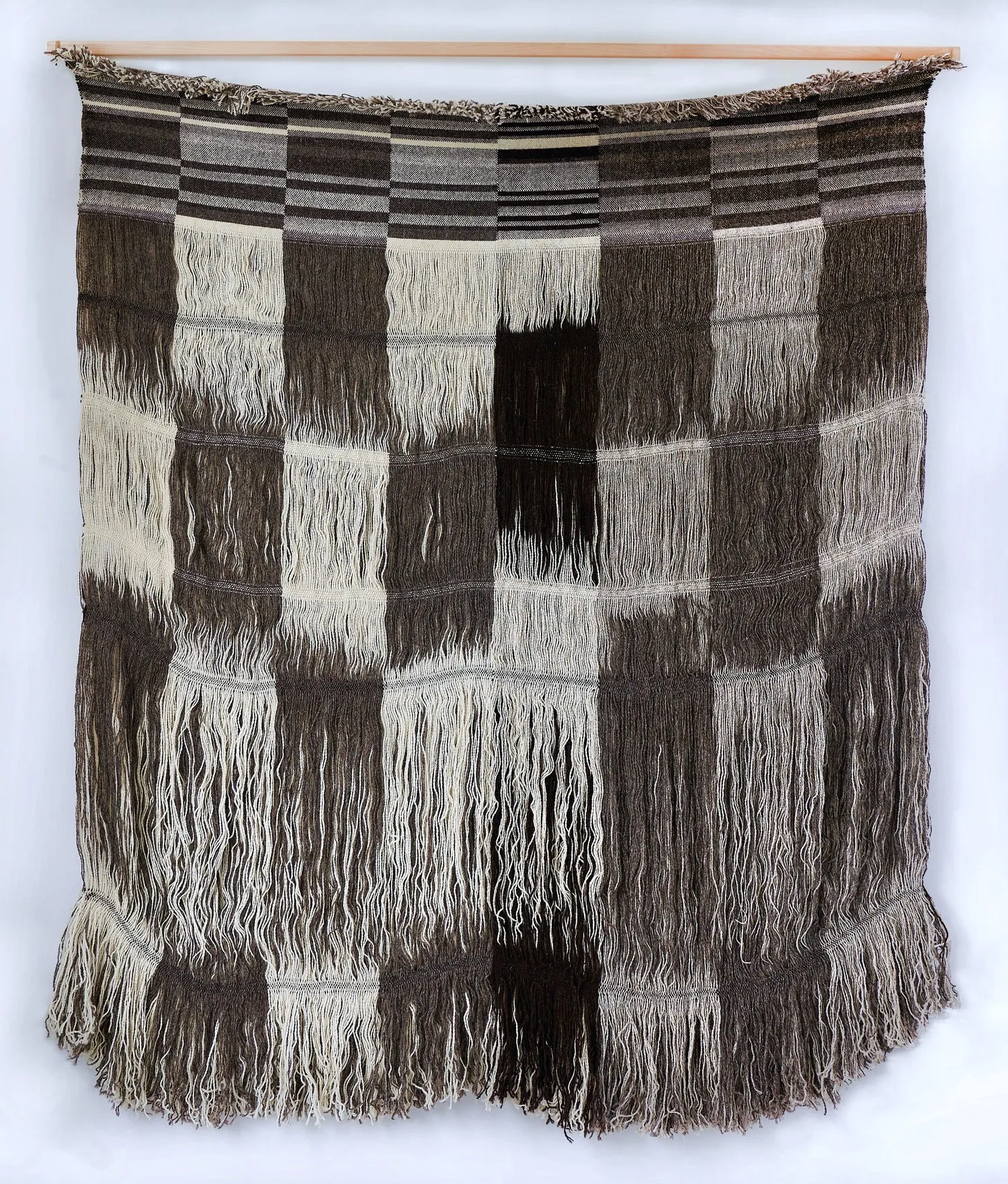
Across cultures, weaving techniques function as tangible records of continuity. They carry the technical skill of their makers alongside the values and traditions that shaped a community, which makes textiles repositories of cultural memory rather than merely useful objects. The five traditions below are among the most studied, and all five are still practised.
Kente cloth, Ghana
Kente is woven in narrow strips on a horizontal loom by the Ashanti and Ewe peoples, then stitched edge to edge into broad cloth. Historically it was reserved for royalty and ceremony. Every pattern and colour combination carries specific meaning, encoding history, proverbs, ethics and political thought, so a Kente cloth can be read as much as worn. In December 2024 UNESCO inscribed the craftsmanship of Kente on its Representative List of the Intangible Cultural Heritage of Humanity, Ghana’s first inscription under that convention — recognition aimed at the weaving knowledge and how it passes down, rather than at the cloth alone.
Navajo weaving, United States
Navajo weavers work upright looms with continuous warp, producing tapestry-weave blankets and rugs in wool. Geometric vocabulary dominates: diamonds, zigzags, banded fields. Historically these served as garments and blankets before the trading-post era reframed them as floor rugs, and today they are held as works of art. The Met’s collection includes several important nineteenth-century Navajo serapes.
Ikat, Indonesia, India and Central Asia
Ikat is a resist-dye technique rather than a weave structure. Bundles of yarn are bound and dyed before anything reaches the loom, so the pattern exists in the threads themselves. Because alignment can never be perfect, the finished cloth carries a characteristic feathered blur at every colour boundary — the signature by which ikat is identified.
Andean weaving, Peru
Andean communities weave on backstrap looms using alpaca and vicuña alongside sheep’s wool. Warp-faced structures predominate, which means the pattern is carried almost entirely in the warp and the weft disappears. Symbolic motifs record cosmology, landscape and daily life, and the technique passes down through generations by demonstration rather than notation.
Tartan, Scotland
Tartan is a twill woven with the same coloured sequence in warp and weft, so the bands cross to produce blended intersections. Each sett is associated with a clan, family or region and holds documented historical significance. Traditionally woven in wool for kilts, plaids and shawls, tartan is the clearest everyday demonstration that a weave structure and a colour order together make a pattern.


Silk, the Silk Road and weaving’s global reach
To weave silk is to work the finest filament available before synthetics, and for centuries the knowledge of how to do it was guarded as state secret. That scarcity gave woven silk its value, and its value gave the Silk Road its name. The exchange of woven textiles along those routes moved more than goods: patterns, motifs and loom technology travelled with the cloth, which is why a Persian medallion surfaces in Italian velvet and a Chinese cloud band appears in Ottoman silk.
Silk also drove the loom’s development directly. Figured silk demands independent control of individual warp threads, and that requirement produced the drawloom, then the Jacquard mechanism, then the punched card. In other words the most technically ambitious cloth pulled the technology forward, and the technology eventually industrialised everything else.
Weaving therefore functioned as a cultural bridge between civilisations that never met directly. Advances in loom technology, from the drawloom to automated systems, have continually reshaped trade dynamics — a demonstration that a single craft can determine how connected societies become.
Handwoven versus machine-woven: what actually differs
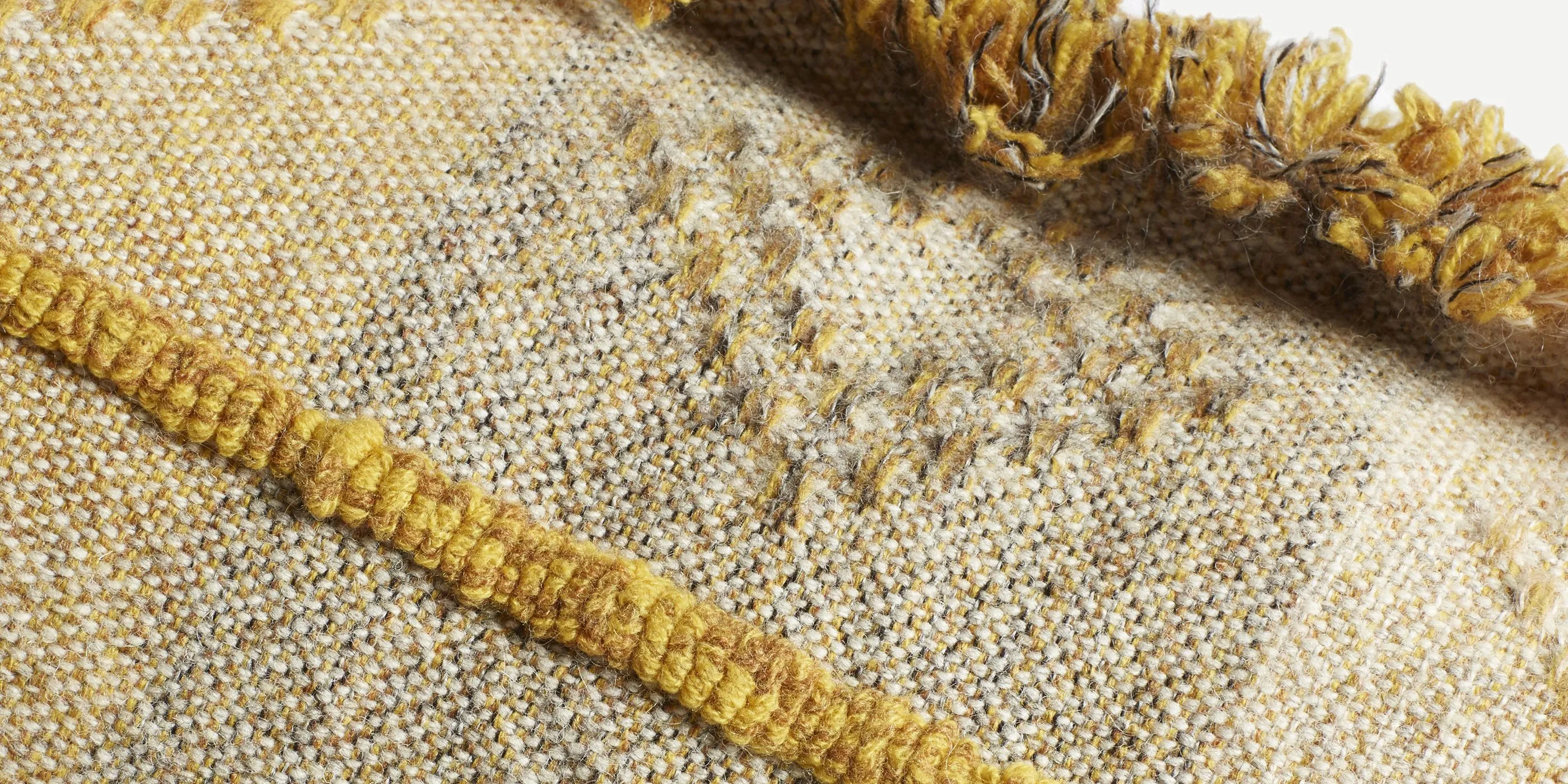
A power loom produces cloth of remarkable evenness. A hand weaver cannot match that consistency and generally is not trying to. Hand weaving allows tension, sett and colour to shift mid-piece, and it permits discontinuous weft, irregular selvedges and yarns too slubbed or fragile for industrial tension. Consequently the two processes suit different ends: machine weaving for volume and repeatability, hand weaving where the structure itself is the subject.
In practice you can read the difference. Look at the selvedge for slight variation, at the beat for rhythm in the weft spacing, and at the reverse face, which on handwoven cloth is usually as considered as the front. Studios working this way — from flatweave kilims to woven wall pieces — treat the loom as a drawing tool rather than a production line.
Weaving in a fast fashion world
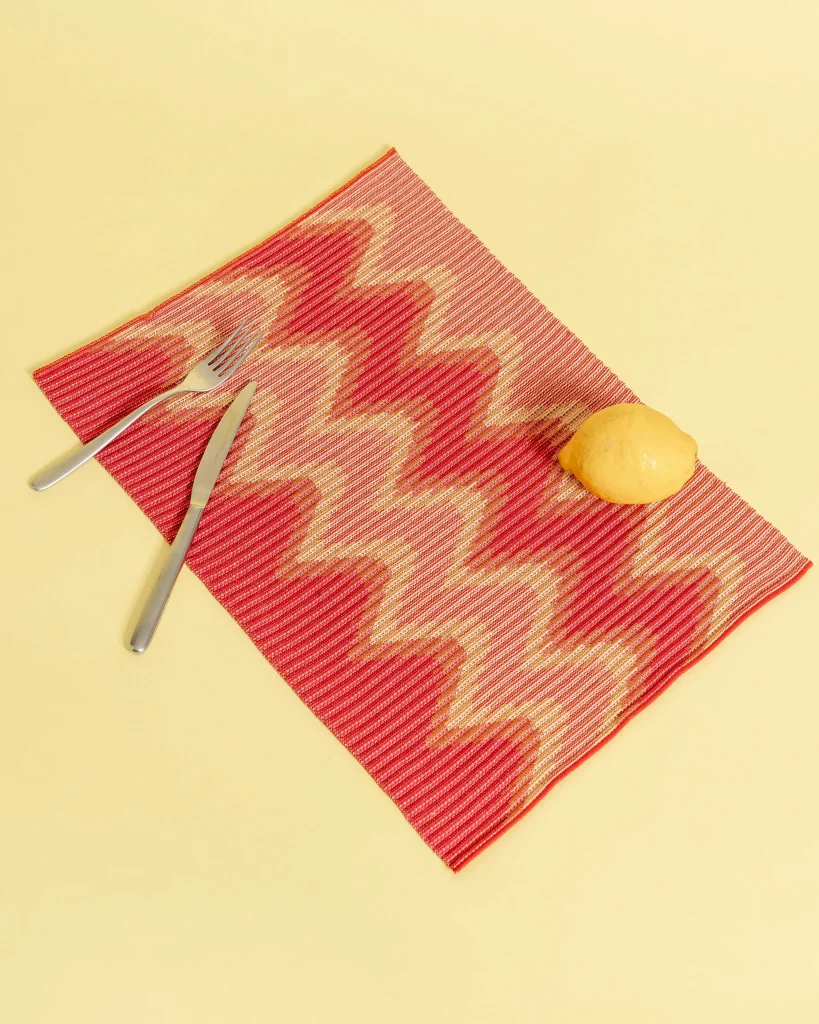
Reflecting on industrialised weaving demands acknowledging its dual nature. Increased production fuelled economic growth and introduced problems of its own. Consider the original Luddites, early nineteenth-century textile workers who broke mechanised looms out of fear for their livelihoods — an anxiety that echoes in contemporary arguments about automation and AI. Today “Luddite” describes anyone hostile to technology, yet the original grievance was economic hardship rather than machinery as such. Ironically, weaving work initially expanded, because mechanisation increased the yarn supply faster than it displaced weavers.
That cycle repeats in fast fashion. Technological leaps enable rapid, cheap manufacturing while displacing labour, degrading working conditions, damaging the environment and prompting demands for sustainability. Both eras illustrate the double edge of innovation: societies reshaped by progress and by its consequences at once. Recognising the depth of weaving’s history is therefore also an argument for mindful consumption — for owning fewer textile pieces and understanding how each was made.
Frequently asked questions
When was weaving invented?
The earliest surviving woven textiles date to roughly 5000 BCE in ancient Egypt. Indirect evidence — clay impressions, twisted cordage, needle finds — pushes the practice of interlacing fibres considerably further back, likely well before 10,000 BCE. No single inventor or date exists; weaving appears independently across separate regions.
Where did weaving originate?
There is no single origin point. The oldest physical evidence comes from Egypt and the Near East, while comparable early traditions developed independently in China, the Andes and Anatolia. Weaving is best understood as a technique that emerged repeatedly wherever people had fibre, tension and time.
How old is weaving?
Around 7,000 years of surviving cloth, and plausibly 20,000 or more years of the underlying technique if basketry and cordage are counted. That makes weaving older than the wheel, writing and metalworking.
What is the difference between weaving and knitting?
Weaving interlaces two separate thread systems at right angles. Knitting loops one continuous yarn through itself. As a result woven cloth is stable and resists stretch, whereas knitted fabric is elastic and recovers its shape.
What is the strongest type of weave?
Plain weave is the most stable, because it interlaces most frequently. Twill weave is generally the most durable in use: it takes abrasion well, drapes without sagging and hides wear. Satin is the weakest of the three, since long floats snag.
Is weaving still done by hand today?
Widely. Hand weaving continues as living tradition in the Andes, West Africa, South and Southeast Asia, and as studio practice internationally. Contemporary weavers work floor, table and backstrap looms to make textile pieces, rugs and wall works that industrial production cannot reproduce.
Why weaving still earns its place
Weaving rewards attention because it sits at the junction of engineering and expression. A weave structure is a set of decisions about tension, sequence and material, and those decisions are legible in the finished cloth to anyone who knows how to look. Understanding warp from weft, or twill from satin, changes what a rug or a wall piece communicates when you stand in front of it.
Above all, weaving records how technology actually moves through a society: gradually, unevenly, and with consequences nobody forecasts. The loom industrialised the world, seeded computing, and is still worked by hand in a hundred places. Few crafts carry that much history and remain this alive.