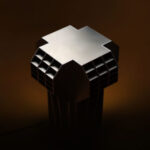
Orbital Array Table Lamp in Aluminum
by BUREAU OF ENTROPY · Wuppertal, Germany

20x20x35cm (8x8x14")Aluminum

A table lamp by Bureau of Entropy, built without welds or glue — pure compression and precise engineering hold it together. Dimmable light filters through four dome-shaped openings in brushed aluminium, bending into soft reflections and shadow.

Read more
2 others are viewing this
Certificate of authenticityAll pieces on ADORNO are authentic and studio-made. To verify that, a certificate, signed by the maker, is always included in the box.
Open Edition
Ongoing series by the maker. Slight variations may apply.
Made for you
You will get pictures of the final piece before shipping
Delivered between23 – 30 Oct
We arrange insured delivery from door to door.
Buyers protection
  • Certificate of Authenticity A signed certificate from the maker is always included in the box.

  • Lowest price guaranteed Find a lower price from the seller, we'll match it.

  • Secure online transactions All personal information that you send to us is encrypted and cannot be viewed by others.

  • 100% insured global deliveries We arrange worldwide delivery, and every shipment no matter the price is fully insured against damages.

  • 14 days return policy In the rare event, you receive a piece that you are not fully satisfied with, you can return it within 14 days of receipt for a full refund except return shipping costs. Made-to-order items are not eligible for return.

Shipping and delivery
Ships fromWuppertal, Germany
Delivery toyour location
Estimated delivery dateOctober 23 - October 30
Cardboard30x30x50cm, 7kg
  • Tracked from studio to doorstepYou receive a tracking link as soon as the piece leaves the studio, and can follow it through every carrier hand-off until it reaches your door.
  • 100% insured, door to doorEvery shipment is fully insured from pickup to delivery. If anything happens in transit, you are covered for the full purchase price.
  • All made to order purchases are finalThis piece is produced specifically for you once you order, so it cannot be returned or exchanged.
  • Duties and taxes may applyWe declare all pieces as original duty-free works, however, your local customs office makes the final decision. Learn more
Specifications
Dimensions LxWxH
Piece Weight (kg)

5

Production Year

2026

Material

Technique

Design Class

Open Editions

FAQ
Does this lamp come with a bulb included?

Yes, it includes an E27 LED bulb, 8.5W, 2800K, 1,055 lumens.

Is the light dimmable?

Yes, it has a built-in dimmer switch.

What plug does it come with and will it work in my country?

It comes with a standard EU plug (Type C/E). Adaptation for other countries is available upon request — use Chat with the maker to arrange this.

Can I customize this piece?

Yes, this lamp can be customized upon request — reach out via Chat with the maker to discuss options.

How long is the cord?

The cord is 300 cm long.

How long does it take to receive this lamp?

This piece is made to order and usually ships in about 3 weeks.

Are the small marks on the aluminum a defect?

No, fine scratches or slight distortions in the aluminum are a natural result of the handcrafted, weld-free construction rather than a flaw.

Can I return this piece if I change my mind?

This piece is made to order, so it is excluded from the standard 14-day return policy.

What is a bedside lamp?

A bedside lamp is a small table lamp placed on a nightstand or shelf next to the bed, made for low, warm light rather than full room illumination. It usually covers three jobs: reading before sleep, finding your way at night, and adding character to the surface it stands on.

What is the difference between a bedside lamp and a table lamp?

Bedside lamps are a type of table lamp, defined by scale and quality of light rather than by category. A bedside lamp is typically 40–60 cm tall, warm, dimmable, easy to switch off by feel, and modest in output. A general table lamp can be far larger and brighter because nothing about it has to be usable half-asleep. Many sculptural pieces work in both roles; a tall, wide-shaded lamp designed for a console rarely works the other way around.

How tall should a bedside lamp be?

Between 40 and 60 cm for a standard bed and nightstand. Rather than measuring the lamp alone, sit on the edge of the bed: the bottom of the shade should sit between your chin and your eyes so the bulb stays hidden. Low beds and low nightstands need smaller lamps — 25–35 cm is often right.

What size lamp should I choose for my nightstand?

Keep the lamp narrower than the nightstand and leave usable surface beside it. As a rule of thumb, the widest point of the lamp should be no more than about two-thirds the depth of the nightstand, with a base around 10–16 cm across. If the lamp overhangs the edge or you have to move it to put a book down, it is too big.

How bright should a bedside lamp be?

Less than most people expect. Around 100–300 lumens is right for ambient bedside light, and 250–450 lumens for reading in bed with the light aimed at the page. Dimmability matters more than maximum output, because the same lamp has to serve reading and the minute before sleep.

What is the best light color for a bedroom?

Warm, between 2200 K and 2700 K. Amber-toned light in the evening is easier on the eyes and less stimulating than neutral or cool white. Where a very low night light is needed — for a child, or for moving around at night — the softest, warmest setting available is preferable to a brighter cool one.

Do you need two matching bedside lamps?

Not necessarily. A matching pair gives a calm, symmetrical bedroom and is the safe choice with a formal headboard. Two pieces sharing a material or a maker but differing in form often looks better in a collected interior. Since much of ADORNO's catalogue is made to order, a second piece from the same studio can frequently be arranged — contact the curation team to check.

Do you have cordless or rechargeable bedside lamps?

Yes. Several designers make wireless and rechargeable lighting, which is useful when the socket is in the wrong place, when you want to carry the light to another room, or on a nightstand where a trailing cable spoils the piece. Availability changes as pieces are one-off or limited, so browse the current Battery-Operated Lights selection or ask us for a specific request.

What materials make the best bedside lamps?

Ceramic, stoneware, alabaster, marble, hand-blown glass, brass, steel and solid wood. All age well, all feel substantial at close range, and each handles light differently — stone and alabaster glow from within, opaque ceramic and metal shades throw a defined pool of light downward for reading.

Can a bedside lamp be used elsewhere in the house?

Yes, and most are better for it. The same scale suits a console table, a desk, a bathroom shelf, a windowsill or a hallway. A dimmable bedside lamp on a dining sideboard is one of the simplest ways to soften a room in the evening.

Are designer bedside lamps worth it?

A bedside lamp is switched on and off every day and sits within arm's reach, so material quality and light quality are noticed constantly. A well-made piece in ceramic, stone or glass also functions as a sculptural object during daylight hours, which mass-produced nightstand lamps rarely do. Buying from independent studios means the piece is made in small numbers by the person who designed it.

Description

Orbital Array is built entirely without welds or glue, relying on compression and precise engineering so that every part locks into place with intent. A dimmable light source sits at the centre, filtered through four dome-shaped openings; brushed aluminium bends that light into soft reflections and shifting shadows, so the piece stays visually active even switched off.

The design draws on mid-century science fiction and Space Age references — echoing, in Bureau of Entropy’s words, the vision of a Swiss architect working in Palm Springs — landing somewhere between a stable, symmetrical object and one that reveals new tension from every angle.

The lamp comes with a standard EU plug and a built-in dimmer. Fine scratches or slight distortions in the aluminium are a natural result of the handcrafted process rather than a flaw.

Dimensions LxWxH
Piece Weight (kg)

5

Production Year

2026

Material

Technique

Design Class

Open Editions

About BUREAU OF ENTROPY Visit Showroom →

STRUCTURAL NECESSITYBureau of Entropy treats construction as a form of thought. Its objects begin with forces rather than images: weight, pressure, resistance, balance, and the precise point at which separate elements become a stable whole. Components are cut, aligned, interlocked, and held through their own geometry. What carries the object is not hidden. Structure remains visible as both evidence and expression. This legibility is central to the practice. A connection does not merely solve an assembly problem; it determines proportion, rhythm, and presence. Material is not shaped around a predetermined silhouette. The silhouette emerges through the negotiation between material behavior, structural demand, and human use. Working across furniture, lighting, and functional sculpture, Bureau of Entropy returns to elemental typologies: the seat, the table, the source of light. These familiar forms are treated as unresolved structures rather than established designs. Their functions remain recognizable, while their construction is reconsidered from the ground up. The work draws on architecture, engineering, precision manufacturing, and the anonymous intelligence of objects refined across cultures and generations. Such references are not reproduced as styles. They are examined as accumulated responses to recurring conditions: how a body is supported, how weight is transferred, how light occupies space, and how an object establishes presence. Bureau of Entropy does not separate technical resolution from artistic expression. Precision produces character. Constraint generates form. An object reaches completion when its structure and presence can no longer be understood independently from one another.FOUNDATIONBureau of Entropy was founded in Wuppertal, Germany, in 2025 by Marvin Julian Freund and Matthias Figurowicz. Both founders trained as toolmakers, developing an early understanding of metal, tolerance, manufacturing, and assembly through direct physical practice. This shared technical foundation was later extended through different disciplines. Freund studied architecture and conceives the objects through proportion, spatial presence, cultural context, and the relationship between body and structure. He develops both their formal expression and their underlying construction, determining how each work is manufactured, joined, and assembled. For Freund, designing is also a way of thinking through what resists resolution in language. Through drawing, testing, and assembling, personal experience enters the work without becoming illustration or fixed narrative. It is held in the persistence of the process: remaining with a question until the object arrives at its precise form. Figurowicz studied mechanical engineering and contributes an understanding of forces, mechanisms, material performance, and functional systems. He supports the physical realization of the works through fabrication, assembly, and technical implementation. This continuity from conception to realization allows each object to emerge as a coherent structural whole. Construction is not added to form; it is the means through which form becomes necessary.
Question for the maker?
BUREAU OF ENTROPY
Photo BUREAU OF ENTROPY
· Wuppertal, Germany
We are here to make sure you get the answers you need - in time.
Member since 2025 · Expect a reply within 24 hoursReply in 24 hours
More Ways To Browse
Bedside Lamps Metal Table Lamps Table Lamps Lamps Desk Lamps