“To see a world in a grain of sand.” – William Blake
Updated on: November 12, 2026
Blake’s line proposes that even the smallest, most unassuming material can hold unexpected beauty. In contemporary design, sand is going through just such a reevaluation. Once a residue swept off workshop floors, it has become a medium of intention, shaped into sculptural lighting, furniture and objects.
Two processes drive the shift: sand 3D printing, which builds forms grain by grain, and sand casting, one of the oldest ways of shaping metal. Here is how both work, why designers are drawn to sand, and six pieces made with it.
Why Designers Are Turning to Sand
Sand is everywhere, cheap and endlessly varied in color and grain, and it carries a sense of place: a designer can print with sand from a specific riverbank or desert. Furthermore, sand objects keep a granular, tactile surface that few other materials offer, closer to stone than to plastic.
There is a sustainability argument too, with caveats. Sand itself is abundant, but construction-grade sand is under real pressure worldwide, and printed or bound sand usually needs a resin or binder to hold together. The most interesting studios work with local, waste or riverbank sand and with bio-based binders, which keeps the material story honest. For more on that, see our guide to sustainable design.
How Sand 3D Printing Works
Most sand 3D printing uses a process called binder jetting. A thin layer of sand is spread across a print bed, and a print head sprays a liquid binder only where the object should be solid. Layer after layer, the form builds up inside a block of loose sand, which supports it as it grows, so overhangs and hollow shapes need no extra structure.
Once printed, the object is lifted out, the loose sand is brushed away, and the surface is usually sealed or infiltrated with resin for strength and water resistance. Consequently, designers can make shapes that would be impossible to mold or carve, while keeping the raw texture of the grain. Wallpaper* picked one early example, Johan Wilén’s 3D-printed quartz sand Contourage console, among the best console tables of recent years.
Sand Casting, the Older Technique
Long before printers, sand was a mold. In sand casting, a pattern is pressed into packed sand, removed, and molten metal is poured into the cavity. The sand leaves its texture on the metal, which is why sand-cast aluminum or bronze has a soft, slightly granular skin instead of a mirror finish. Today, some studios combine the two methods, 3D-printing sand molds for casting shapes that a traditional pattern could not form.
6 Pieces Made With Sand
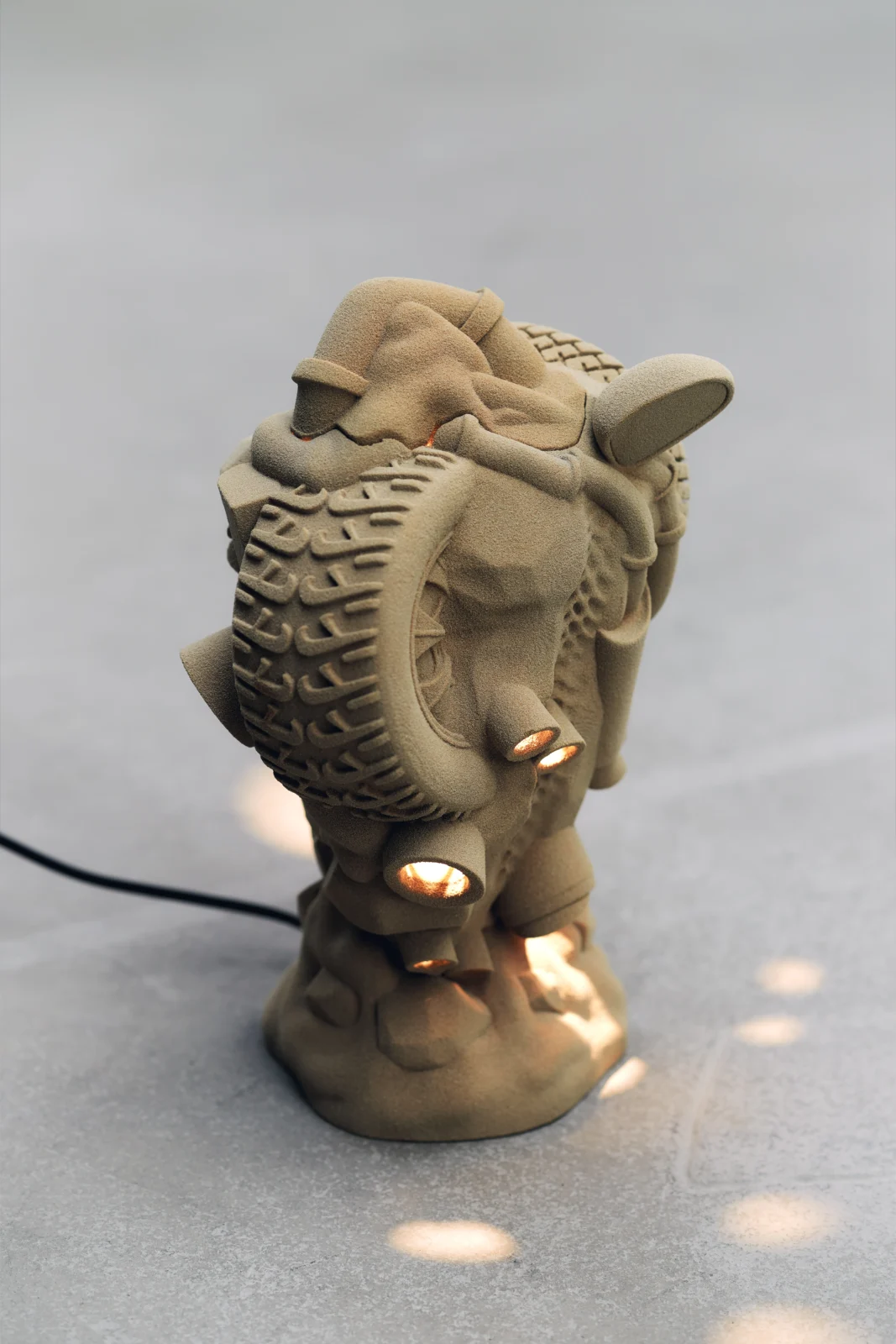
Nascar Table Lamp in Quartz Sand by Jacob Mathias Egeberg

Jacob Mathias Egeberg shapes Nascar entirely from pure quartz sand, taking its fractured form from the aftermath of a crash in the desert. Lit from within, the granular surface turns a warm, sun-bleached gold. At 24 x 24 x 40 cm (9 x 9 x 16 in), it sits on a side table or a shelf as a sculpture first and a lamp second.
By Jacob Mathias Egeberg
€2,200 incl. tax
“Sand in Motion” Pleat Chair I by Rive Roshan

Rive Roshan 3D-prints the Pleat Chair from sand taken from Bavarian riverbanks, freezing a moment of movement into sharp, folded planes. As a result, the chair plays light and shadow across its surface as you walk around it. At 50 x 56 x 74 cm (20 x 22 x 29 in), it is a fully working chair that reads as sculpture in a hallway or a reading corner.
By Rive Roshan
€9,000 incl. tax
Mirror O – Sand Decor & Plaster – Wall Mirror by Sacha Parent & Valentine Tiraboschi

Mirror O comes from the Sand Decor Project, which won the Jury’s Grand Prize at the Villa Noailles Design Parade in 2024. The duo lets sand flow to generate the ornament, and sets it in plaster, so each frame records its own pattern. At 77 x 66 x 8 cm (30 x 26 x 3 in), it brings soft relief to an entryway or a bathroom wall.
By Sacha Parent & Valentine Tiraboschi
€1,350 incl. tax
Sandstone Rock Coffee Table In Paper Pulp And Sand by David Čáp

Czech designer David Čáp makes this one-of-a-kind table by hand from recycled shredded paper and sand, shaped to recall a sandstone boulder. Despite the unusual materials, it carries up to 80 kg (176 lb). At 88 x 67 x 35 cm (35 x 26 x 14 in), it is a low, characterful coffee table for a living room.
By David Čáp
€1,500 incl. tax
Eocene – Sand-Cast Aluminum Vase by Epoche Studio

Epoche Studio casts Eocene in aluminum poured into a sand mold, which leaves the metal with a raw, stone-like skin. Two authentic Green River fish fossils are set into its surface, quiet evidence of life fifty million years old. At 13 x 13 x 22 cm (5 x 5 x 9 in), it holds a single stem on a desk or a shelf.
By Epoche Studio
€1,342 incl. tax
Sandle No. 2 Black – Sandstone Candle Holder by Francesc Gasch Studio

Barcelona designer Francesc Gasch 3D-prints Sandle in sand, using extrusion-like loops that would be impossible to make by hand or mold. Notably, the black version gives the printed texture a deep matte finish. At 18 x 27 x 18 cm (7 x 11 x 7 in), it holds four tapers on a dining table or a mantelpiece.
By Francesc Gasch Studio
€348 incl. tax
Frequently Asked Questions
What is sand 3D printing?
A form of binder jetting: thin layers of sand are spread one at a time and a print head sprays a binder only where the object should be solid. The loose sand supports the form as it builds, so complex, hollow shapes are possible.
Is 3D-printed sand furniture strong?
Printed sand on its own is fairly brittle, so studios seal or infiltrate it with resin after printing. Treated this way, sand chairs, tables and lamps are durable enough for everyday use, though they are best kept away from hard knocks.
What is the difference between sand printing and sand casting?
Sand printing builds the object itself out of bound sand. Sand casting uses packed sand as a mold, into which molten metal is poured; the finished piece is metal, with the sand’s texture pressed into its surface.
Is sand a sustainable material?
It depends on the sand and the binder. Sand is abundant, but construction sand is in high demand worldwide. Pieces made with local, waste or riverbank sand and bio-based binders have the strongest claim.
Explore more digital fabrication on ADORNO, or browse sculptural lamps →