
Tradition only survives if someone keeps changing it.
Updated on: October 20, 2026
Mexico’s design scene has built a strong language around local materials and artisanal techniques, where heritage and identity sit comfortably beside a contemporary eye. Few studios show this as clearly as piedrafuego, which works in volcanic basalt, cantera stone, clay, wood and steel.
Founded in 2013 as Álvareztostado, the studio became piedrafuego, “fire stone,” in 2016, a name that honors the transformation of raw materials by human hands. Below, ADORNO revisits its conversation with founder Aldo Álvarez-Tostado about continuity, craft and technology, then looks at six piedrafuego pieces available now.
Mexican crafts as a living tradition
For Álvarez-Tostado, the key idea is continuity. “We aim to have a free practice, avoiding [handling] traditional craftsmanship as a trend or nostalgia, but rather as a resource that comes naturally when you’re a designer in Mexico,” he explains. “We envision the studio as part of a chain: we are the result of a crafting tradition, but by creating new objects with a contemporary vision, we do a small part in transforming it and thus keeping it alive.”
That view also shapes how he sees innovation. “Tradition should not be treated as static,” he says. “It is our duty, both for designers and artisans, to push craftsmanship to new horizons in order to keep it a tradition and not a mise-en-scène of archaic manufacturing processes.” Yet he is wary of novelty for its own sake, since there is “so much to do in terms of cultural preservation, sustainability in design, and economic growth for artisan families.”
Where hand carving meets CNC
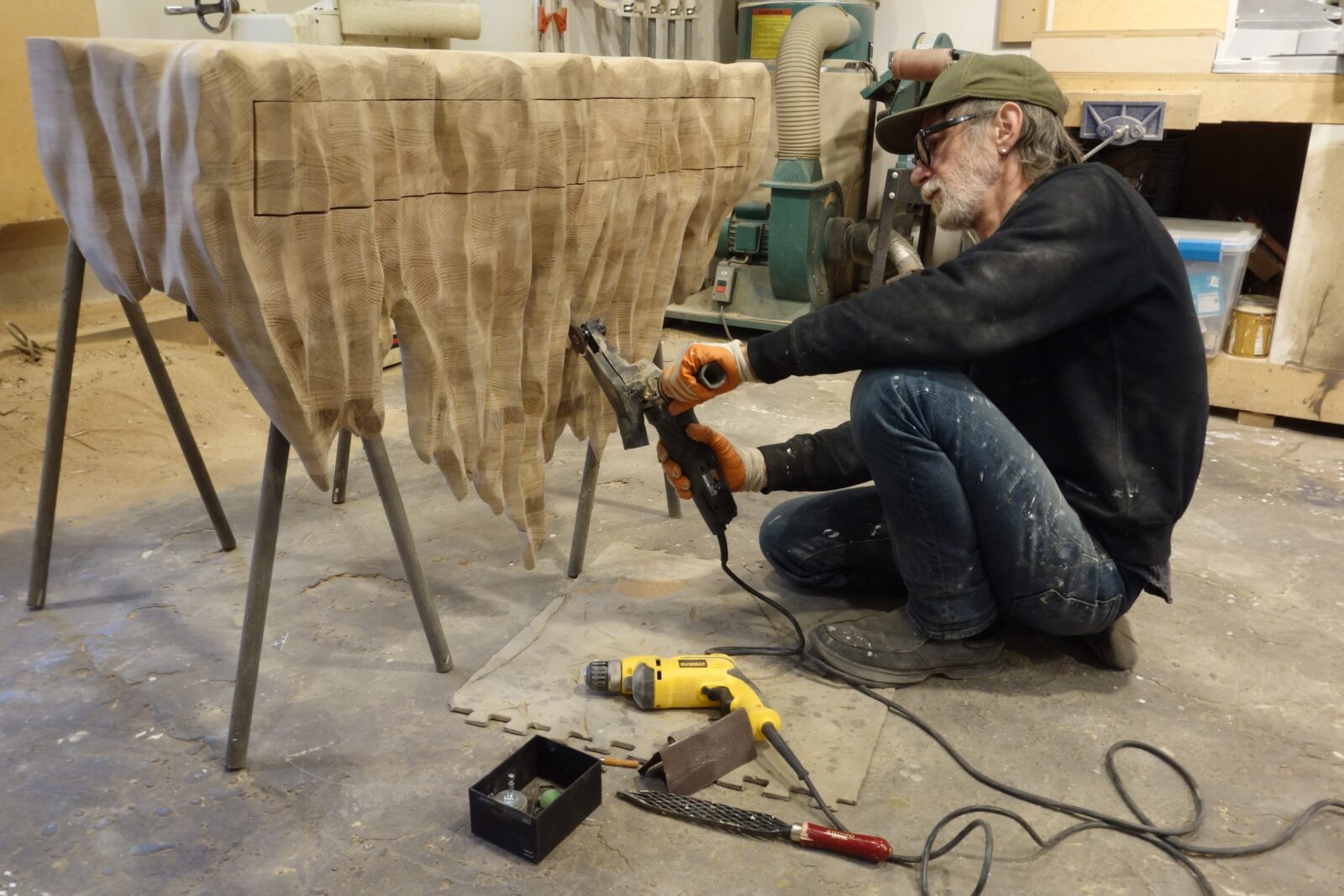
Technology at piedrafuego supports the artisan rather than replacing them. The studio uses CNC-cut guides for precision when carving stone or welding steel, developed a basalt sealing paste for a monolithic sink, and relies on 3D rendering for prototypes. More often, though, it sets a handmade object beside a machined one, “as their sole juxtaposition evidences the virtues of both.” In 2015, the studio even asked Yolanda, a Wixárika artisan from Nayarit, to bead a random color gradient onto turned wood; used to working in patterns, “she organized randomness.”
Basalt, cantera and clay
Three materials define much of the studio’s work. Basalt, a dense volcanic stone, is hand-carved in San Lucas Evangelista, south of Guadalajara, the same stone long used for molcajete mortars. Cantera, a soft volcanic stone used across Mexican architecture, is carved by family workshops. Clay brings the same motifs into everyday planters. Throughout, Álvarez-Tostado pursues values he traces to Mesoamerica: “abstraction, monumentality, and respect for the material.” For more on the country’s design scene, see ADORNO’s guide to Mexican design and its interview with Ayres MX.
6 piedrafuego pieces to collect
From the studio’s first stone containers to its best-selling planters, these pieces are available on ADORNO now. See the full collection on the piedrafuego studio page.
“san Lucas” Container Set by piedrafuego

The piece that started it all in 2013. Inspired by the molcajete mortar, the containers are hand-carved in volcanic stone in San Lucas Evangelista, while their zapotillo hardwood lids are CNC-cut near Guadalajara, so the precise lid shows off the naturally irregular stone.
By piedrafuego
€233 incl. tax
Lava Stone Bookends Set by piedrafuego

Hand-carved in basalt, the bookends take the form of a staircase, recalling the stepped talud-tablero pyramids of Mesoamerica and the sculptural stairs of Luis Barragán. They are the studio’s most collected stone piece.
By piedrafuego
€63 incl. tax
Tzom – Solid Stone Planter by piedrafuego

Carved in cantera stone by the Íñiguez family, a workshop better known for Catholic imagery, Tzom is covered in rows of small skulls inspired by Mesoamerican tzompantli walls. The project brought two traditions together, and, as Álvarez-Tostado recalls, “It was never a problem.”
By piedrafuego
€311 incl. tax
Pantli: Ceramic Planters by piedrafuego

Pantli brings the skull motif of Tzom into terracotta, so the same ancient pattern becomes an everyday ceramic planter. With 30 sales, it is piedrafuego’s best-selling piece on ADORNO.
By piedrafuego
€60 – €97 incl. tax
“Potro” Stool by piedrafuego

Carved from solid wood, Potro is a metaphor for the anatomy of a horse, with a clear debt to Constantin Brancusi. It works as a seat, a side table or a small sculpture by the door.
By piedrafuego
€270 incl. tax
Archipiélago Black Side Table in Powder-Coated Steel by piedrafuego

Inspired by the unexpected outlines of islands, Archipiélago is a set of three nesting tables in powder-coated steel, made in Guadalajara. It shows the studio’s industrial side, where precise metalwork meets organic form.
By piedrafuego
€540 incl. tax
How to style Mexican stone and clay at home
Volcanic stone and terracotta bring weight and warmth, so let them sit against calm backgrounds: white walls, pale wood, linen. Group small pieces in odd numbers on a shelf or windowsill, such as stone bookends with a row of ceramic planters, so the textures speak to each other. In the kitchen, a basalt container for salt or spices nods to the molcajete it came from. Finally, mix in one industrial piece, like a steel nesting table, to show the same dialogue between hand and machine that runs through piedrafuego’s work.
Mexican identities, in the plural
Álvarez-Tostado is careful to speak of Mexican identities rather than one identity. “Mexico, as a Latin American country, is not homogenous,” he notes, and the landscape remains one of his main sources. He has also pointed to stories outside audiences rarely hear, such as the cultural exchange with Asia through the Manila galleon trade. “Mexico is above all, a formalist society,” he says. “The way things are expressed is as important as the content.”
Frequently asked questions
What is piedrafuego?
A Mexican design studio founded in 2013 by Aldo Álvarez-Tostado that works with artisans in stone, clay, wood and steel. It took the name piedrafuego, “fire stone,” in 2016.
What is basalt stone?
A dense, dark volcanic stone. In Mexico it is traditionally carved into molcajete mortars and, today, into containers, bookends and sinks.
What is cantera stone?
A soft volcanic stone quarried in Mexico and widely used for carved architectural details, fountains and, increasingly, design objects.
How do I care for a stone or ceramic planter?
Use a saucer or liner to protect furniture, empty standing water, and wipe the surface with a damp cloth. Bring stone planters indoors before frost.
Are piedrafuego pieces handmade?
Yes. Stone and clay pieces are carved or shaped by artisan workshops in Mexico, sometimes combined with machine-cut parts for precision.
Keeping craft alive
Piedrafuego’s work shows that Mexican crafts stay alive not by being preserved behind glass but by being used, changed and passed on. Every carved bookend or skull-patterned planter is one more link in that chain.






Responses