A breath of air, a gather of molten glass, and a technique that has barely changed in two thousand years.
In the late 19th century, an American designer fascinated by the science of light set out to reinvent an ancient craft. Louis Comfort Tiffany introduced Favrile glass, layering glass of different colors and densities to create iridescent, textured surfaces, and in doing so gave new life to glass blowing, an art that had changed remarkably little since the Middle Ages.
Today, independent studios carry the same curious spirit forward. This guide explains what glass blowing is, the main techniques, how the craft evolved from ancient Syria to the studio glass movement, and eight hand blown glass pieces you can bring home now.
What is glass blowing?
Glass blowing, or glassblowing, is the technique of shaping molten glass by inflating it through a hollow pipe. A glassblower heats glass to around 2,100°F (1,150°C), when it becomes soft and honey-like, gathers a glob on the end of a blowpipe, and blows into the pipe to form a bubble. By turning the pipe constantly and working the glass with tools, heat and gravity, the maker shapes the bubble into a vase, a glass or a lamp shade. Finally, the piece cools slowly in an annealing oven so it does not crack.
Contemporary studios push that process in very different directions. Brooklyn-based Sticky Glass plays with the fluid, almost liquid nature of the material, Swedish designer Markus Emilsson explores swirling color and texture much as Tiffany did, and Brazilian designer Carol Gay pulls thorn-like spikes out of the hot surface.


Glass blowing techniques
- Free-blowing: the glassblower shapes the bubble by hand, using only breath, rotation, gravity and tools, so every piece is one of a kind.
- Mold-blowing: the glass is blown into a mold of wood, metal or graphite, which gives repeatable shapes and surface patterns.
- Marvering: the hot glass is rolled on a flat steel table, the marver, to center it and smooth its surface.
- Shaping with jacks and blocks: tweezer-like jacks pinch necks and openings, while wet wooden blocks round the form.
- Color and inclusions: colored glass, powders and metal foils are picked up on the gather, a method Venetian makers used to create aventurine.
- Reheating and annealing: the piece goes back into the glory hole to stay workable, then into the annealer to cool slowly over many hours.
A short history of glass blowing
Ancient origins and the Roman Empire
The earliest glass objects, mostly beads, appeared in Mesopotamia and Egypt around 3500 BCE and were cast or molded rather than blown. Glass blowing itself was invented in the region of today’s Syria, Lebanon and Israel in the 1st century BCE, according to the Metropolitan Museum of Art. The Romans adopted the technique quickly, and for the first time glass vessels became everyday objects across the empire.


From Islamic glass to Venice and Bohemia
After Rome declined, glassmaking flourished in the Byzantine Empire and the Islamic world, where artisans developed enameling and gilding. From the 10th to the 15th centuries, the craft spread across Europe, and Venice became its center. On the island of Murano, glassmakers developed cristallo, a glass prized for its clarity, and aventurine, with its sparkling metallic inclusions. Read more in ADORNO’s guide to Murano glass. By the Renaissance, Bohemia had also become a major glass center.


Industry, Tiffany and the studio glass movement
The Industrial Revolution brought machines that pressed and later blew glass automatically, making bottles and windows cheap and abundant. Hand glass blowing survived as an art. Tiffany’s Favrile glass, documented by the Morse Museum, showed how far color and texture could go.


In the 1960s, the American artist Harvey Littleton helped launch the studio glass movement, showing that a single artist could melt and blow glass in a small studio furnace rather than a factory. That shift put the material directly into the hands of designers, and it is the reason so many independent glass studios exist today. For more contemporary examples, see ADORNO’s selections of blown glass designs and colored glass decor.
8 hand blown glass pieces to collect
These designs are all available on ADORNO and each comes from a different studio. They range from a €168 jelly-mold cloche to a mouth-blown ceiling light, and together they show how far today’s glassblowers take the craft.
Mush Brown, Glass Vase by Juliana Maurer
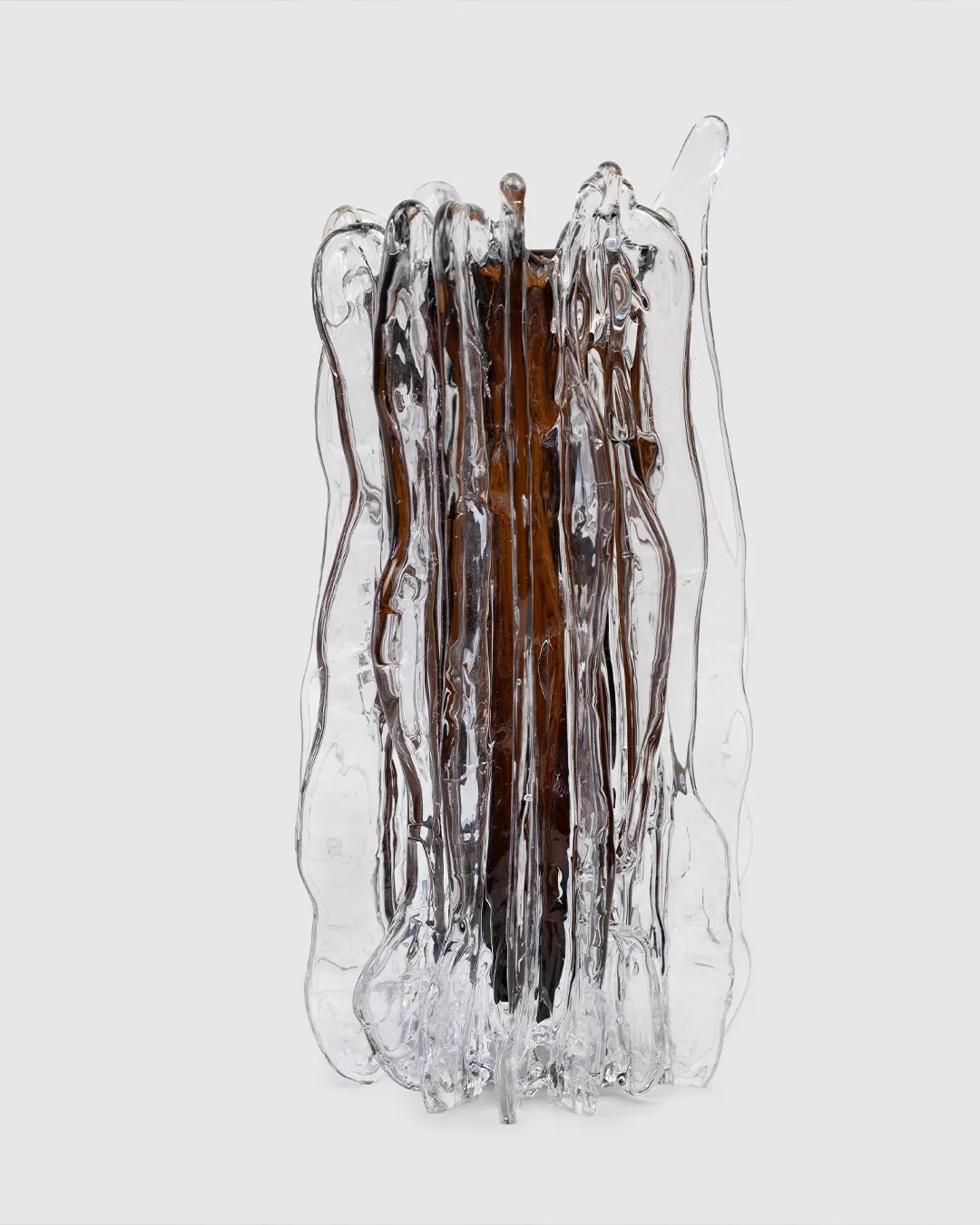
Juliana Maurer shapes every lamella of this vase individually from molten glass in her German studio, then fuses them around a brown core so the piece looks like a cluster of melting icicles. Because each strip is formed by hand, no two vases are alike. It is one of the most-ordered blown glass vases on ADORNO this season.
By Juliana Maurer
€832 incl. tax
Hand-blown Wine Glass by Szkło Studio

Polish studio Szkło blows its glass into forms shaped with stones, wood and ceramics, so every wine glass comes out with an unpredictable, organic bowl. At an average height of 23 cm (9 in), it is made for everyday use, though hand washing is recommended. It is one of the most carted pieces of glassware on ADORNO.
By Szkło Studio
€220 incl. tax
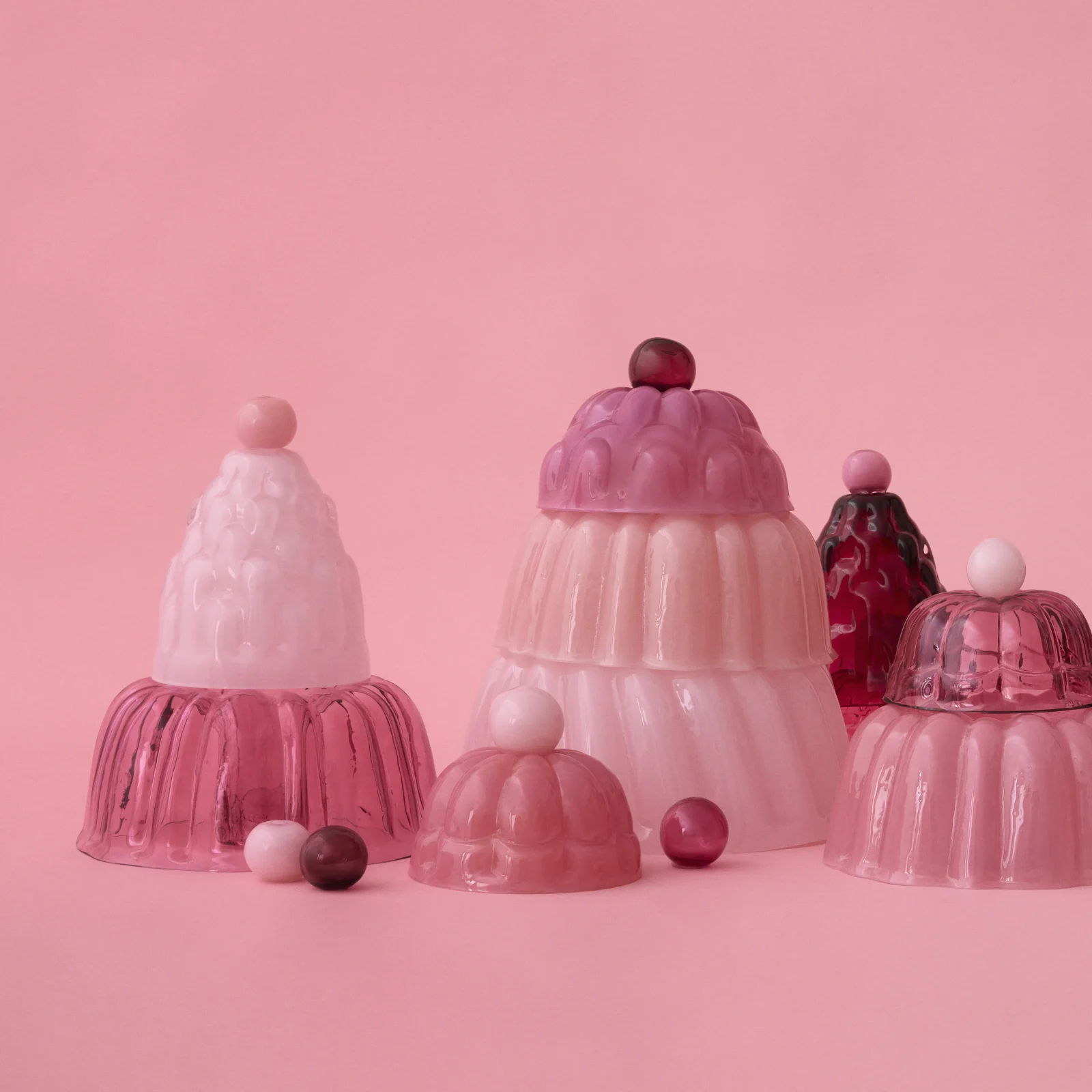
Jello – Small Glass Cloche by STUDIO BERG

STUDIO BERG blows each Jello cloche into 100-year-old cast iron and copper dessert molds, giving the glass the ribbed curves of a wobbly jelly. Use it to cover sweets or small treasures, or simply as a sculpture on a shelf. Available in five forms and five shades of pink, it is also one of the most checked-out glass pieces on ADORNO.
By STUDIO BERG
€168 incl. tax
Persona Mirror Sculpture – Multicolour Small by MILA ZILA
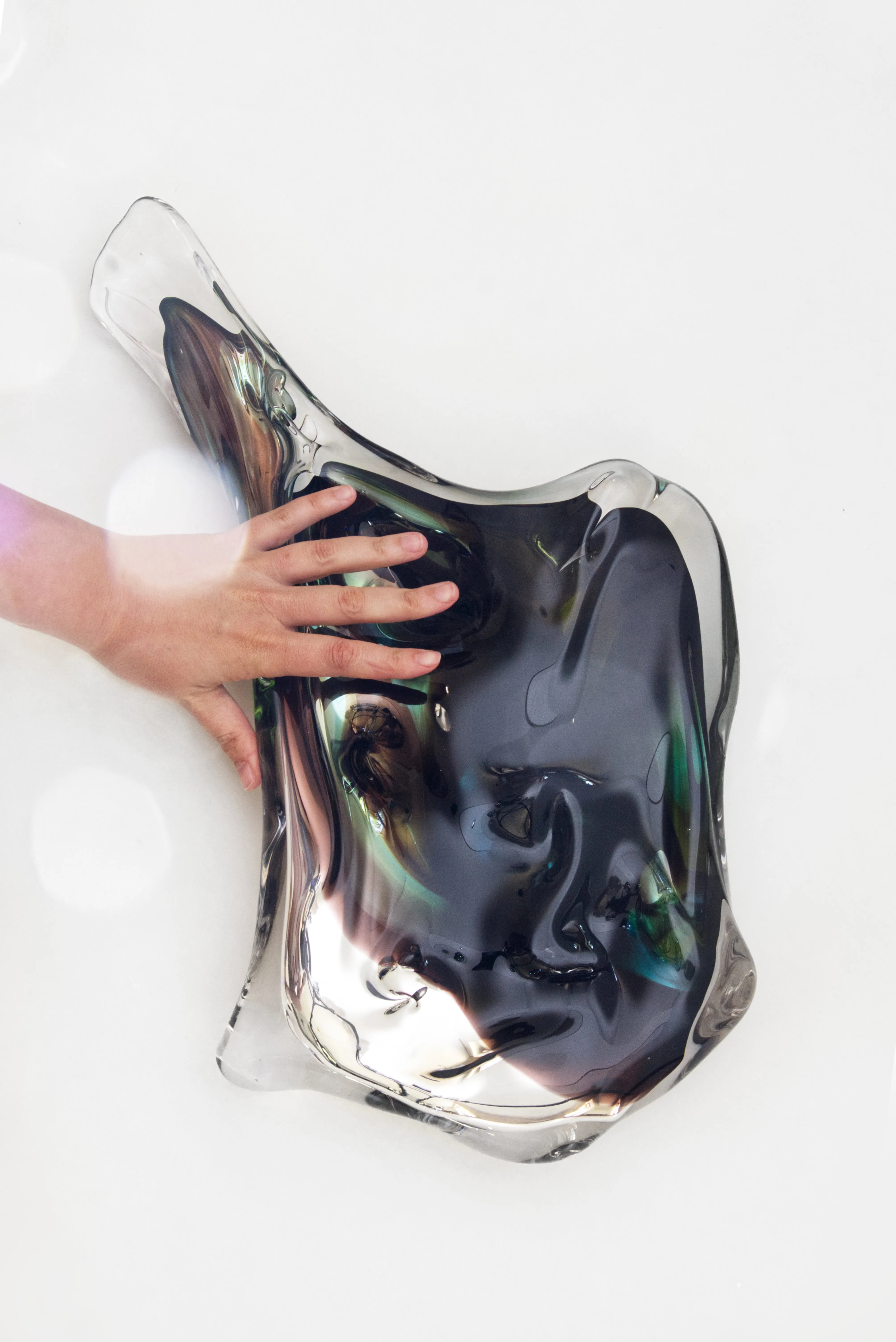
Czech studio MILA ZILA lets hot glass find its own shape through free-form gathering and spinning, then mirrors it, so each wall piece is a one-off record of movement. The result is somewhere between a mirror and a sculpture, and it has already found a buyer on ADORNO.
By MILA ZILA
€1.800 incl. tax
Théros 0.2 Table Lamp in Blown Glass and Marble by Studio Aristotelis Barakos

The smallest lamp in Studio Aristotelis Barakos’s Théros family balances an opaque blown glass globe on a sphere of white Volakas marble from Drama, Greece. At 32 cm (12.6 in) high, it gives a soft, warm glow, and its Mediterranean materials make every lamp slightly different.
By Studio Aristotelis Barakos
€950 incl. tax
Haumea Convex Ceiling Lamp (Flieder Opaque) in Blown Glass by ELOA – Unique Lights

ELOA mouth-blows each Haumea lamp in five sizes, from 19 × 26 cm (7.5 × 10.2 in) to 37 × 55 cm (14.6 × 21.7 in). Mounted close to the ceiling, it spreads a smooth circular gradient of light, which makes it a good choice for rooms with low ceilings. Colors and metal finishes can be customized.
By ELOA – Unique Lights
€2.330 – €4.085 incl. tax
Asea No. 25 Wall Sconce in Blown Glass and Stoneware by Ceren Gürkan

Ceren Gürkan’s Asea collection is an ode to the shifting light of the ocean. Two textured hand-blown glass globes sit in a wavy stoneware plate, so the light ripples across the surface like water. With 13 sales, it is one of the best-selling blown glass lights on ADORNO.
By Ceren Gürkan
€1.100 incl. tax
Chastity Wall Sconce in Stainless Steel and Blown Glass by Studio S II

Studio S II places rippled, custom-molded blown glass beneath a cage of stainless steel, setting the soft, sinuous glass against a rigid grid. Lit, the amber glow brings out both layers. Hardwired and plug-in versions are available.
By Studio S II
€1.946 incl. tax
How to care for hand blown glass
Wash hand blown glass by hand in lukewarm water with a mild detergent, and dry it with a lint-free cloth. Avoid the dishwasher, sudden temperature changes and abrasive sponges, which can cloud or crack the surface. Small bubbles, slight asymmetry and tool marks are signs of handwork, not defects. For lighting, dust the glass when the lamp is cool and use the bulb type the studio recommends.
Frequently asked questions about glass blowing
How hot is glass when it is blown?
Glass is usually worked at around 1,900–2,100°F (1,040–1,150°C), and furnaces run even hotter to keep the glass molten.
Where was glass blowing invented?
In the eastern Mediterranean, in the area of today’s Syria, Lebanon and Israel, in the 1st century BCE.
What is the difference between hand blown and mouth blown glass?
The terms mean the same thing: the glass is inflated by a person blowing through a pipe rather than by a machine.
How can you tell if glass is hand blown?
Look for small air bubbles, slight variations in thickness, and a pontil mark on the base where the piece was attached to an iron rod.
A craft in constant transformation
Just as glass changes form in the heat of the furnace, glass blowing keeps reinventing itself, from Roman cups and Venetian chalices to free-formed mirrors and jelly-mold cloches. Each piece carries the breath and timing of the person who made it.