A century after the school closed, the Bauhaus chair is still the shorthand for furniture that does exactly what it needs to and nothing more.
Updated on: November 12, 2026
Few design schools have shaped how we sit as much as the Bauhaus. Its chairs reduced seating to frame, seat and back, used industrial materials openly, and made geometry the decoration. Today independent studios still work with those ideas, sometimes literally in bent steel tube, sometimes only in spirit.
Here is what makes a chair Bauhaus, where the idea came from, seven Bauhaus chairs, stools and benches from independent studios, and how to choose one for your home.
What Makes a Bauhaus Chair?
A Bauhaus chair follows a few clear principles:
- Form follows function: every part has a job, and nothing is there only to decorate.
- Industrial materials, shown honestly: steel tube, sheet metal, plywood and leather, with joints and frames left visible.
- Basic geometry: circles, squares and straight lines rather than carved or ornamental shapes.
- Lightness: open frames that let you see through the chair, so it takes up little visual space.
- Made to be produced: designs meant for workshops and factories, not for one wealthy client.
As a result, a Bauhaus-style chair can be almost any material or color, as long as its construction is clear and its form is simple. For the wider movement, read our guide to the timeless legacy of Bauhaus design.
A Short History of the Bauhaus Chair
Walter Gropius founded the Bauhaus in Weimar in 1919 to bring art, craft and industry together. The school moved to Dessau in 1925 and closed in 1933 under pressure from the Nazi regime, but in those 14 years its workshops changed furniture design.
The breakthrough was tubular steel. In 1925, Marcel Breuer, then head of the Bauhaus furniture workshop, began bending steel tube into a club chair, later known as the Wassily chair after the painter Wassily Kandinsky. Soon after, Mart Stam and Ludwig Mies van der Rohe developed cantilevered chairs that rest on a single bent frame with no back legs. Furthermore, these chairs were light, strong and suited to production, the qualities the school had been looking for.
The legacy has never left the furniture world. Wallpaper*’s review of the Vitra Design Museum’s Bauhaus exhibition shows how widely those ideas still travel. Contemporary designers rarely copy the originals; instead, they take the method, a clear structure in an honest material, and apply it to new forms.
7 Bauhaus Chairs, Stools and Benches from Independent Studios
Each of these pieces takes a Bauhaus idea, the bent tube, the pure circle, the repeated module or the primary color, and makes it new. Browse more on our Bauhaus style page.
BO Armchair by Giácomo Tomazzi Studio

A low leather sling stretched over a 90 cm (35.4 in) metal circle. It nods to Lina Bo Bardi and the modernist architecture of São Paulo, but the logic is pure Bauhaus: a few geometric parts, nothing added for decoration.
By Giácomo Tomazzi Studio
€2,300 incl. tax
Prowling Lounge Chair by FURN OBJECT

Curved steel tubes enclose the seat, and the parts are joined so they barely seem to touch. Made by hand by artisans in Odesa, Ukraine, and upholstered in velvet, faux fur or bouclé.
By FURN OBJECT
€2,250 incl. tax
Slide Stool / Chair by Ziroru Studio

Inspired by single-line drawings and Bauhaus principles, this stainless steel frame takes two layers of merino wool felt that lock through it with no glue or sewing. Remove the sliding backrest and the chair becomes a stool.
By Ziroru Studio
€1,360 incl. tax
Bauhaus Low Stool by Vintola Studio
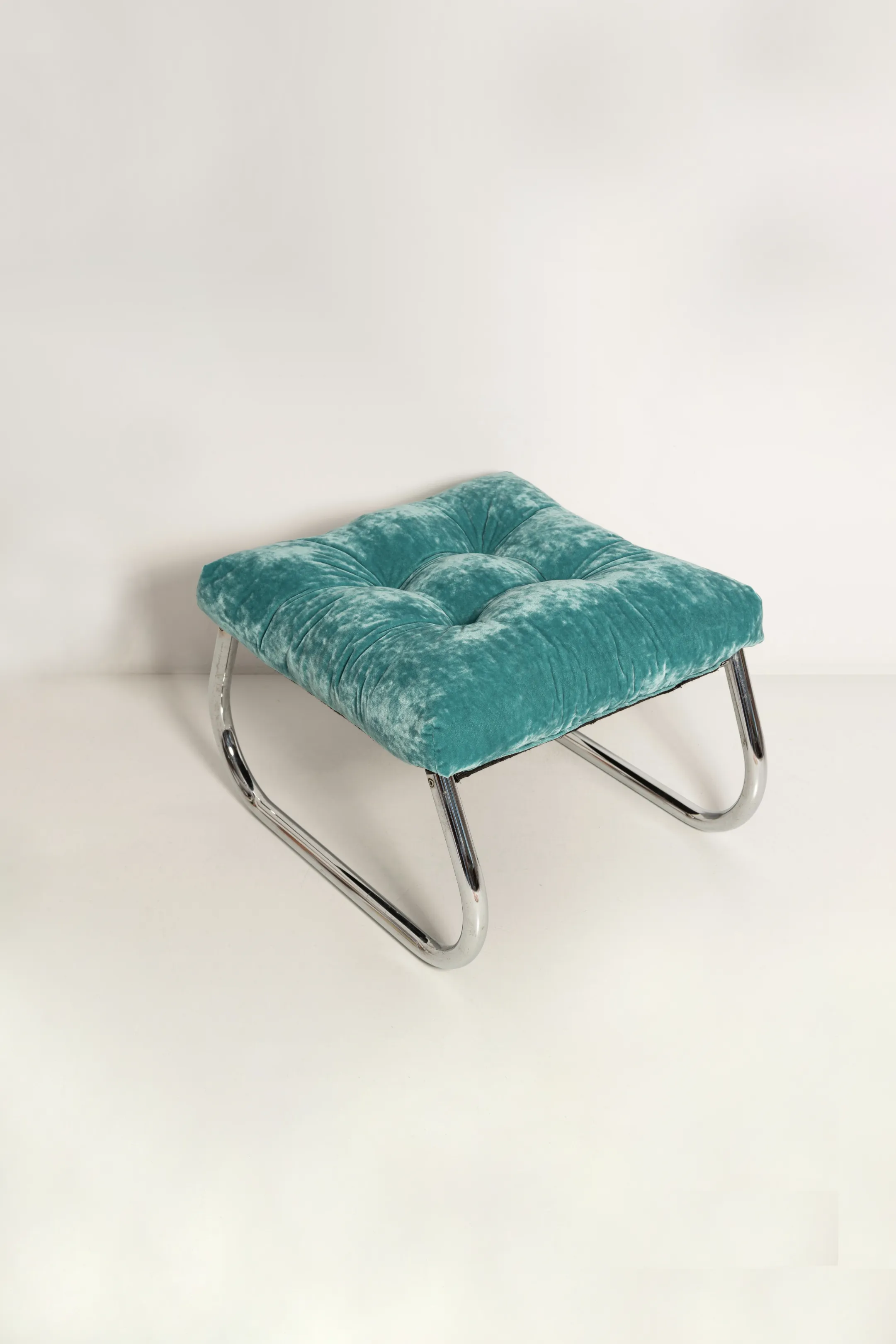
A vintage modernist footstool on a chrome tubular frame, fully restored and reupholstered in watered velvet. The closest piece here to the original 1920s tubular steel furniture.
By Vintola Studio
€1,200 incl. tax
OVNI Stool by Cultivado em Casa

OVNI, Portuguese for UFO, lands as a stool in stacked discs and bent tube with ball feet. Its strong geometry and bold color recall the Bauhaus color studies, and it comes in green, purple, yellow or tricolor.
By Cultivado em Casa
€745 incl. tax
Matrix Bench by OS ∆ OOS

Built from individual ribs that form a grid, Matrix began as a system for endless configurations, from furniture to architecture. Seen from the front it is transparent; as the grid curves, the transparency fades into a gradient of light.
By OS ∆ OOS
€6,800 incl. tax
Uniform Bench by Flensted Mouritzen

Troels Flensted and Ragna Mouritzen built this bench from a single repeated element for the 2018 Cabinetmakers’ Autumn Exhibition in Copenhagen. One color, one form, and ribs that throw light and shadow across it.
By Flensted Mouritzen
€6,000 incl. tax
How to Choose a Bauhaus Chair
Start with the frame. The structure is the design, so look at how the legs, seat and back are joined. A clear, visible construction is the best sign of a true Bauhaus approach.
Check the size. Lounge chairs with low seats, like the BO Armchair, need more floor space than their light frames suggest. Allow about 90 cm (35 in) of depth for a lounge chair, and around 45 cm (18 in) of seat height for a dining chair.
Mix, don’t match. One Bauhaus chair works well beside a wooden table or a soft sofa, because the contrast shows off its lines. A whole room of tubular steel can feel cold.
Think about color. The Bauhaus used primary colors with black, white and gray. A single bold piece, such as a colored stool, adds energy without overwhelming a room.
Look at the materials up close. Steel and chrome can be wiped clean; leather and felt soften with use. Restored vintage pieces may show small marks of age, which are part of their history.
Frequently Asked Questions
What is a Bauhaus chair?
A chair designed by, or in the spirit of, the Bauhaus school (1919–1933). It is defined by simple geometry, visible construction and industrial materials such as tubular steel and leather.
What is the most famous Bauhaus chair?
Marcel Breuer’s tubular steel club chair from 1925, known as the Wassily chair. The cantilever chairs of Mart Stam and Mies van der Rohe are close behind.
Is Bauhaus furniture still made today?
Yes. Many classic designs are still in production, and independent studios continue to make new pieces based on Bauhaus principles, from bent steel stools to modular benches.
What materials are used in Bauhaus chairs?
Mainly tubular steel, often chrome-plated, combined with leather, canvas or wood. Contemporary studios also use aluminum, felt, plywood and powder-coated steel.