 Athari Table Lamp in Ceramic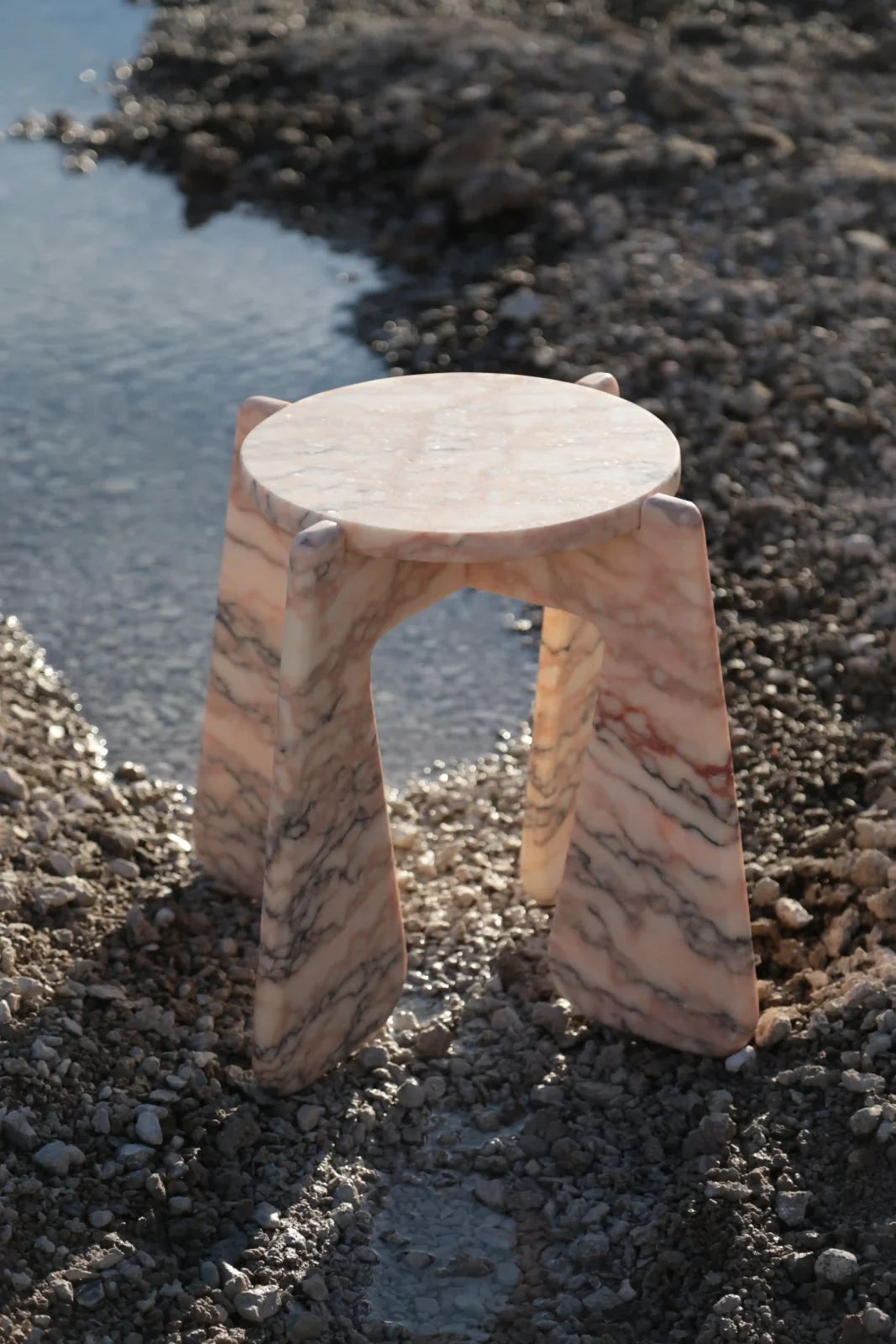
Marble Side Tables: 9 Sculptural Pieces Set in Stone
Stone takes millions of years to form. A good side table lets you feel every one of them.
Marble has furnished rooms since Roman villas, and it has barely lost its appeal since: cool to the touch, heavy in the hand, and veined in patterns no two blocks repeat. Even a small table carved from it reads as an object rather than an accessory.
What has changed is who does the carving. These nine marble side tables come from independent studios in Mexico, Europe and Turkey, most shaped from solid block. Consequently, they read as sculpture first — honed, colored, and often hollowed or pierced.
How to choose a marble side table
Start with height. A side table should sit within a few inches of the sofa arm, typically 20–26 inches (50–65 cm); beside a bed, match the mattress instead, or look at nightstands with storage. Moreover, a top of 14–18 inches (35–45 cm) holds a lamp and a cup, and next to a coffee table the side table should sit slightly lower.
Then weigh finish and base. Solid marble is heavy and stable but hard to move, and a honed surface forgives far more than a polished one. Finally, the base sets the tone: an all-stone monolith feels grounded, while wood or metal lightens it. Browse marble tables by base type, and pair yours with a stone-based table lamp.
Colors and construction
Geologically, marble is limestone recrystallized by heat and pressure, which is why it takes a polish, why it veins, and why acids mark it. Beyond that shared chemistry, each stone behaves differently once it is in a room.
White and gray marbles
Carrara, White Veneciano and the soft gray Masahua marble quarried in Mexico are the quiet end of the spectrum. Their fine veining sits back, so the form of the table does the talking. As a result, they suit pierced, split or carved silhouettes, where a louder stone would fight the geometry.
Colored marbles
Calacatta Viola carries wine-colored veins through a cream ground, Verde Lepanto reads like moss or deep water, Emperador Dark is a warm chocolate brown, Sky Blue is pale and cloud-like, and Rosso Francia glows a warm brick red. By contrast with white stone, a colored marble becomes the room’s accent. Therefore, it rewards simpler forms and plainer surroundings.
Onyx
Onyx is a banded calcite that lets light pass through its thinner edges, giving it a glow no opaque stone can match. Notably, it is softer and more porous than most marbles, so it needs regular sealing. In return, it shifts in tone throughout the day as daylight moves across it.
Travertine and stone alternatives
Travertine is technically a limestone, but it is sold and styled alongside marble. Its open pores give a warmer, more textured surface; filled and honed, it becomes smoother and easier to live with. Several studios here offer their designs in travertine as well, which is worth asking about for a lower-contrast finish.
Honed versus polished finishes
A polished finish mirrors light and deepens the color of the veining, but it shows every ring and etch mark. A honed finish is ground to a satin matte that feels soft under the hand and forgives daily use. Accordingly, most of the carved pieces below are honed, letting the mass of the block come through instead of its shine.
Solid block, slab tops and mixed bases
Monolithic tables are carved from a single block, which makes them heavy, stable and unmistakably functional art. Slab-top designs, by contrast, set a thinner plane of stone on oak or metal, keeping the weight manageable. Meanwhile, ask whether the top is solid or laminated: solid stone can be re-honed for decades, while thin veneer cannot.
9 marble side tables to collect
Match! Studio Edition 001 Side Table by please touch studio
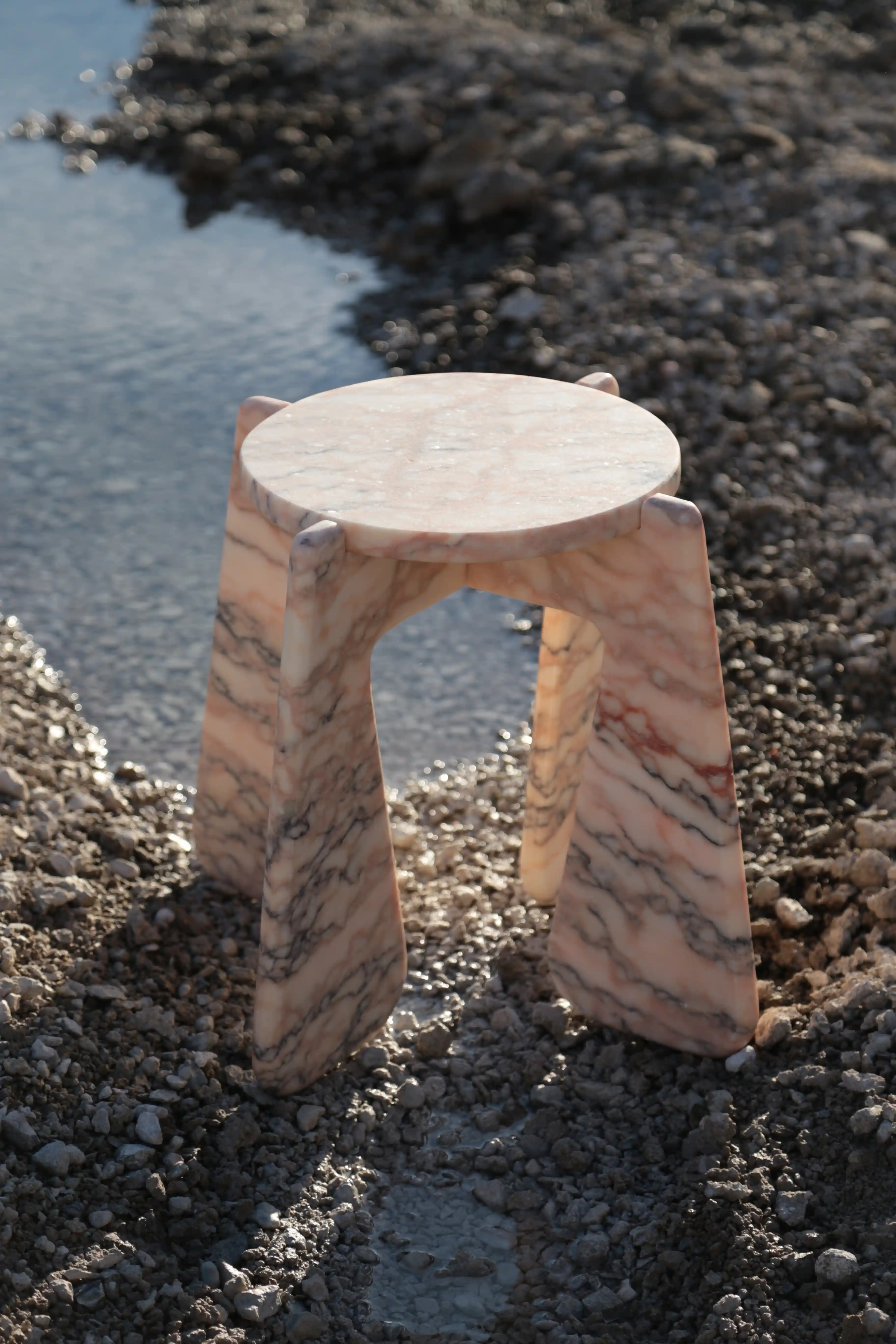
Made entirely from marble, cut, polished and hand-finished in a limited edition. Its rounded, almost playful forms push against the raw character of the stone, so light slides across the curves and turns the table into something closer to a sculpture on a plinth. The most-viewed marble piece on ADORNO this season, and the one that argues most clearly for stone as a minimalist material with a sense of humor.
By please touch studio
€1.900 incl. tax
Bolero – Marble Side Table by Alter Ego Studio
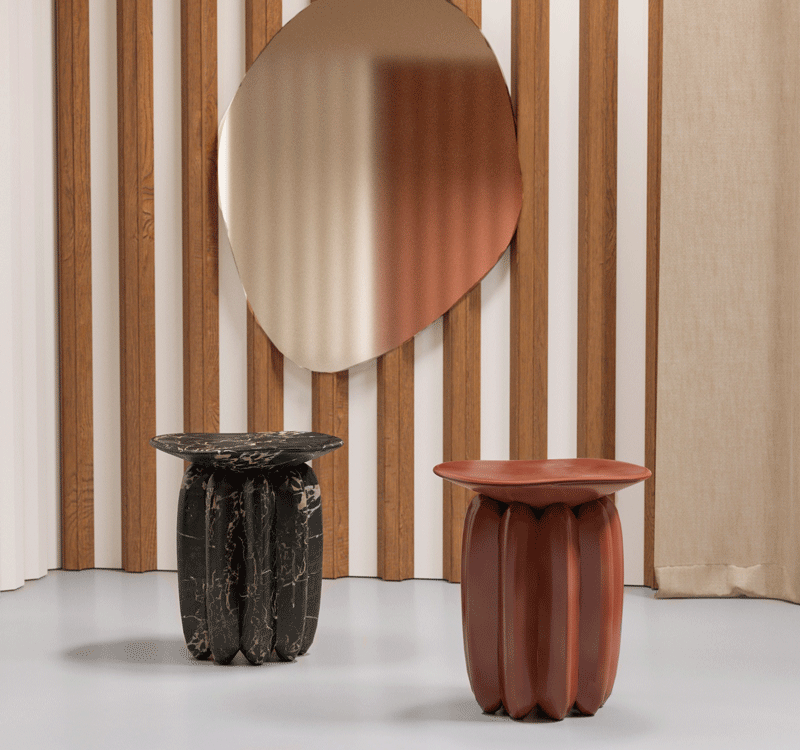
Cut from solid marble, with all the drama placed below the top: the legs twist into an asymmetrical, sculptural form with an almost totemic, ethnic character. Above them, the tabletop is kept to a plain, weighty volume, so the eye travels down the piece rather than across it. Offered in black-and-gold or gray stone in two sizes, and one of the most-collected marble pieces on ADORNO — a radical table that still behaves like a classic.
By Alter Ego Studio
€7.260 incl. tax
Departed Rosso Francia Marble Side Table by Studio TOOJ
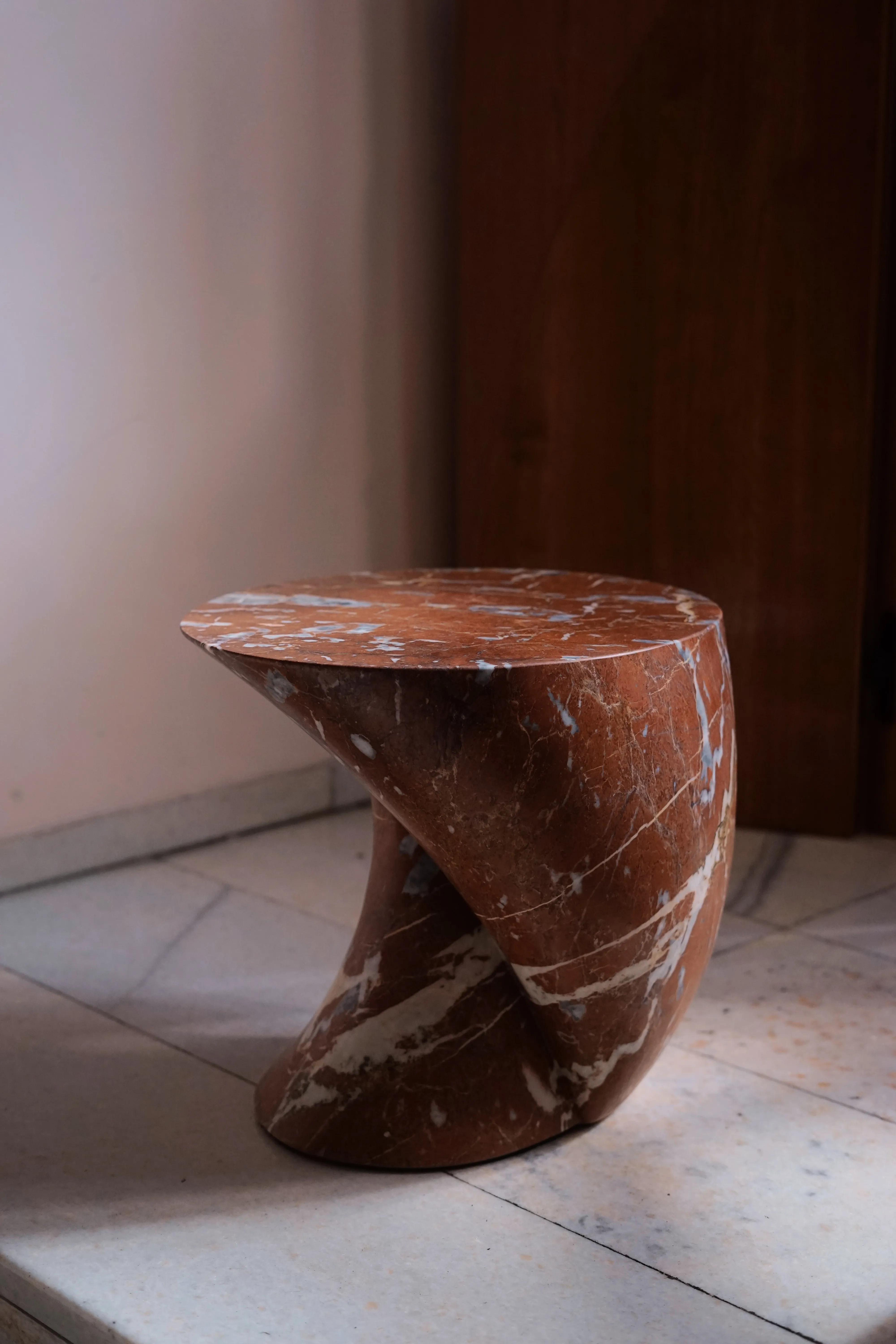
Designed by Johan Wilén and hand-finished by artisans in Italy, in warm red Rosso Francia marble with a soft-honed surface. The lines are simple and the proportions generous, and all of its 110 kilograms go into letting the stone speak. Furthermore, it can be made in other stones and dimensions — the most restrained piece here, and one of the few ready to ship.
By Studio TOOJ
€9.600 incl. tax
Kado – Side Table by Drusch Design

Carved in Mexico from solid Masahua marble, a native stone with a soft gray tone and fine white veining, honed to a matte finish. Two surfaces of different lengths merge through rounded junctions, leaving a void at the center that makes a heavy block feel almost weightless. A quietly brutalist piece, made to order in a long list of Mexican marbles, travertines and volcanic stone.
By Drusch Design
€2.656 incl. tax
Matera Side Table In Marble Verde Lepanto by MERCOEUR EDITION
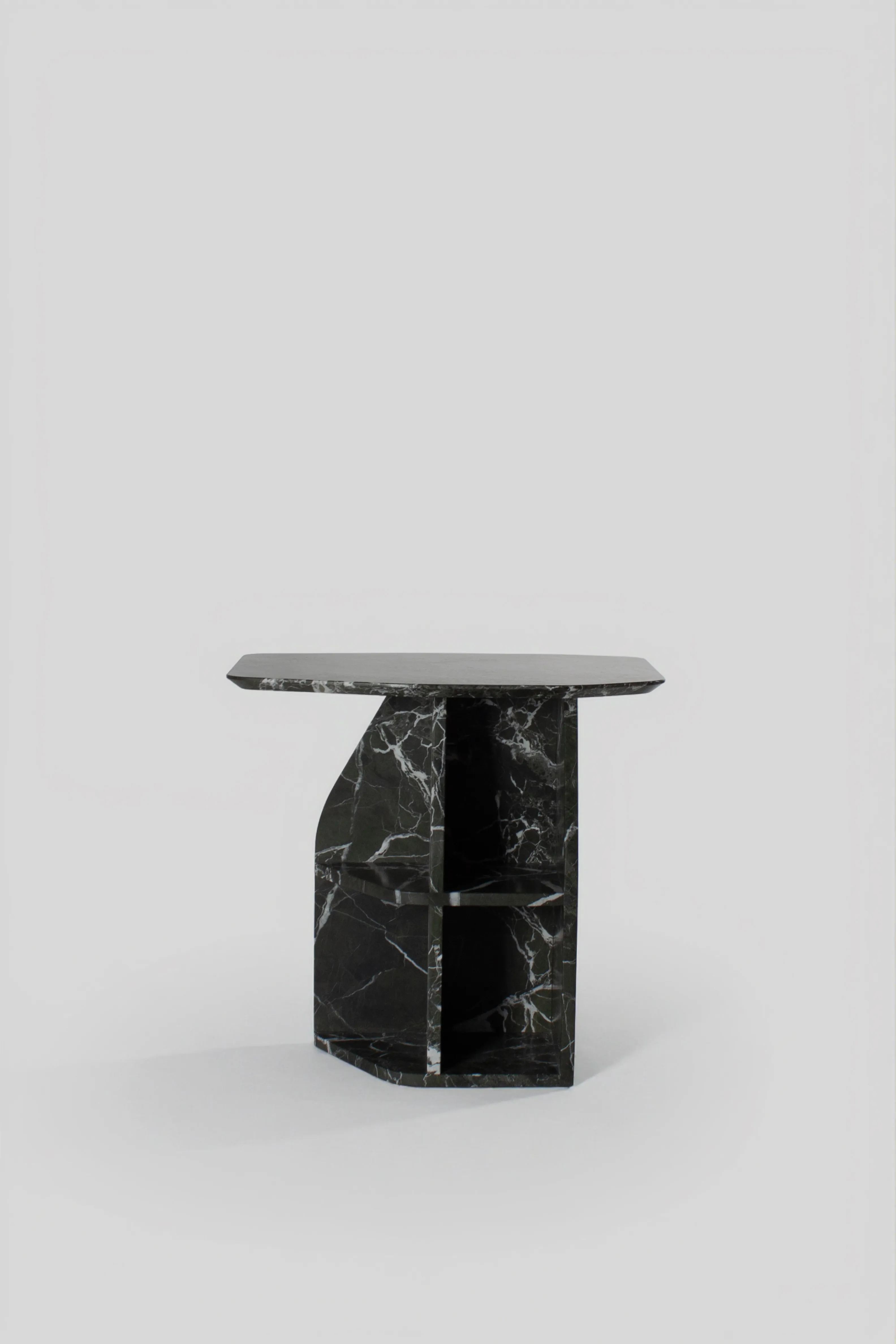
Designed by Sébastien Kiefer and carved from green Verde Lepanto marble, shaped by subtraction rather than assembly. Its hollowed volume recalls the rock-cut dwellings of the Sassi di Matera, so the void carries as much of the design as the stone does. New to French studio Mercoeur’s collection this summer, with other marbles and wood available on request.
By MERCOEUR EDITION
€1.813 incl. tax
Round Marble And Oak Side Table – Sherman Series by Lebanto
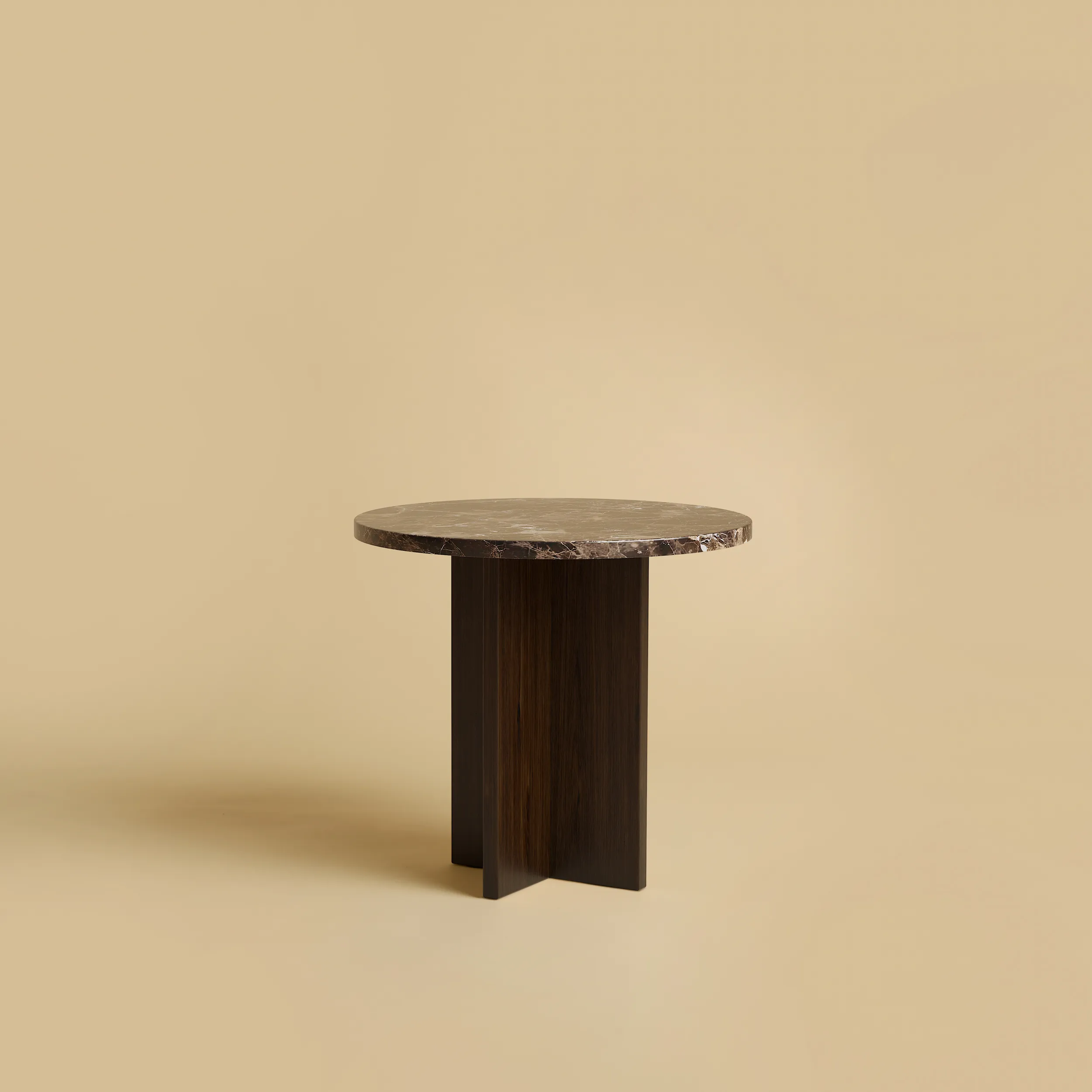
Emperador Dark, a warm brown Spanish marble crossed with cream veining, set on a base of oak smoked to a deep brown. Two solid boards slot through each other in a cross, and that exposed join is the table’s single gesture of craft. Made to order in Cantù, Lombardy’s furniture district, and low enough to sit beside a reading chair in a mid-century modern room without breaking its lines.
By Lebanto
€1.850 incl. tax
Cult Stool – Sculptural Side Table In White Onyx by Panorammma Atelier

Hand-sculpted from a conglomerate of Mexican marble and onyx, stones endemic to the region where the atelier works. The form draws on a primal, architectural language, while the stone’s eccentric banding decides how each edition finally looks. Every piece is one of a kind, and its tone may run from cream to white — a small pedestal of a table that behaves like found geology.
By Panorammma Atelier
€2.500 incl. tax
Element Side Table – Calacatta Viola by Vincent Mazenauer
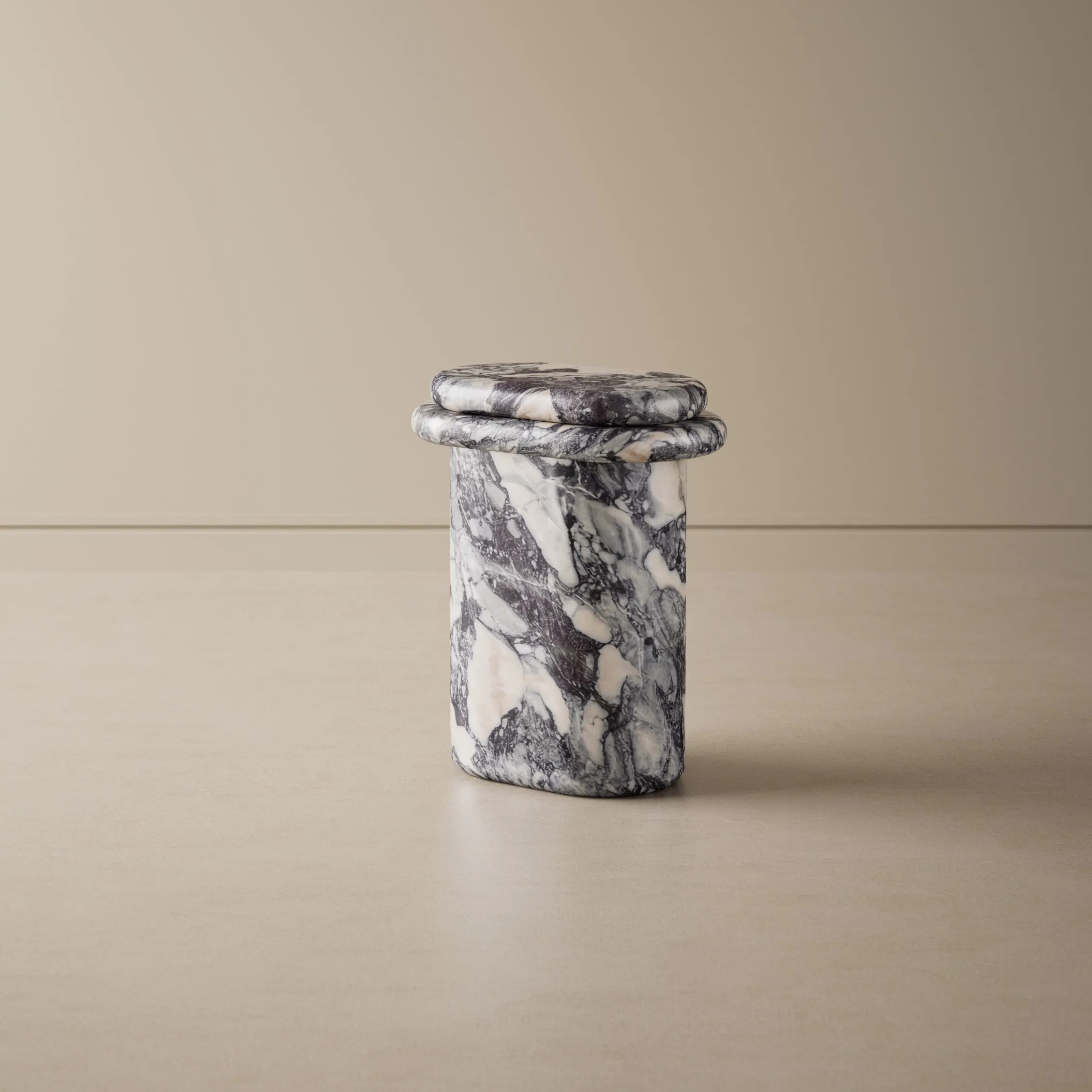
Calacatta Viola, with its wine-colored veining over a cream ground, cut into generous rounded volumes. Soft curves meet a firm structural stance, so the table feels grounded without turning heavy-handed. The boldest stone in this edit, and customizable in other marbles for anyone who wants the form in a quieter voice — a natural fit for a maximalist scheme.
By Vincent Mazenauer
€5.500 incl. tax
Hera Side Table, Sky Blue Marble by Studio Mohs
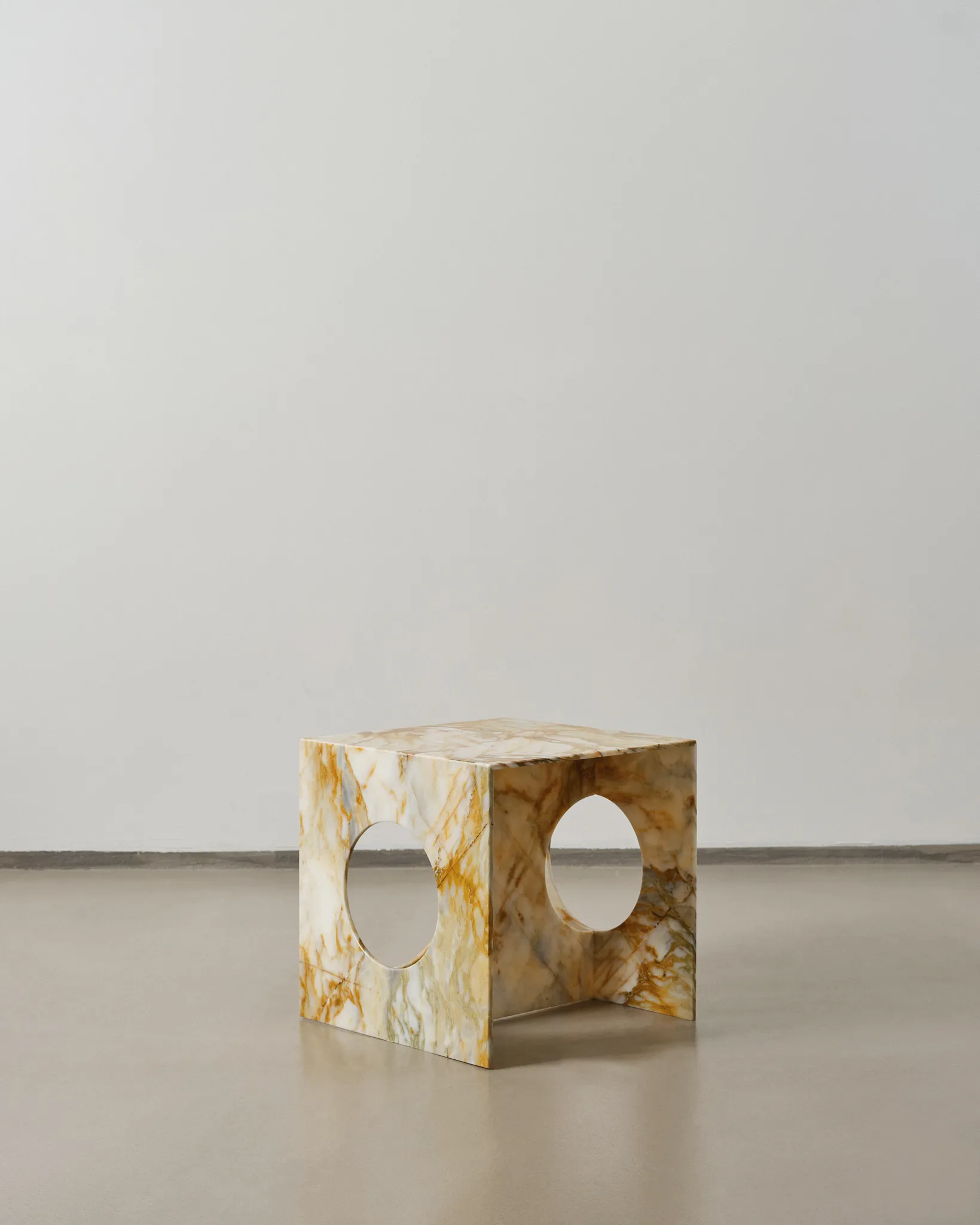
Made entirely of Sky Blue marble at the studio’s marble workshop in Alanya, on Turkey’s southern coast. A cube pierced by circular cutouts, so solid and void trade places as you walk around it and the pale stone feels lighter than its mass. Used alone it is a side table; set in multiples, the modules build a larger coffee table composition — and its soft blue suits a coastal room especially well.
By Studio Mohs
€2.703 incl. tax
Marble side tables room by room
Living room
In a living room, a marble side table works best as the counterweight to soft furniture. Place it where a sofa or a pair of armchairs needs grounding, and let it pick up a color already in the room — green stone against olive upholstery, brown against walnut or leather. Moreover, a sculptural piece can stand apart from the seating, near a window where daylight rakes across the veining. For more schemes, browse by room.
Beside the sofa or a reading chair
As an end table, the piece needs to sit within easy reach and roughly level with the arm of the seat. A drum or cylinder works well here because it has no corners to catch a knee. Similarly, when it sits next to a coffee table, choose a stone that relates to it without matching, so the grouping feels collected over time.
Bedroom
Beside a bed, a marble side table becomes a nightstand, so match its top to the mattress height and leave room for a lamp, a book and a glass of water. Onyx is especially effective here, since a bedside lamp makes its thinner edges glow softly in the evening. On the other hand, if you need storage, look at nightstands that build compartments into the stone itself.
Entryway and hallway
In an entryway, a small marble table gives keys and mail a landing point and sets the tone for the rest of the home. Choose a compact footprint so it doesn’t narrow the passage, and keep the top to a vase or a single object. Alternatively, where a wall runs long, a stone console table or one of the entryway tables carries the same material at a larger scale.
Troubleshooting marble side tables
Leveling and wobble
Solid stone rarely wobbles, but a hand-carved base may not sit perfectly flat on an uneven floor. Rotate the table a few degrees first, since carved pieces often find a stable position on their own. If it still rocks, clear felt or cork pads level it and protect wood or tile at the same time.
Protecting the surface from etching and water rings
Marble is calcite, so wine, citrus, vinegar and many cleaning sprays dissolve its surface and leave dull etch marks. Consequently, the best protection is habit: coasters, prompt wiping and no acidic cleaners. A sealer slows staining but does not stop etching, and a honed finish makes any marks far less visible.
Removing stains and marks from stone
For everyday cleaning, warm water, a drop of pH-neutral soap and a soft cloth are enough. For oil or organic stains, a baking-soda poultice left under plastic wrap for a day draws the stain out of the pores. Deeper etching needs professional re-honing; the Natural Stone Institute is a reliable starting point before calling a restorer.
Sealing marble and onyx
Most honed marble benefits from an impregnating sealer every one to two years, while onyx and open-pored travertine may need it more often. To test, drip a little water on the surface: if the stone darkens within a few minutes, it’s time to reseal. Always ask the studio which product suits their finish, since some sealers shift the stone’s color.
Moving a heavy marble table safely
Never drag a marble table, as thin edges chip and a carved base can crack under uneven stress. Lift from the lowest solid point with two people, or slide a moving blanket underneath and walk it across the floor. Furthermore, if the top separates from the base, remove it first and carry it on edge, never flat.
Frequently asked questions
What is the standard height for a marble side table?
Most side tables stand 20–26 inches (50–65 cm) high. Aim to match the arm of your sofa or chair within a couple of inches; beside a bed, match the mattress top instead.
How do I protect a marble side table?
Use coasters, wipe spills immediately and clean only with pH-neutral soap. Reseal the stone every one to two years, and choose a honed finish if you want wear to show less.
How do I remove water rings from marble?
A dark ring is trapped moisture and fades as it dries, helped by a hair dryer on a low setting. A pale, dull ring is an etch from an acidic drink and needs marble polishing powder or professional re-honing.
Is a solid marble side table better than veneer?
Solid stone is heavier and costlier, but it can be re-honed for decades and shows the full depth of the veining at every edge. Veneer is lighter and cheaper, yet deep chips or scratches cannot be sanded away.
What is the difference between marble, onyx and travertine?
Marble is recrystallized limestone with fine veining, onyx is a banded, partly translucent calcite, and travertine is a porous limestone formed around mineral springs. All three are calcite-based, so they share the same sensitivity to acids.
Can a marble side table be customized?
Often, yes — most studios here offer their designs in other stones or sizes, and several make every piece to order. For something finished, browse pieces ready to ship, or ask our curation service to source a specific stone.
Why marble side tables earn their place
A side table is the smallest piece of furniture most rooms own, and the one most often bought as an afterthought. In marble, it becomes the opposite: a small, dense object that anchors the furniture around it and ages alongside the people who use it. Indeed, stone that waited millions of years in a quarry is in no hurry to go out of fashion.
ADORNO works with independent studios that carve, hone and finish stone themselves, treating the block as the starting point of the design rather than a surface to apply. Browse the full edit below, or widen the search to side tables in every material.
