
Updated on: September 8, 2026
A shelf is the most exposed piece of furniture in a room. There is no upholstery to hide behind and no drawer front to close — the joinery, the span and the grain are all visible, permanently. That makes wooden shelving an unusually honest test of how something was made.
The ten below are from independent studios, in oak, teak, maple, Icelandic birch and cork. Each is priced, and most are made to order, so treat the dimensions as a starting point rather than a fixed spec.
What to look for in a wooden shelf
- Span before style. An unsupported timber shelf sags over time, and the failure point is length rather than load. Around 80cm is the practical limit for a 25mm solid board carrying books; beyond that you need a thicker section, a central support or a metal spine.
- Wall-mounted or floor-standing. Wall-mounted returns floor area and looks lighter, but transfers all the load into your wall — worth checking what that wall is before buying. Floor-standing units carry themselves and can be moved.
- Fixed or modular. Modular systems adapt as your needs change and can usually be extended later. Fixed pieces are stronger for the same material, since a joint that never moves can be glued or wedged rather than bolted.
- How the wood is cut. Solid timber moves with humidity and plywood does not, which is why some of the pieces here use ply edges deliberately rather than hiding them. Neither is better — but a solid oak shelf in a damp room will behave differently in year five than in year one.
10 wooden shelf designs from independent studios
Skógarnytjar – Large Shelf by studio Björn Steinar

Designed around a genuine constraint: Iceland has very little commercial forestry, so the piece had to work with the short, narrow sections the island’s sector actually produces and the machinery available locally. The Scandinavian modern restraint is a consequence of that limitation rather than a stylistic choice — which is the most interesting thing about it.
Mara No. 1 – Oak Wood Shelving Unit by Guillaume Thireau
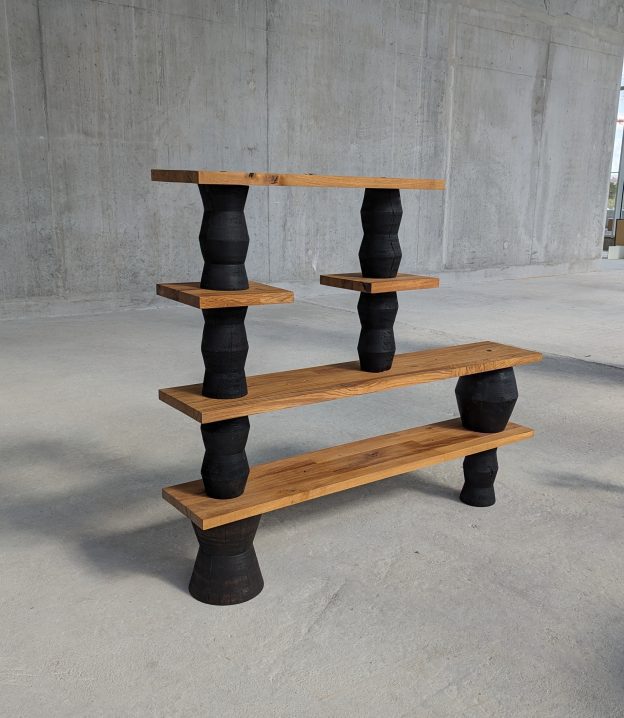
A modular oak system whose sections intertwine into one continuous structure rather than stacking as separate boxes. That matters practically as well as visually — interlocked modules brace each other, so the unit is more rigid than the same timber bolted into a grid. Extendable later, which is the main argument for buying modular at all.
“Stairs” Library System by Architetti Artigiani Anonimi

A revisiting of the anonymous, old-model library shelf — the kind found in institutions rather than homes, where the design was never authored by anyone in particular. The stepped profile gives each level a different depth, which is more useful than uniform shelving for anyone storing objects alongside books.
Crooked Shelf by Nazara Lazaro

From the Crooked Collection, an ongoing series of asymmetric and angular pieces. The angles are doing structural work rather than decorative — a canted upright braces against lateral movement in a way a vertical one cannot, which is how the piece stays rigid without a back panel. Minimalist in palette, not in geometry.
Useful Arbeitsloser (Jobless) by Sanghyeok Lee
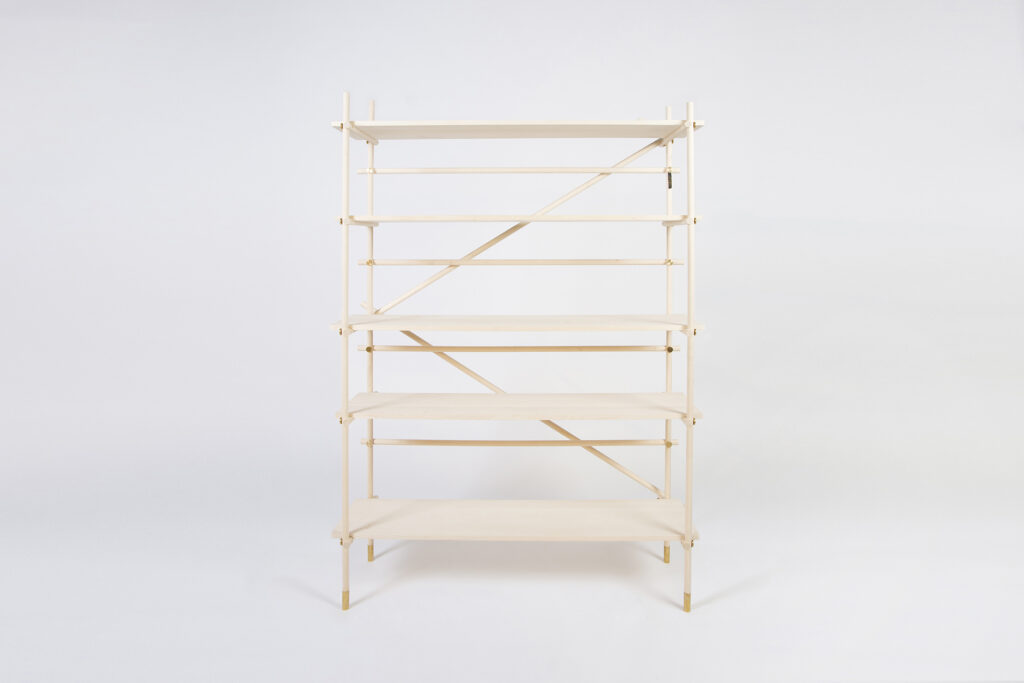
Brass and maple, built around the idea of joblessness — an object that holds a posture of readiness without a task. The material pairing is the practical point: brass takes the structural load in thin sections, which lets the maple read as a surface rather than as a beam.
Shelf No. in Teak by KunSik Choi

A wall-mounted Scandinavian modern shelf in minimal shapes. Teak is the notable choice — it is oily enough to resist moisture without finish, which is why it survives in bathrooms and kitchens where oak would need sealing and would still move.
Doressā by Moneo Brock Studio

Doressā is Japanese for sideboard, and the piece sits between shelving and cabinetry — open storage at a height meant for day-to-day objects rather than display. Closer to mid-century modern proportions than anything else here.
Common Sense by Sanghyeok Lee

From the Domestic Architecture series, and the form comes from an unlikely source — the movement of human arms draining water from curdled milk. Whether or not that reads on the object, it produces a shelf whose angles look arrived at rather than designed, which is the hardest quality to fake.
Mortaise – Cork and Metal Shelf by Clemence Birot

The one piece here that is not timber, included as the counter-argument. Cork and metal assembled with no glue at all — a folded metal frame embedded into a cork slab, each material holding the other in place. Cork also does something wood cannot: it deadens sound instead of reflecting it. Available as Mortaise 400 and 750.
Skógarnytjar – Wall Shelf by studio Björn Steinar

The wall-mounted companion to the floor-standing piece above, handmade from Icelandic wood. The smallest and most affordable entry into the collection, and a sensible way to test whether a shelf this open suits how you actually store things — open shelving demands tidiness that closed storage forgives.
Frequently asked questions
How long can a wooden shelf span without support?
Around 80cm for a 25mm solid board carrying books, less for a heavier load. Sagging is driven by length rather than weight, so doubling the span more than doubles the deflection. Beyond that you need a thicker section, a central bracket or a metal spine.
Which wood is best for shelving?
Oak and ash are stiff and hold a span well. Teak resists moisture without finish, which suits kitchens and bathrooms. Plywood is the most dimensionally stable and will not move with humidity, which is why some designers leave its edges exposed rather than hiding them.
Wall-mounted or floor-standing shelves?
Wall-mounted returns floor area and reads lighter, but puts the entire load into your wall — check whether it is masonry or plasterboard before committing, since stud spacing may dictate where the piece can go. Floor-standing units carry themselves and can be moved without patching anything.
Are modular shelving systems worth the premium?
If you expect to move or to change what you store, yes — modules can be reconfigured and usually extended later. If the shelf is going in one place permanently, a fixed piece is stronger for the same material and money, because a joint that never moves can be glued or wedged rather than bolted.
Why does designer shelving cost more than flat-pack?
Solid timber rather than veneered particleboard, joinery rather than cam locks, and short production runs. The practical difference shows at the ten-year mark: a solid shelf can be sanded, refinished and re-squared, while a delaminated chipboard one cannot be repaired at all.
How do you stop a wooden shelf sagging over time?
Shorten the span or deepen the section — depth resists bending far more than width does, which is why a shelf on edge is stiffer than the same board laid flat. Rotating a solid shelf occasionally also helps, since deflection sets in the direction of load.
Browse our full selection of shelves
More wooden and mixed-material shelving from independent studios. Related reading in wooden storage, metal shelves and neo-industrial cabinets and shelves.