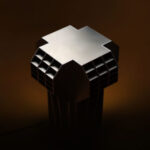
STRUCTURAL NECESSITYBureau of Entropy treats construction as a form of thought.
Its objects begin with forces rather than images: weight, pressure, resistance, balance, and the precise point at which separate elements become a stable whole. Components are cut, aligned, interlocked, and held through their own geometry. What carries the object is not hidden. Structure remains visible as both evidence and expression.
This legibility is central to the practice. A connection does not merely solve an assembly problem; it determines proportion, rhythm, and presence. Material is not shaped around a predetermined silhouette. The silhouette emerges through the negotiation between material behavior, structural demand, and human use.
Working across furniture, lighting, and functional sculpture, Bureau of Entropy returns to elemental typologies: the seat, the table, the source of light. These familiar forms are treated as unresolved structures rather than established designs. Their functions remain recognizable, while their construction is reconsidered from the ground up.
The work draws on architecture, engineering, precision manufacturing, and the anonymous intelligence of objects refined across cultures and generations. Such references are not reproduced as styles. They are examined as accumulated responses to recurring conditions: how a body is supported, how weight is transferred, how light occupies space, and how an object establishes presence.
Bureau of Entropy does not separate technical resolution from artistic expression. Precision produces character. Constraint generates form. An object reaches completion when its structure and presence can no longer be understood independently from one another.FOUNDATIONBureau of Entropy was founded in Wuppertal, Germany, in 2025 by Marvin Julian Freund and Matthias Figurowicz.
Both founders trained as toolmakers, developing an early understanding of metal, tolerance, manufacturing, and assembly through direct physical practice. This shared technical foundation was later extended through different disciplines.
Freund studied architecture and conceives the objects through proportion, spatial presence, cultural context, and the relationship between body and structure. He develops both their formal expression and their underlying construction, determining how each work is manufactured, joined, and assembled.
For Freund, designing is also a way of thinking through what resists resolution in language. Through drawing, testing, and assembling, personal experience enters the work without becoming illustration or fixed narrative. It is held in the persistence of the process: remaining with a question until the object arrives at its precise form.
Figurowicz studied mechanical engineering and contributes an understanding of forces, mechanisms, material performance, and functional systems. He supports the physical realization of the works through fabrication, assembly, and technical implementation.
This continuity from conception to realization allows each object to emerge as a coherent structural whole. Construction is not added to form; it is the means through which form becomes necessary.