Crystal Vases: Inside Carol Gay’s Crystals Collection
“Crystals were always present in my life as a child, strolling through handicraft fairs and observing gifts that my parents had received.” – Carol Gay
Updated on: November 12, 2026
Most crystal vases are made of crystal glass. Carol Gay’s are made with crystals. For her Crystals Collection, the São Paulo designer blows molten glass directly onto raw amethyst, citrine, calcite and black tourmaline, so each stone first shapes the vessel and then holds it up.
Here is how the collection came about, what each crystal brings, how to care for a glass and crystal vase, and the pieces available today.
Who Is Carol Gay?
Carol Gay was born in São Paulo in 1976 and graduated in architecture and urbanism from Mackenzie University in 2000. From 1999 to 2000, she took part in the “Construction of the Object” workshop at MuBE, the Brazilian Museum of Sculpture and Ecology, with designers Fernando and Humberto Campana, an experience she sees as the genesis of her work. For more on that influence, see Wallpaper*’s tribute to Fernando Campana.
A hands-on approach, constant artisanal skill and the search for new materials have become the core of her practice. Furthermore, she works closely with glassblowers, letting the craft process push her forms rather than drawing every detail in advance. See all her pieces on her ADORNO page.
The Crystals Collection
The Crystals Collection grew out of what Gay calls obsessive research into the materials of daily life and into individual and collective memory. Crystals, sold at every Brazilian craft fair and handed out as gifts, had become banal through overexposure. She wanted to show these minerals, which populate Brazilian soil, in a new light.
Through experiments with blown glass, she first used the stones as a form-giving element, then as a supporting structure. She chose amethyst, citrine, calcite and black tourmaline for their color and form, selecting stones that would deform the glass while still showing their crystalline structure. Consequently, every piece balances weight and lightness, transparency and color.
Four Crystals, Four Characters
Amethyst is the purple variety of quartz, and Brazil is one of the world’s main sources. In the collection it gives the strongest color, a cluster of violet points under clear glass.
Citrine is golden quartz, from pale yellow to deep amber. It warms the whole vessel when light passes through.
Calcite is softer and often honey-toned, with a waxy, almost glowing surface that makes it the calmest of the four.
Black tourmaline, shown here in quartz, is jet-black and glossy. Set against milky quartz, it gives the most graphic contrast of the series.
How to Care for a Crystal and Glass Vase
Change the water often and clean the glass with warm water and a soft brush or cloth; avoid the dishwasher. Keep water off the stone where you can, because some crystals, especially calcite, are soft and can lose their luster over time. In addition, avoid long periods of strong direct sun on amethyst and citrine, which can slowly fade. Finally, lift each vase by the stone base rather than the rim, since the stone carries the weight.
The Crystals Collection and More by Carol Gay
Amethyst Large – Crystal Vase by Carol Gay

Clear glass is blown directly onto a raw amethyst cluster, so the stone shapes the glass and then holds it up as a base. As a result, the purple crystal sits inside and outside the vessel at once. At 33 x 33 x 35 cm (13 x 13 x 14 in), it holds an armful of branches on a dining table or a console.
By Carol Gay
€2,614 incl. tax
Citrino Large – Crystal Vase by Carol Gay

A band of golden citrine pushes into the side of the glass as it is blown, leaving the vessel slanted and visibly deformed by the stone. Notably, citrine’s warm tone turns the whole vase amber when light passes through. At 33 x 33 x 34 cm (13 x 13 x 13 in), it suits a sunny windowsill or a sideboard.
By Carol Gay
€2,614 incl. tax
Black Tourmaline and Quartz Large – Crystal Vase by Carol Gay

The tallest of the collection, this vase rests on a block of black tourmaline set in quartz, a striking contrast of jet-black and milky white beneath clear glass. Indeed, the stone carries the whole vessel like a pedestal. At 33 x 33 x 44 cm (13 x 13 x 17 in), it is a statement piece for an entryway or a mantel.
By Carol Gay
€2,376 incl. tax
Calcite Large – Crystal Vase by Carol Gay

A pale, honey-toned calcite forms the base of this rounded vase, its soft, waxy surface a quiet counterpoint to the clear glass above. Moreover, calcite’s gentle color makes it the easiest of the four to place in a calm room. At 31 x 31 x 40 cm (12 x 12 x 16 in), it works on a bedside table or a bookshelf.
By Carol Gay
€2,370 incl. tax
Espinhos – Blown Glass and Onyx Vase by Carol Gay
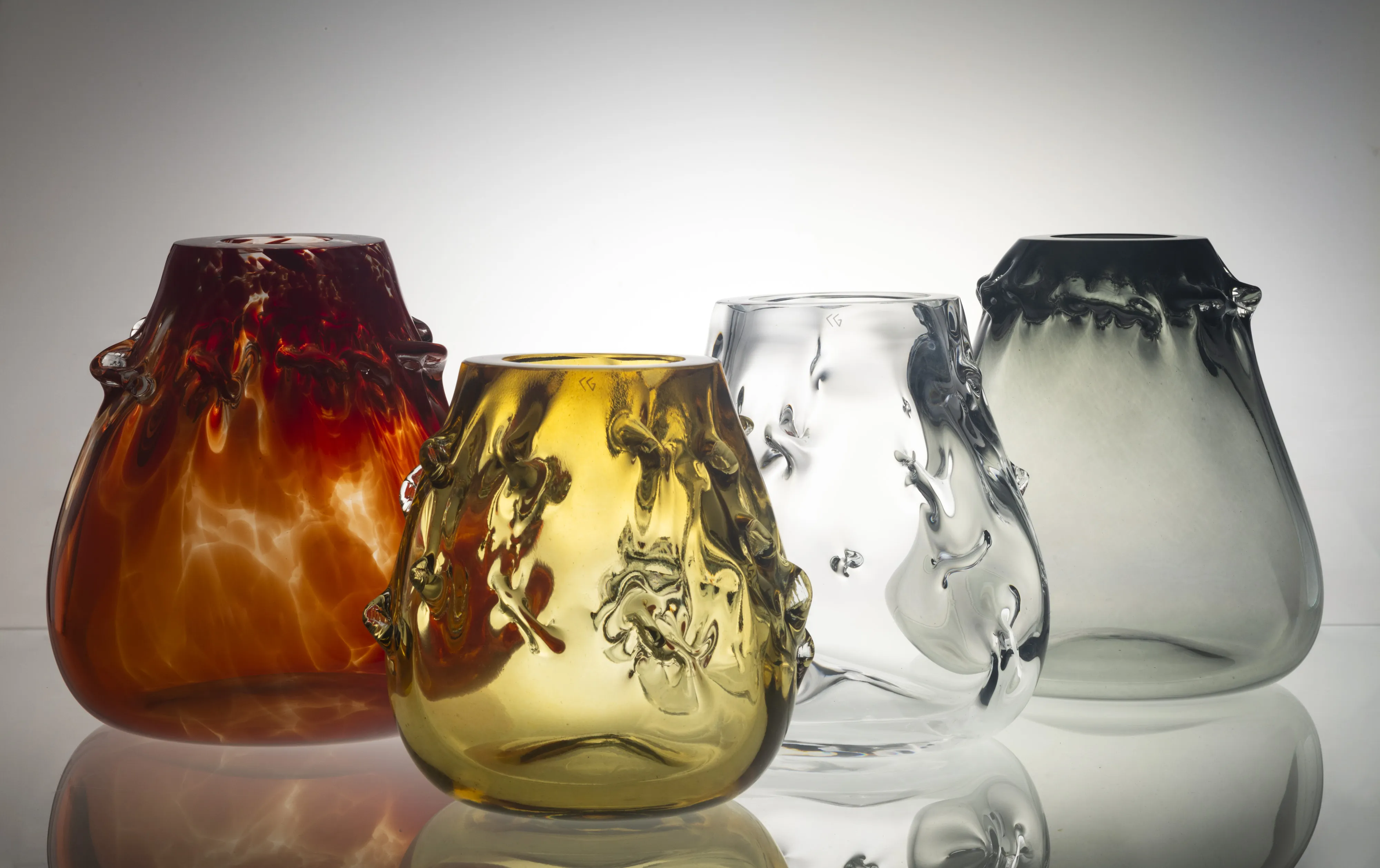
For Espinhos, meaning “thorns”, Gay experiments with traditional glassblowing until spikes rise from the glass like a crown or scatter freely across the surface. Each vase sits on a base of onyx, in amber, olive, clear or smoke. At 24 x 24 x 23 cm (9 x 9 x 9 in), they work alone or grouped on a table.
By Carol Gay
€777 – €868 incl. tax
Esférico – Blown Glass Vase by Carol Gay

Esférico tests how far glass can be deformed while it is still being blown: Gay and the glassblower intervene in the round shape, provoking a process usually used for identical serial pieces. As a result, every sphere comes out slightly different. At 28 x 28 x 25 cm (11 x 11 x 10 in), it holds a single stem or a small bunch on a side table.
By Carol Gay
€1,915 – €2,260 incl. tax
Frequently Asked Questions
What is a crystal vase?
Usually a vase made of crystal glass, a clear glass with a high clarity and sparkle. Carol Gay’s Crystals Collection is different: each vase is blown glass formed around a real mineral crystal that also serves as its base.
Which crystals does Carol Gay use?
Amethyst, citrine, calcite and black tourmaline with quartz, all minerals found in Brazilian soil. She chooses stones that will deform the glass while showing their crystalline structure.
Are the Crystals vases one of a kind?
Yes. Every crystal is different, so each vase takes a different shape as the glass is blown onto it. Most are made to order.
Can you put water in a crystal vase with a stone base?
Yes, the glass holds water, but change it often and keep the stone as dry as possible. Soft stones such as calcite can dull if they stay wet.