“[This collection] presents studios which generally are not interested in the ‘spectacular’, but rather on problematizing the ‘normal’.” – Juan García Mosqueda, curator of HACKING INDUSTRY
Updated on: November 12, 2026
Most collectible design sells itself on rarity, luxury materials and a famous name. HACKING INDUSTRY, a collection curated for ADORNO in 2021 by Juan García Mosqueda, argued for something else: small, almost stupid interventions in ordinary industrial processes. A bench made of construction tube. A chair cut from one sheet of foam. A stool cast in aluminum from a foam pattern.
Here is what the collection set out to do, the curator’s 2021 interview in full, and the pieces from it that you can still buy today.
What Is Collectible Design?
Collectible design is furniture, lighting and objects made in limited numbers, as unique pieces or to order, and bought for their ideas and craft as much as their use. It sits between the gallery and the home: the pieces are functional, but they are designed, exhibited and collected the way art is.
Much of the field leans on precious materials and virtuoso making. HACKING INDUSTRY took the opposite route. Mosqueda’s curatorial statement turns Robert Smithson’s idea of “abstract geology” into “abstract technology”, a method that lets designers use off-the-shelf products and “fairly boring/dumb manufacturing processes” as raw material. As a result, the value of each piece lies in the hack: the small shift that makes a standard process produce something unexpected.
HACKING INDUSTRY: The 2021 Collection
Launched on ADORNO in May 2021, HACKING INDUSTRY gathered stand-out pieces from exhibitions and projects Mosqueda had curated over the previous two years. It brought together studios from North and South America whose work follows a trial-and-error method, where failed experiments matter as much as finished ones. The collection was presented as a set of 3D renders by Nazzareno Giannelli, staged in a single warehouse space.
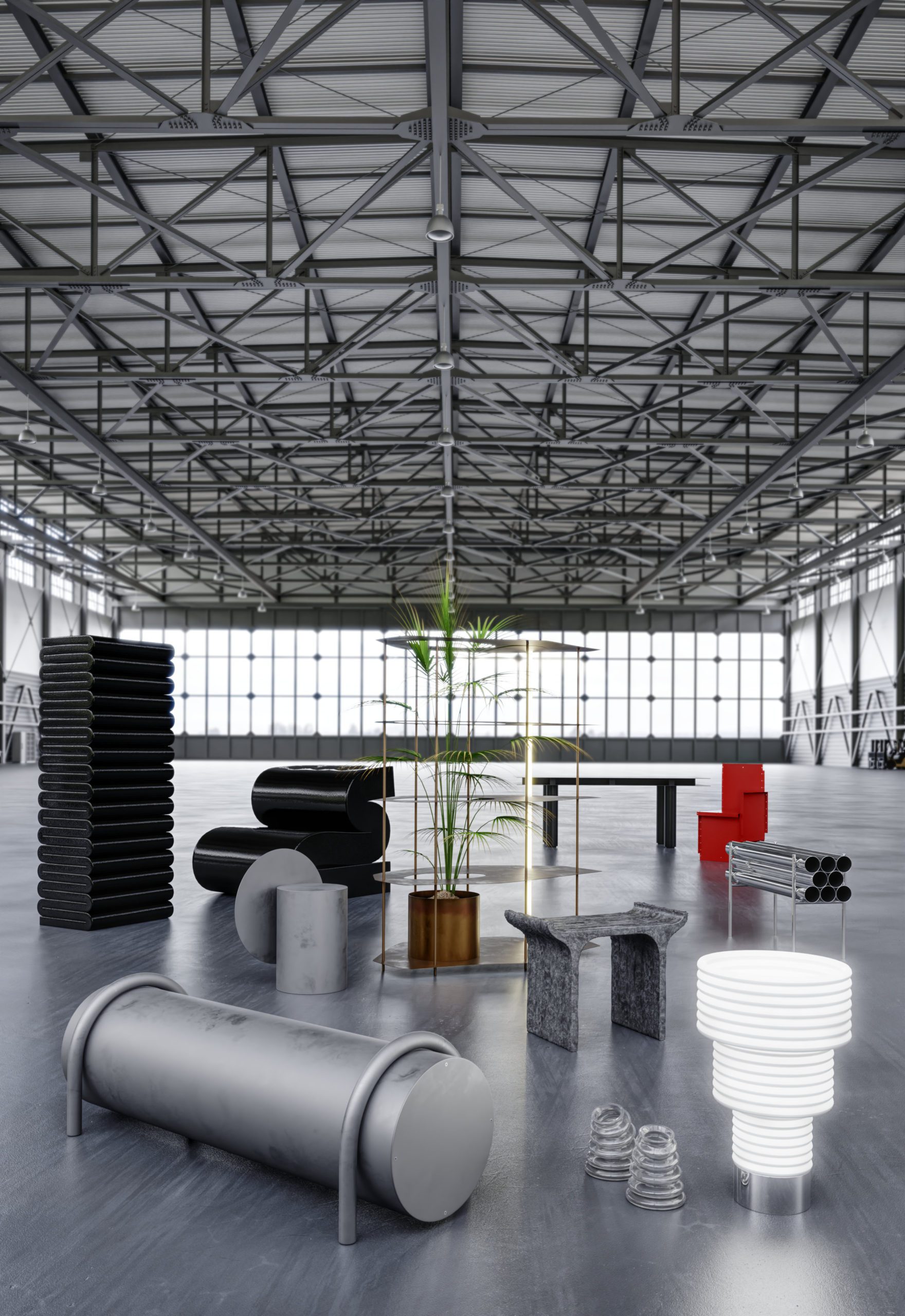
The original collection featured eight studios: Buffet Collective, Deon Rubi, IT-MET, Jumbo, MOS Architects, Objects of Common Interest, Ries Studio and Rodrigo Bravo F. Three of them, Deon Rubi, Jumbo and Ries Studio, still sell their work on ADORNO, and their pieces are listed below.
For a related take on play in design, read A Playful Design Utopia: Bubble Lamp by Teun Zwets.
Who Is Juan García Mosqueda?
Juan García Mosqueda is a curator and designer. He founded and curates the contemporary design platform Chamber, and in 2018 he started QUICK TINY SHOWS in Buenos Aires with Ries Studio, an independent series of two-day exhibitions of progressive art and design.
Interview with Curator Juan García Mosqueda (2021)
This interview was first published on ADORNO on May 6, 2021, and is kept here as a record of the collection.
The HACKING INDUSTRY collection is derived from stand-out pieces from previous exhibitions of QUICK TINY SHOWS. Can you tell us a bit about the QUICK TINY SHOWS initiative?
QUICK TINY SHOWS is an independent initiative started in Buenos Aires, Argentina to promote the exhibition of progressive art and design ideas in new contexts. Founded in 2018 by Ries Studio and myself, this unique platform hopes to play a vital role in the region and open new doors for experimental thinkers and practitioners who are part of a global, contemporary discourse. Each edition is up on display only for two days. We wish these to be rapid, work-in-progress exercises in curatorial work that challenge traditional institutional exhibition formats.
With your background as both a curator and a designer, which aspects of a designer’s practice draw your attention? Why?
Consistency in the narrative. I am mostly into studios that have a solid foundation from which to keep building work from and a certain kinship in terms of similar interests. Once you have that, the collections themselves can take you anywhere. Establishing a horizontal relationship between curator and designers is essential to get the most out of collaborations.
How have you approached the curation of HACKING INDUSTRY?
I noticed that there is a common thread between some architecture and design studios all over the world which revolves around these small hacks or interventions of fairly standard manufacturing processes. Studios which generally are not interested in the ‘spectacular’, but rather on problematizing the ‘normal’; studios interested less in the ‘innovative’ and more on the ‘banal’, values usually looked down upon in design culture.
In your curatorial statement, you express a desire for a re-introduction of playful or leisurely experimentation in production processes. How do the participating designers’ practices work to illustrate this?
Play, boredom, leisure are all strategies that are key to developing these kinds of objects. Sometimes called dumb-technics, most of the material manipulations that are evidenced here are usually done by trial and error, experimentation, and alternative readings of production processes. I’ve seen the process of some of these from day one, and they embrace failure as much as success.
With reference to the uncertainty of the last year and a move towards smaller and more digital exhibition tactics, what do you see for the future of the collectible design industry?
There is a lot of useless, trivial talk around NFTs at the moment. I would not dare to predict anything around that, as much as I would not dare to talk about the volatile future of cryptocurrency. So far, it has been used poorly, same as with VR, AR, and other alternative realities, but maybe there is something there to explore. I doubt that physical galleries, museums, and traditional physical shows will die, that is completely absurd. It reminds me of the conversation around the end of graphic design and print in the 2010s which, of course as we all know, led to better zines and better books than ever before, and the strengthening of the profession. I think that this is a similar case. We will see smaller, fewer, but better, physical shows with the help and support of platforms like ADORNO to promote the work and help push it to a bigger audience.
Three Hacks on Industry: How the Pieces Are Made
Tube. Deon Rubi, who works between Buenos Aires and Miami, builds furniture from basic construction materials. Her Tube Bench uses standard metal tube, the kind found on any building site, and lifts it into a polished, reflective object through proportion and finish alone.
Foam. Jumbo, the New York practice of Justin Donnelly and Monling Lee, works with reductivism and whimsy. Their Dumb Chair is made from a single piece of high-density foam sheet and finished in a sprayed rubber coating. Sight Unseen’s profile of Jumbo traces the same cartoonish, seamless forms across their work.
Cast metal. Ries, a Buenos Aires studio with roots in architecture and industrial design, casts its Tori Stool in sand using the lost-foam technique. A foam pattern is buried in sand, and molten aluminum burns it away and takes its place, leaving a rough, stone-like surface no mold could plan.
Collectible Design from HACKING INDUSTRY Available Now
Tube Bench by Deon Rubi

Deon Rubi turns standard construction tube into furniture. Polished metal tubes slot into a welded frame, so the bench picks up the colors of the room around it. It measures 110 × 46 × 69 cm (43.3 × 18.1 × 27.2 in) and is made to order.
By Deon Rubi
€4,000 incl. tax
Dumb Chair by Jumbo

Cut from one sheet of high-density foam and finished in a sprayed rubber coating, the Dumb Chair champions the naive, the uncool and the cute. Jumbo also makes it as the longer Dumber Bench. Made to order.
By Jumbo
€12,400 incl. tax
Tori Stool by Ries Studio

Sand-cast in aluminum with the lost-foam technique, Tori takes its shape from the Japanese torii, the gate that marks the threshold to a sacred space. It was first made for QUICK TINY SHOWS #01 and measures 60 × 35 × 50 cm (23.6 × 13.8 × 19.7 in). Ries also makes the hand-blown Fuso Vase (€270).
By Ries Studio
€3,200 incl. tax
How to Buy Collectible Design
Expect made-to-order lead times. Most collectible pieces are produced in small runs after you order, so ask the studio for a production time before you plan a room around a piece.
Check size and weight early. Sculptural seating takes up more space than its use suggests. Measure doorways and stairs as well as the room, and confirm the dimensions in both centimeters and inches on the piece page.
Accept variation. With hand-cast metal, hand-blown glass or sprayed coatings, no two pieces are identical. Marks of the process are part of the design, not flaws.
Buy into a story you like. A piece from a curated collection carries its exhibition history with it. Knowing where and why it was first shown is part of what you are collecting.
Frequently Asked Questions
What is collectible design?
Furniture, lighting and objects made in limited numbers or to order, designed and collected for their ideas and craft as much as their function. It sits between gallery art and everyday furniture.
What was HACKING INDUSTRY?
A collection curated for ADORNO in 2021 by Juan García Mosqueda. It gathered studios from North and South America that make small, playful interventions in standard manufacturing processes, presented as 3D renders by Nazzareno Giannelli.
Who is Juan García Mosqueda?
A curator and designer, founder of the design platform Chamber and co-founder, with Ries Studio, of QUICK TINY SHOWS, a series of two-day exhibitions started in Buenos Aires in 2018.
Can you still buy pieces from HACKING INDUSTRY?
Yes. The Tube Bench by Deon Rubi, the Dumb Chair and Dumber Bench by Jumbo, and the Tori Stool and Fuso Vase by Ries Studio are available on ADORNO, most made to order.