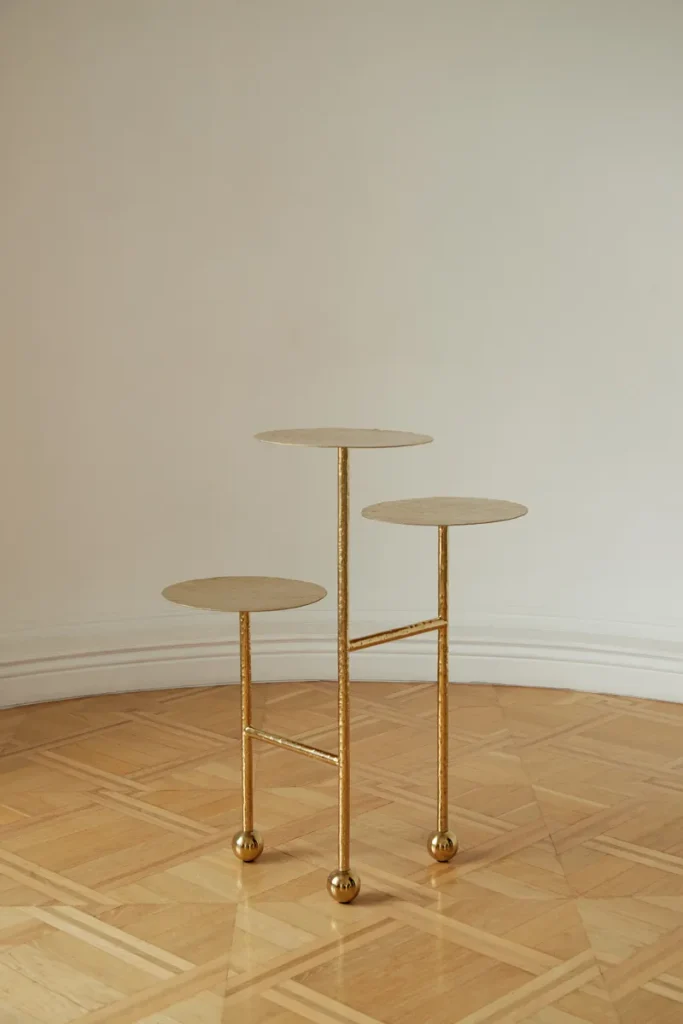
A century on, Art Deco still knows how to make an entrance.
Art Deco was born in the 1920s, when designers fell for speed, geometry and gleaming materials. Its furniture traded the curling lines of Art Nouveau for stepped forms, bold symmetry and the shine of brass, lacquer and polished stone. A hundred years later, the style is back in contemporary interiors, often in a quieter, more sculptural form.
Tables are where Art Deco furniture works best today, since one strong piece can carry a whole room. Below, ADORNO explains what makes a table Art Deco and how to choose one, then picks ten coffee, side, dining and console tables by independent studios.
What is Art Deco furniture?
Art Deco furniture combines geometric form with rich materials. Look for stepped or tiered silhouettes, circles and fans, strong symmetry, and surfaces such as marble, brass, lacquer, fluted glass and exotic woods. The style reached well beyond furniture, from skyscrapers to ocean liners, as Wallpaper*’s guide to Art Deco architecture shows. By contrast with its predecessor, covered in ADORNO’s guide to Art Nouveau furniture, Deco favors the ruler over the vine.
How to choose an Art Deco table
Start with the material that will lead the room: veined marble for drama, travertine for warmth, brass or polished steel for shine. Next, look for one clear geometric idea, such as a stepped base, a fluted surface or a perfect circle, rather than several competing details. Finally, check scale. An Art Deco coffee table should sit about 16 to 18 inches (40 to 46 cm) high and roughly two-thirds the length of your sofa, while a side table works best within 2 inches (5 cm) of the arm height.
Art Deco coffee tables
The coffee table is the centerpiece of an Art Deco living room. For more ideas, see ADORNO’s edit of the best coffee tables.
Arkhe No. 1 Round Coffee Table in Travertine by Studio Kali

A tribute to the amphitheaters of the Mediterranean, Arkhe splits its round travertine top into smooth and ribbed halves on a crossed base. The concentric grooves give an Art Deco coffee table rhythm without any ornament at all.
By Studio Kali
€6.170 incl. tax
Tinian Coffee Table in Dark Emperador Marble and Oak by Lebanto

A round top of dark Emperador marble, veined in white, rests on two perpendicular slabs of oak. The contrast of polished stone and dark wood is classic Art Deco, kept simple enough for a contemporary living room.
By Lebanto
€2.010 incl. tax
Lasso Coffee Table in Stainless Steel and Borosilicate Glass by Nitush and Aroosh
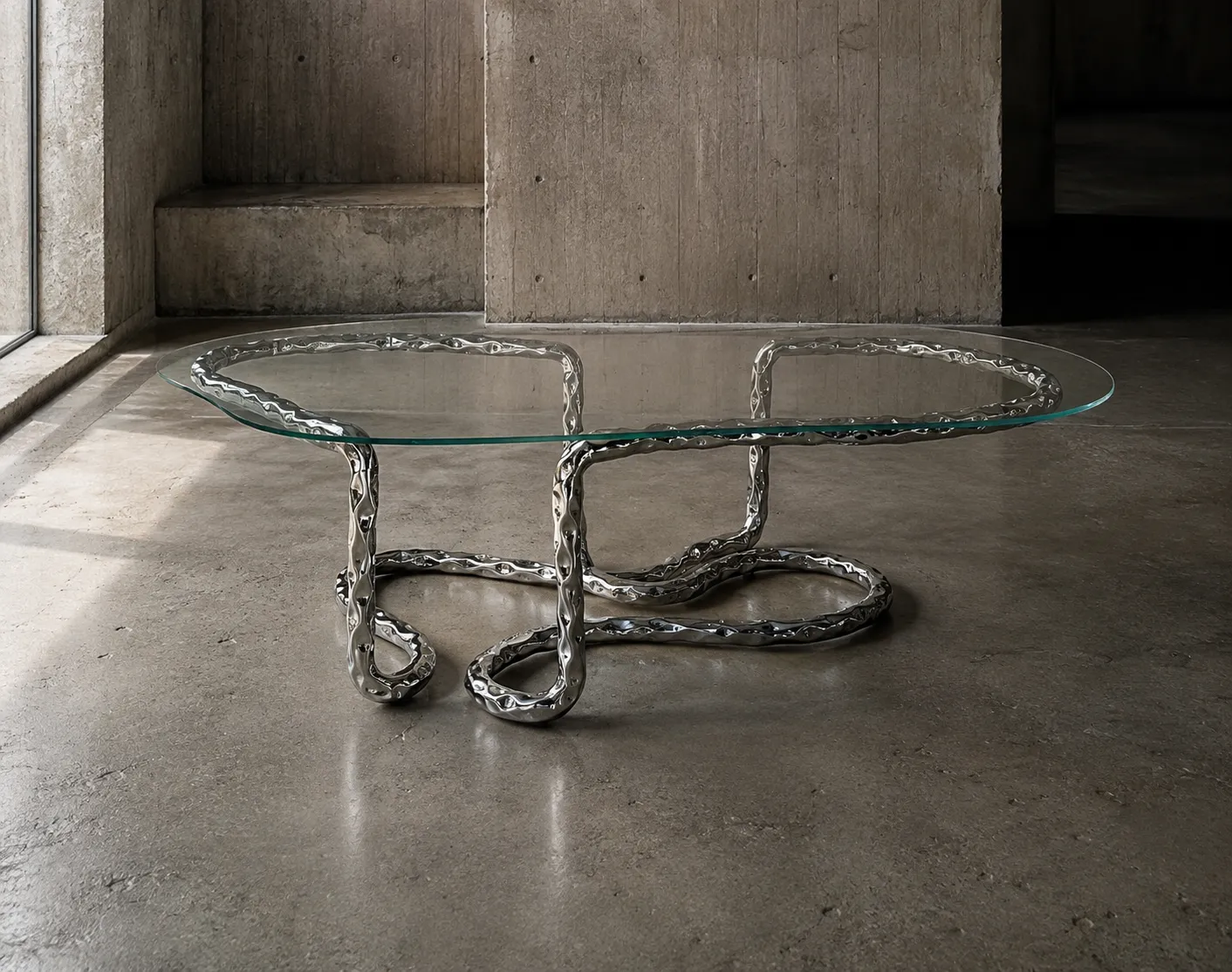
A polished stainless steel base twists and loops like a rope caught mid-throw, cut and bent by hand, beneath a clear borosilicate glass top. It brings the streamlined glamour of late Art Deco into a sculptural coffee table.
By Nitush and Aroosh
€4.250 incl. tax
Art Deco side tables
Small side tables let you try the style without committing a whole room. ADORNO’s marble side tables edit has more in stone.
Kaila-I Side Table in Ribbed Glass by Yugen Lab

Ribbed glass, set vertically and horizontally, catches the light in a gradient from pink to orange. Fluted glass was a signature of the 1920s, and Kaila-I gives it a bright, contemporary twist.
By Yugen Lab
€1.050 incl. tax
Cherry Side Table in Steel and Wood by SALAK Studio
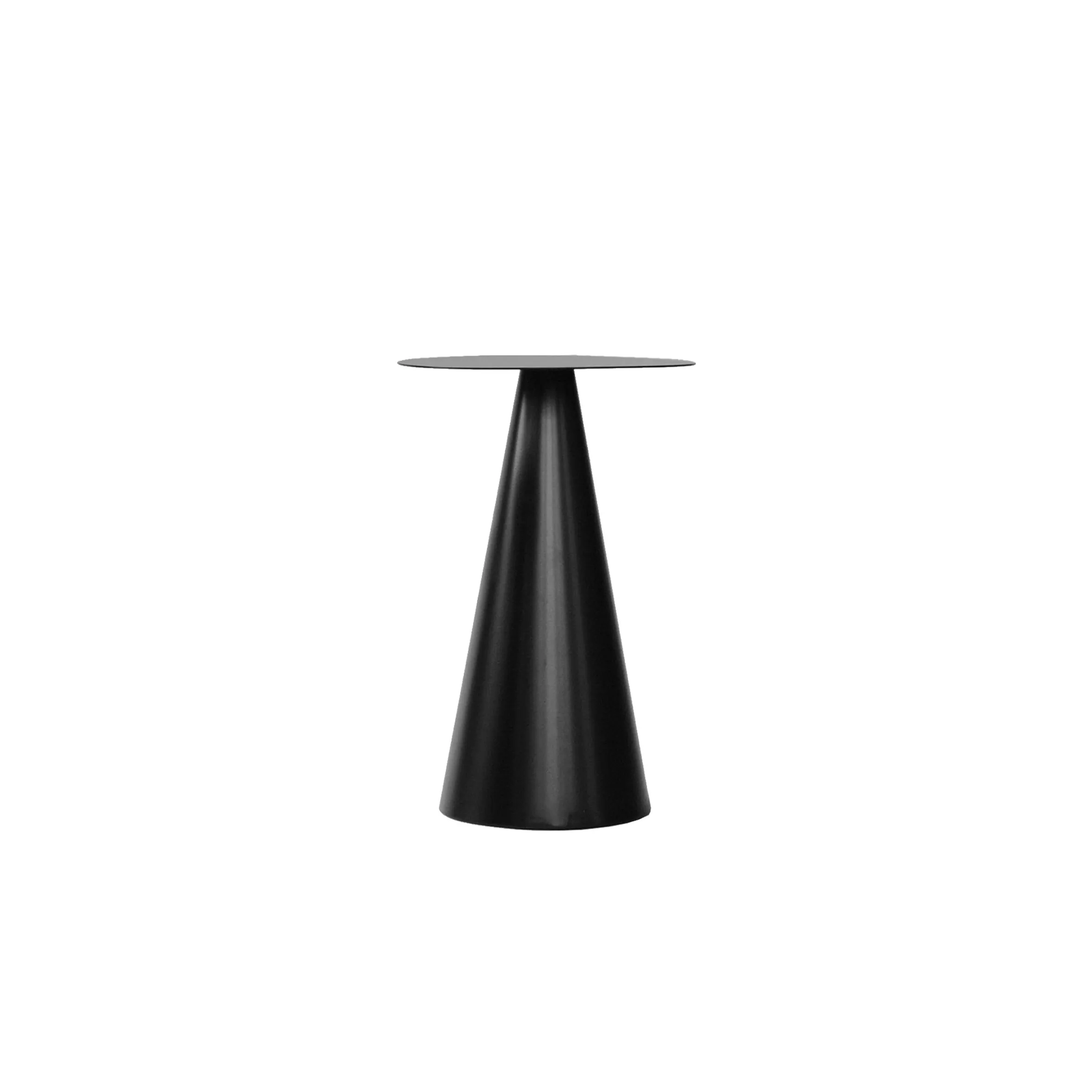
A slim round top balances on a tall black cone of steel. The pure geometry and dark finish echo the machine-age side of Art Deco, in a piece small enough for a bedside.
By SALAK Studio
€590 incl. tax
Theia Side Table in Golden Pyrite and Brass by LMNOH

A limited edition by LMNOH, Theia pairs tops of golden pyrite with cast metal bases that flare like roots. The sparkle of the stone and the polished metal give two small tables the presence of jewelry.
By LMNOH
€2.100 incl. tax
Servant Side Table in Black Marble, Oak, Acrylic and Brass by VAUST Studio

A slab of gray acrylic links a marble top to an oak base, held by mirror-polished brass. The layered planes and gleaming metal recall Art Deco cabinetry, while the transparent core keeps the piece light.
By VAUST Studio
€7.600 incl. tax
Liquid Pedestal in Tin-Coated Steel by FURN OBJECT
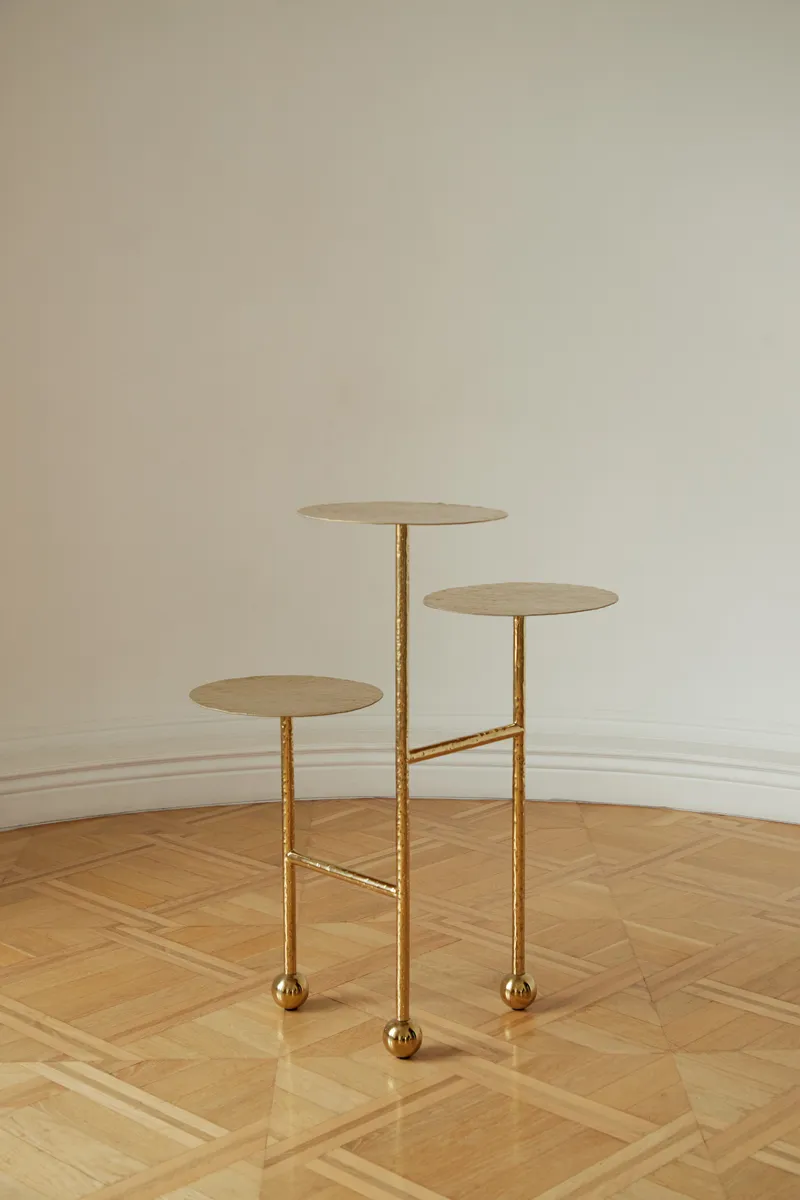
Three round trays rise on slender rods with ball feet, finished in tin-coated steel that glows like gold. Inspired by water and the play of metal in light, the tiered pedestal is the most purely Art Deco piece here, all stepped levels and gleam.
By FURN OBJECT
€3.600 incl. tax
Art Deco dining and console tables
Larger pieces such as dining tables and console tables are where Art Deco shows its full ambition.
Giada Dining Table in Leather and Carved Wood by Costantini Design

An upholstered top in leather or fabric sits within a bronze trim on a hand-carved wooden base in a metallic finish. The textured pedestal and rich color make it an Art Deco dining table for a room that likes ceremony.
By Costantini Design
€13.800 incl. tax
Element Console Table in Green Picasso Marble by Vincent Mazenauer

Carved entirely from Green Picasso marble, the Element console rests on two rounded pillars beneath a softly stepped top. The bold veining and monumental form recall the marble halls of the 1920s, scaled for an entryway.
By Vincent Mazenauer
€18.500 incl. tax
Art Deco interior design tips
Let one Art Deco table lead, and keep the rest of the room calm so its geometry stands out. Repeat one finish at least twice, such as brass in a table and a lamp, so the scheme feels deliberate. Finally, mix eras: a 1920s silhouette next to a contemporary sofa reads as modern Art Deco rather than a period set.
Frequently asked questions
What is Art Deco style?
A design movement of the 1920s and 1930s known for bold geometry, symmetry and rich materials such as marble, brass, lacquer and glass.
What makes a table Art Deco?
A clear geometric form, such as a stepped base, a round pedestal or fluted surfaces, combined with stone, metal or lacquered finishes.
What is the difference between Art Deco and Art Nouveau?
Art Nouveau, which came first, uses flowing natural curves. Art Deco replaced them with geometry, symmetry and an industrial sheen.
Does Art Deco furniture work in a contemporary home?
Yes. One or two Art Deco pieces against simple surroundings feel fresh rather than nostalgic.
How do I care for a marble Art Deco table?
Use coasters, wipe spills quickly with a damp cloth and mild soap, and reseal the stone every year or two to protect it from stains.
Why Art Deco tables endure
Art Deco has lasted because it treats furniture as architecture: clear forms, honest materials and a sense of occasion. Consequently, a single well-chosen Art Deco table can give a room both structure and glamour.