A drink, something salty and an hour with nowhere else to be. That is all aperitivo hour asks for.
Updated on: October 28, 2026
Somewhere between the end of the workday and dinner, Italy pauses. Bars set out bowls of olives and chips, friends order a spritz or a Campari soda, and nobody is in a hurry. This is aperitivo hour, and it is one of the easiest rituals to bring home: you need a few bottles, a few snacks and the right pieces on the table.
This guide explains where aperitivo comes from, what to pour and what to serve, how to set up aperitivo hour at home, and nine glasses, bowls, trays and ashtrays by independent designers to set the table with.
What is aperitivo hour?
Aperitivo is the Italian ritual of a light, usually bitter drink before dinner, served with small snacks. The word comes from the Latin aperire, to open, because the drink is meant to open the appetite, not fill it. In most Italian cities, aperitivo hour runs from about 6 to 9 p.m. It is not a happy hour: the point is not cheap drinks but a slow transition from the day into the evening.
The habit took shape in northern Italy. In 1786, Antonio Benedetto Carpano began selling vermouth in Turin, and bitter liqueurs followed. Gaspare Campari created his red bitter in the 1860s and made it a Milan institution, a story Wallpaper* traces back to the city’s Galleria. In 1932, Futurist artist Fortunato Depero designed the cone-shaped Campari Soda bottle, still in use today; Wallpaper* tells its design history. Design has been part of aperitivo from the start.
What to pour: classic aperitivo drinks and their glasses
An aperitivo drink is low in alcohol, bitter or dry, and usually served cold. These are the classics, and the glass each one is usually served in:
- Spritz: prosecco, a bitter such as Aperol or Campari, and a splash of soda, born in the Veneto. Serve it over ice in a large wine glass or a wide tumbler.
- Negroni: gin, Campari and sweet vermouth in equal parts. Serve it in a short, heavy tumbler over one large ice cube.
- Americano: Campari, sweet vermouth and soda, the lighter ancestor of the Negroni. Serve it in a tall or medium tumbler.
- Vermouth: on ice with a slice of orange, in a small wine glass or tumbler.
- Campari soda and non-alcoholic bitters: straight from the bottle or poured into a small glass. Sparkling water with citrus is just as welcome.
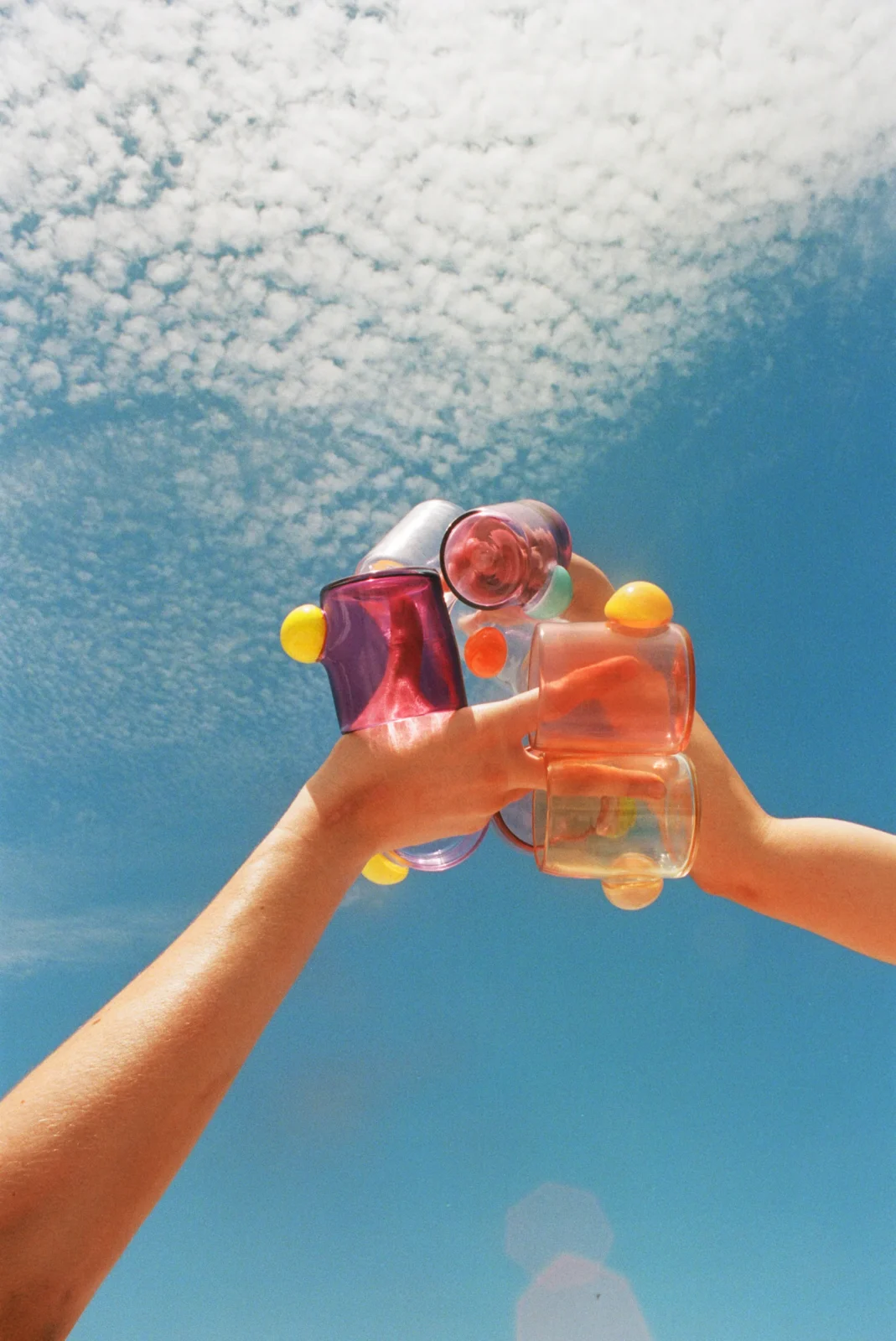
Mixing glass shapes is part of the charm. A table of mismatched, hand-blown cups and glasses feels more like aperitivo than a matching set of twelve. For more glassmaking, read our guide to glass blowing, or see how Dutch artist Boris de Beijer turns cocktail glasses into small sculptures in Sight Unseen.
What to serve: aperitivo snacks
Aperitivo is not a meal. The food should be salty, easy to eat with your fingers, and gone before dinner. Classic aperitivo snacks include:
- Green olives, especially large Castelvetrano or Ascolana olives
- Potato chips and taralli, small crunchy rings of bread from Puglia
- Cubes of Parmigiano Reggiano or slices of pecorino
- Salami, prosciutto or mortadella, cut thin
- Bruschetta, focaccia or small crostini
- Salted almonds, pistachios or roasted chickpeas
Serve them in small portions, refilled as they run out. Wide, shallow bowls work for chips and nuts, small plates for cheese and cured meats, and trays to carry everything outside. In Milan, a generous spread that replaces dinner is called apericena, from aperitivo and cena, dinner.
How to set up aperitivo hour at home
- Keep it small: three or four snacks and two or three drinks are plenty.
- Set out empty dishes: a small bowl or tray for olive pits, toothpicks and citrus peels keeps the table tidy.
- Chill everything: glasses, prosecco, soda and vermouth should be cold before guests arrive.
- Use what you have, then add one piece: a single sculptural bowl or a few hand-blown glasses change the whole table.
- Go outside if you can: a balcony, garden or terrace is aperitivo’s natural setting. Choose heavy pieces in concrete, stone or metal that will not tip in the wind.
If guests smoke, give them a proper ashtray instead of a saucer. Our guide to ashtray design has more ideas, and an ashtray doubles as a dish for pits and peels when nobody smokes.
9 pieces for aperitivo hour
Each piece comes from a different studio and is available on ADORNO, ordered by demand on ADORNO over the last 90 days: the serving bowls and ashtrays first, then the glasses.
Betonschüssel – Concrete Bowl by clasik.studio

Cologne studio clasik.studio casts this bowl by hand in concrete and leaves the rim as it falls, so the edge is slightly uneven on every piece. Listed at 30 cm (11.8 in) across, it is big enough for a heap of chips or a full bunch of grapes in the middle of the table. At €45, it is also the most affordable piece in this edit.
By clasik.studio
€45 incl. tax
Wrp-004 Stainless Steel Ashtray by NAVE

Made in Ecuador by NAVE with STUHL, WRP-004 is built from flat plates of 3 mm (0.12 in) stainless steel that create three zones: a tray for ash, a slot for spare cigarettes and a rest for the one in use. A single plate bends into a soft curve, the one gesture that breaks the grid. At 19 x 19 x 6 cm (7.5 x 7.5 x 2.4 in), it also works as a dish for olive pits and citrus peels.
By NAVE
€250 incl. tax
Pillow Tray Ultramarine – Design Tray by julius.works

German studio julius.works casts this tray in fine concrete and shapes it like a cushion that someone has just leaned on, then paints it by hand in a matte ultramarine. It measures 15 x 15 x 5 cm (6 x 6 x 2 in) and weighs 1.3 kg (2.8 lb), heavy enough to stay put on a windy terrace. Use it for nuts, olives or a lighter and matches. Keep hot pans off it: the pigment layer is not heat resistant.
By julius.works
€120 incl. tax
Bruciata Wooden Tray by Gábor Góbi

Hungarian designer Gábor Góbi cuts these trays from old barn beams and chars them with Yakisugi, the Japanese technique of burning wood to protect it. They are finished with natural oils and beeswax, and any cracks are mended with unburned wood from the same beam. At 20 x 20 x 5 cm (7.9 x 7.9 x 2 in), one tray holds a small board of cheese; a stack of three makes a set for the table.
By Gábor Góbi
€189 incl. tax
Ash Tray – Solid Aluminum by PRACTICE

Korean studio PRACTICE machines this ashtray from solid blocks of aluminum and bolts the parts together, leaving a small rest to set a cigarette down between sips. It is heavy, simple and almost indestructible, and the metal picks up fingerprints and small scratches over time. It is made to order.
By PRACTICE
€150 incl. tax
Brutalist Catchall by Studio S II

Brooklyn’s Studio S II casts these bowls in gypsum cement and bases their notched shape on the National Theatre in London. On their own they hold almonds or olives; stacked, they look like a small concrete building. Each color, Bone, Volcanic Black and Terracotta, is limited to 50 pieces.
By Studio S II
€119 – €265 incl. tax
Hand-blown Wine Glass by Szkło Studio

Polish glassblowers at Szkło Studio shape each glass with stones and ceramics while it is still hot, so the bowl comes out dented and the stem bends its own way. No two are the same. At around 23 cm (9 in) tall, it holds a glass of wine or a vermouth on ice. Wash it by hand.
By Szkło Studio
€220 incl. tax
Bubble Cup by Sticky Glass

Brooklyn studio Sticky Glass blows each tumbler with an outer bubble that liquid flows in and out of. The studio suggests keeping your martini olives in it, and the bubble also gives your fingers somewhere to rest. Each cup is about 8.9 x 7 x 7.6 cm (3.5 x 2.75 x 3 in), a good size for a Campari soda or sparkling water. Hand wash only.
By Sticky Glass
€77 – €94 incl. tax
Persona Glass Multicolour by MILA ZILA

Czech studio MILA ZILA has each Persona glass blown in Northern Bohemia, leaving a gather of colored glass at the base that is different every time. Some are restrained, others fuller, so a set never matches exactly and that is the point. Use it as a tumbler for a negroni or an Americano. It joined ADORNO this year.
By MILA ZILA
€120 incl. tax
Aperitivo etiquette
Aperitivo has few rules, but Italians tend to follow a handful. Drinks come before food, never the other way around. Snacks are shared, not plated per person. One or two drinks is the norm, because dinner is still to come. And no cappuccino: milky coffee belongs to the morning. Whether you host at home or go out to a bar, the aim is the same, a slow hour with good company.
FAQ
What time is aperitivo hour?
In Italy, aperitivo hour usually runs from about 6 to 9 p.m., between the end of the workday and dinner. In Milan and Turin it often starts around 6:30 p.m.
What is the difference between aperitivo and happy hour?
Happy hour is about discounted drinks. Aperitivo is about opening the appetite before dinner: a light, often bitter drink and small snacks, enjoyed slowly. In many Italian bars, the snacks come free with the drink.
What glasses do you need for aperitivo?
A wine glass or wide tumbler for spritz, a short tumbler for Negroni and vermouth, and a small glass for Campari soda or sparkling water. Mixing shapes is fine; hand-blown glasses make the table feel more personal.
What do you serve at an aperitivo?
Salty finger food in small portions: olives, chips, taralli, nuts, cubes of Parmigiano, cured meats and bruschetta. Add an empty dish for olive pits and toothpicks.
What is apericena?
Apericena combines aperitivo and cena, the Italian word for dinner. It is an aperitivo with a buffet generous enough to replace the evening meal, common in Milan.
See all tableware on ADORNO.