Updated on: August 5, 2026
Although recognised today as Nepalese rugs, these pieces have their origins deeply rooted in Tibet, Nepal’s northern neighbour. Understanding their history in Tibet is what explains how the craft became one of Nepal’s largest industries. It is a narrative of tradition, displacement, cultural integration and heritage — foundations shared by many textile design industries.
For centuries, Tibetan mothers have woven carpets upon the birth of a baby girl, bestowing a birthright: the carpet itself, and the weaving knowledge behind it, often learned by age ten. In Tibetan tradition a girl’s marriage means departure from her immediate family, but the carpet woven at her birth and the skill behind it remain hers, passed down through generations.
Tibetan homes still hold numbers of these carpets, warming the inhabitants of the “roof of the world” and connecting generations. That domestic tradition continued until the upheaval of the 1959 diaspora, which is what founded Nepal’s hand-knotted carpet industry. What follows covers the history, the knot, the materials, the motifs, how to care for one, and where the industry actually stands now.
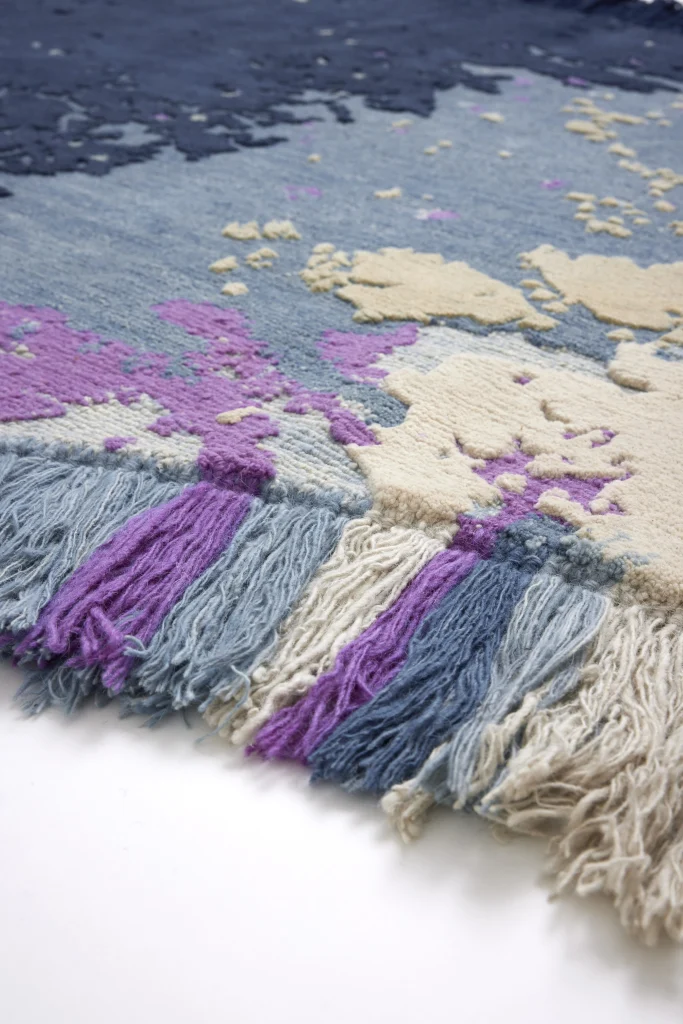
What is a Nepalese rug?
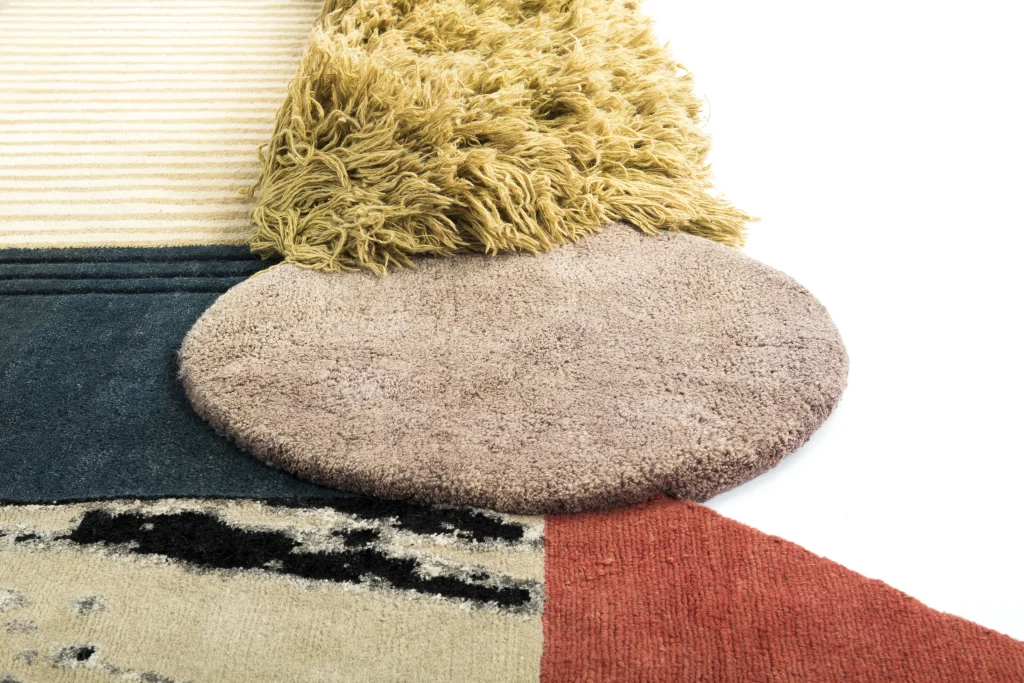
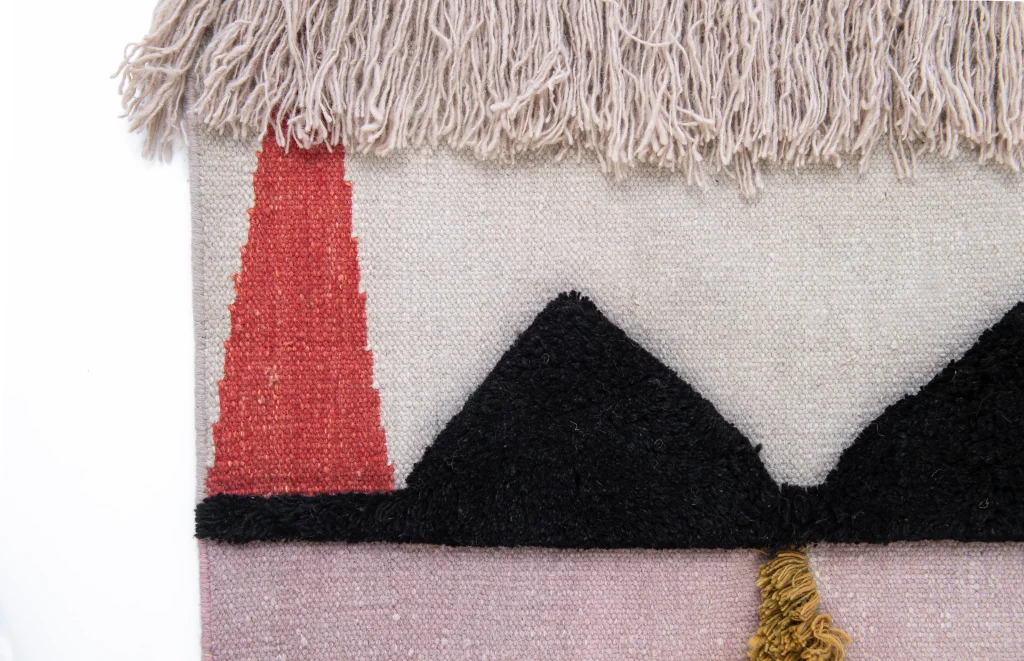
A Nepalese rug is a hand-knotted pile carpet made in Nepal using Tibetan technique: Himalayan sheep’s wool, often blended with silk, knotted onto a vertical warp using the Tibetan knot, and coloured with natural or low-impact dyes. The name describes where it is made rather than a distinct design tradition, since the method, the motifs and the vocabulary all arrived from Tibet.
Consequently the terms Nepalese rug, Nepali carpet and Tibetan rug are used almost interchangeably in the trade, and a rug sold as Tibetan today was in all likelihood woven in Kathmandu. Notably Nepal has held roughly a 12% share of world exports of hand-knotted woollen carpets — a substantial position for a country of its size, built on small workshops able to take custom orders rather than on volume.
Historical context: from the Tibetan plateau to Kathmandu
The Tibetan carpet tradition grew out of the nomadic life of the plateau, where a carpet was furniture, insulation and ritual object at once. These pieces served as meditation seats, bedcovers and welcoming mats — functional first, symbolic throughout.
The 1959 diaspora
The 1959 Tibetan uprising led to the flight of the XIV Dalai Lama and tens of thousands of Tibetans into neighbouring countries, Nepal among them. Those refugees arrived with weaving knowledge and little else. Therefore what had been a domestic craft became, within a decade, a livelihood and then an export sector.
Jawalakhel and the Swiss programmes
Refugee settlements around Kathmandu became the hubs where the craft was rebuilt, supported by the Swiss Agency for Technical Assistance. The Jawalakhel Handicraft Centre, established in 1960, is the origin point of the commercial industry: it gave the weaving a workshop structure, a quality standard, and access to the tourist market then beginning to grow. Nepal’s first genuine export boom followed in 1976, the year carpets first registered in international trade statistics at around 7.6% of national exports.
The 1990s boom — and what came after
The early 1990s were the peak, sometimes called the Gold Rush. Carpets accounted for roughly 65% of Nepal’s total exports and employed 250,000 to 300,000 people according to International Labour Organisation figures, drawing workers from remote districts into Kathmandu and functioning as a rural remittance economy.
Then it contracted sharply. Allegations of child labour in Nepali and wider South Asian carpet production surfaced in European markets during the 1990s and did lasting reputational damage — the GoodWeave certification scheme, founded in 1994, exists because of exactly this. Political instability at home and the 2007–09 financial crisis compounded the decline. By the 2023/24 fiscal year carpets had fallen to around 8% of Nepal’s exports, ranking fourth behind iron and steel, coffee, tea and spices, though export values have been rebounding from their low point.
That trajectory matters when buying. An industry that has been through a child-labour scandal and out the other side has certification infrastructure that many crafts lack, which makes provenance genuinely checkable — see our piece on how we relate to the objects we own.


How Nepalese rugs are made
The Tibetan knot
The Tibetan knot is genuinely distinct from the Persian and Turkish knots used across most of the rug-weaving world, and the difference is a metal rod. Rather than tying each tuft individually, the weaver runs a continuous length of yarn across a row, looping it around each pair of warp threads and around a temporary gauge rod laid horizontally in front of the warp. Once the row is complete, the loops are cut along the rod with a knife, releasing the rod and leaving a row of cut pile.
Two consequences follow. First, pile height is set by the rod’s diameter, so it is perfectly consistent across the whole carpet and can be changed deliberately between areas to create relief. Second, the method is faster than knot-by-knot tying without sacrificing density, which is a large part of why the Nepali industry could scale. Leave the loops uncut and the same technique produces a loop pile instead — the basis of much contemporary texture work.
One point of frequent confusion: the Tibetan knot is sometimes wrongly equated with the Senneh knot. They are not the same. Senneh is the asymmetrical Persian knot, tied individually around single warp threads. The Tibetan technique is a cut-loop method, and the trade often describes it as a double-knotting system.
Hand-knotted versus hand-tufted
This is the distinction that most affects what you pay and what you get. A hand-knotted rug is built knot by knot on a loom; the pile is structural, integral to the foundation, and there is no backing. A hand-tufted rug is made by punching yarn through a stretched canvas with a tufting gun, then gluing a secondary backing on to hold the tufts in place.
Consequently a hand-knotted rug can last generations and is reversible in the sense that its structure is visible from behind — flip it and you see the knots as a mirror of the pattern. A hand-tufted rug depends on adhesive, which eventually degrades, and shows a plain fabric backing underneath. Hand-tufting takes days; hand-knotting takes months. Both are made by hand, but only one is woven.
Knot density and what it means
Nepalese rugs are typically graded in knots per square inch, and the traditional benchmarks are 60, 80 and 100 knots. Higher counts allow finer detail and curved lines; lower counts suit bold, graphic fields and read as chunkier. Density is not straightforwardly a quality measure, though — a 60-knot rug in excellent Himalayan wool will outlast a 100-knot rug in poor yarn. Above all, judge the fibre first.
The hand loom
Weaving happens on a vertical loom, with warp threads held under tension top to bottom and the weaver working upward from the base. Rows of knots alternate with rows of weft, which are beaten down to compact the pile. Because tension, density and knot count are all controlled by hand, two rugs from the same drawing are never quite identical — and adjustments can be made mid-piece in a way no machine allows.


Materials
Himalayan wool
The defining material is wool from Himalayan sheep, and its quality is a function of altitude. Sheep living through hard winters at elevation grow long, coarse fibre with a high lanolin content, which gives Himalayan wool its natural sheen, its resistance to soiling and its resilience underfoot. Lanolin repels water and dirt before either can penetrate, so the fibre stays cleaner than its softness would suggest.
Furthermore the long staple means less shedding once the rug has settled, and the crimp means the pile springs back rather than matting in traffic. Traditionally the wool is hand-carded and hand-spun, which leaves slight irregularity in the yarn — and that irregularity is what produces the subtle striation, known as abrash, that distinguishes a hand-made rug from a uniform machine one.
Silk
Silk appears as accent more often than as ground, blended with wool or used to pick out specific motifs. Because silk floats reflect light directionally while wool scatters it, a silk highlight shifts as you walk past — the pattern appears to move. It is the most effective way to build contrast into a single-colour field, and it is also the most fragile element, since silk abrades faster than wool.
Natural dyes
Colour comes from plant, mineral and insect sources — madder root for reds, indigo for blues, walnut husk and various barks for browns, and lac or cochineal for deeper crimsons. Natural dyes age rather than fade abruptly, mellowing toward a warmer tone over decades in a way synthetic dyes do not. They also produce the slight batch-to-batch variation that gives abrash its character. The trade-off is limited colour range and less absolute lightfastness, so a naturally dyed rug should be kept out of direct sun and rotated periodically.


Traditional motifs and their meanings
The design vocabulary is Tibetan and largely Buddhist, and most of it is legible if you know what to look for.
The endless knot
The endless knot is a single line looping through itself with no beginning or end, standing for the interdependence of all things. It is one of the eight auspicious symbols of Tibetan Buddhism and among the most common motifs in the tradition. Note that it is a symbol woven into rugs, not a knotting technique — a confusion the name invites.
Tibetan tiger rugs
Tiger rugs are the most striking category in the tradition and the most collected. Woven as stylised pelts — sometimes with stripes alone, sometimes with claws and a head — they were used as meditation seats by tantric practitioners, the tiger standing for fearlessness and the transmutation of aggression. Because the form is essentially abstract, nineteenth and early twentieth-century Tibetan tiger rugs read as startlingly contemporary, which is why they hang in galleries as often as they lie on floors.
Lotus, dragon and floral motifs
The lotus stands for purity and spiritual growth, rising clean out of muddy water. Dragons are protective rather than threatening in this vocabulary, and carry associations of power and good fortune borrowed from Chinese design. Peonies and chrysanthemums, likewise Chinese in origin, signal prosperity and longevity — evidence of how much travelled along the trade routes into the plateau.
Colour symbolism
Colour carries meaning alongside the motif: deep reds for vitality and protection, blues for wisdom and healing, greens for harmony and balance, white for purity, yellow for the earth and for monastic life. Geometric borders frame the field and often encode philosophical structure rather than mere decoration.
How to clean and care for a wool rug
A hand-knotted Himalayan wool rug is built to last decades, and most of what shortens that lifespan is avoidable.
Routine care
Vacuum regularly but without a beater bar or rotating brush, which tears at the pile and pulls fibre loose. Use suction only, and go in the direction of the pile rather than against it. Never vacuum the fringe. Rotate the rug every six to twelve months so wear and light exposure distribute evenly, and use a breathable underlay to reduce abrasion between rug and floor.
Spills and stains
Act immediately, because lanolin buys you time but not much. Blot with a clean white cloth from the outside of the spill inward — never rub, which drives the spill into the foundation and distorts the pile. Use cool water and, if needed, a small amount of wool-safe detergent. Avoid anything alkaline, anything containing bleach or oxygen bleach, and any enzyme cleaner: wool is a protein fibre, and enzyme formulations digest it.
Deep cleaning
Hand-knotted wool rugs should not go through steam or hot-water extraction. Heat and agitation felt the fibres irreversibly, and excess moisture can bleed natural dyes and rot a cotton foundation. Every three to five years, use a specialist rug cleaner who washes flat and dries flat. Between times, taking a smaller rug outside and beating it face-down over a line remains genuinely effective.
Shedding
New wool rugs shed, and it is not a defect. Loose fibre left from cutting and finishing works its way out over roughly the first six months, and hand-spun yarn sheds more than machine-spun. Vacuum gently and frequently through that period and it settles. Persistent heavy shedding after a year, by contrast, suggests short-staple wool or a tufted construction losing its adhesive.
Economic and social impact
The industry remains one of Nepal’s significant employers, concentrated in and around Kathmandu but drawing labour and raw material from rural districts. Where rug weaving is a traditional craft, it has supported local economies, skill transmission and small-scale entrepreneurship in places with few alternatives.
Women make up a large share of the weaving workforce, which has meant independent income and recognised skill in a context where both were scarce. Meanwhile the certification regimes introduced after the 1990s scandals — GoodWeave foremost among them — have made the supply chain unusually traceable for a handcraft sector. That is not the same as saying every workshop is exemplary, and buyers who care should ask which one made the rug. Studios such as Lyk Carpet work with named Nepali partner workshops precisely so that question has an answer.


Nepalese rugs in the global market
Nepal competes on quality and flexibility rather than price. Indian and Chinese producers are cheaper and more efficient at volume, so the Nepali position rests on small workshops that take custom orders, hold consistent standards and command higher prices as a result. Germany has long been the single largest destination, with the United States and the wider European market close behind.
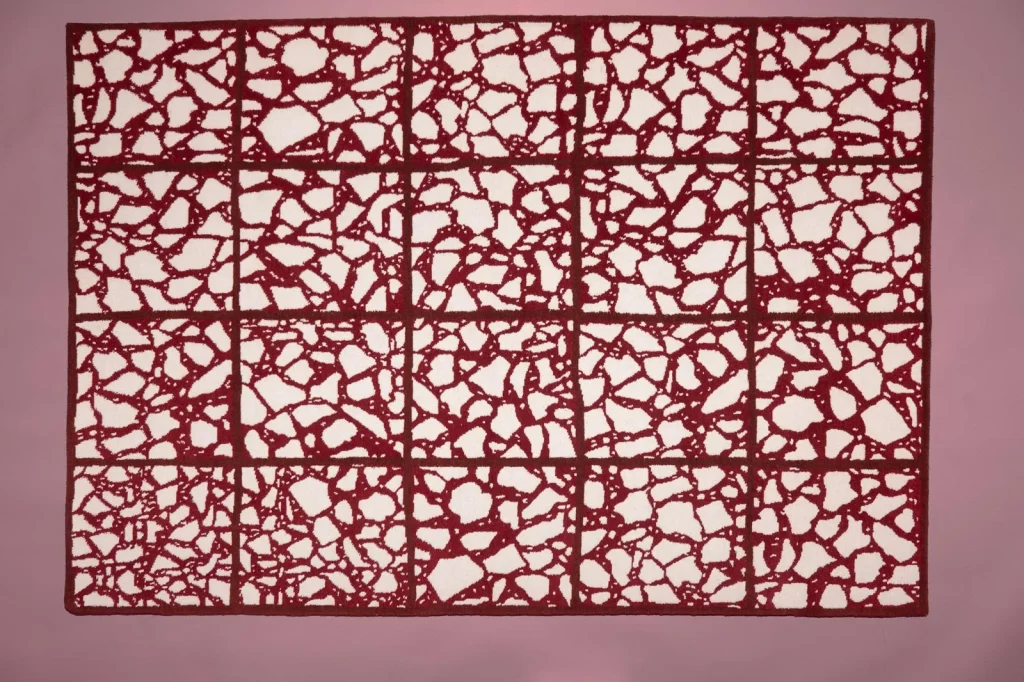
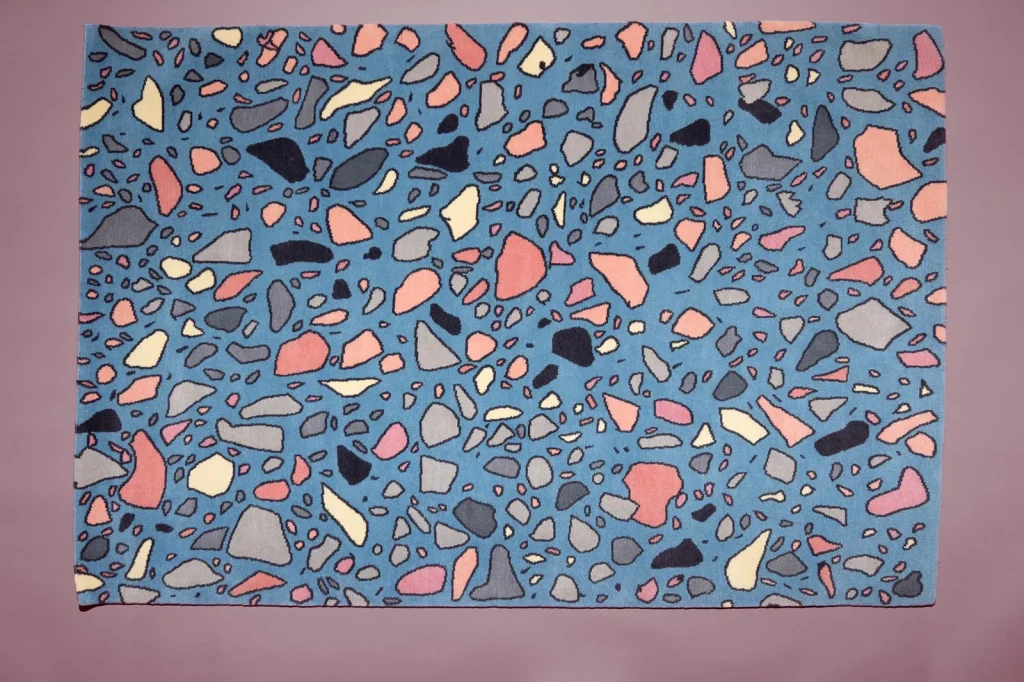
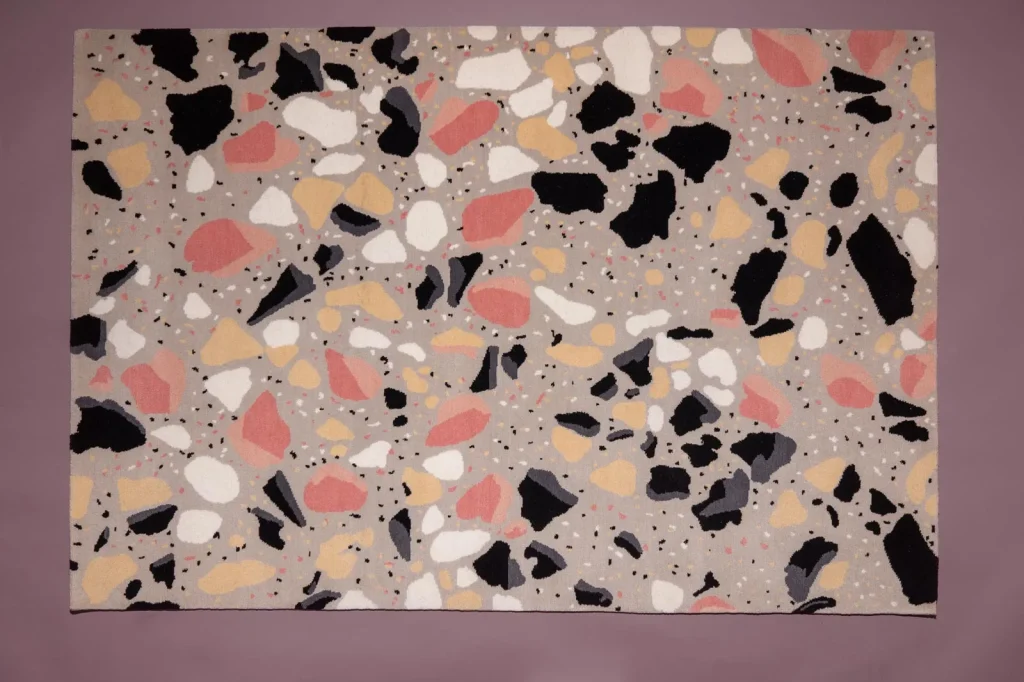
The contemporary demand is largely for custom work — designers specifying colour, scale and knot count for a specific room, which suits Nepal’s structure exactly. Studios working in rugs increasingly treat the Nepali workshop as a collaborator rather than a supplier, and the results sit closer to commissioned textile art than to floor covering. Our roundup of wool rugs worth looking at collects several.
Frequently asked questions
How can you tell if a rug is hand-knotted?
Turn it over. A hand-knotted rug shows the pattern on the reverse as a mirror image, built from visible individual knots, with no backing material. A hand-tufted rug shows a plain glued-on canvas backing. Machine-made rugs have uniform, perfectly regular reverses and often a serged rather than hand-finished edge.
What is the difference between hand-knotted and hand-tufted?
Hand-knotted rugs are woven on a loom, knot by knot, with the pile structurally integral and no adhesive. Hand-tufted rugs are punched through a canvas with a tufting gun and held by a glued backing. Knotting takes months and lasts generations; tufting takes days and depends on adhesive that eventually fails.
How long does a Nepalese rug take to make?
Months rather than weeks, depending on size and knot count. A large rug at 100 knots per square inch can occupy several weavers for the better part of a year, before washing, stretching and hand-finishing the edges.
How do you clean a wool rug at home?
Vacuum on suction only, with no beater bar. Blot spills immediately from the outside inward using cool water and a wool-safe detergent. Avoid steam cleaners, enzyme cleaners and anything containing bleach — wool is a protein fibre and all three damage it. Leave deep cleaning to a specialist rug washer.
Do wool rugs shed, and does it stop?
Yes, and yes. Loose fibre from cutting and finishing works out over roughly the first six months, more so with hand-spun yarn. Gentle regular vacuuming speeds it up. Heavy shedding continuing past a year points to short-staple wool or a failing tufted backing rather than normal settling.
Are Nepalese rugs ethically made?
The sector has a documented history of child labour, exposed in the 1990s, and the certification infrastructure built in response — GoodWeave in particular — is a direct result. That makes provenance more checkable here than in most handcrafts, but certification is not automatic. Ask which workshop wove the rug and whether it is certified.
Final thoughts
The route from a carpet woven for a newborn on the Tibetan plateau to a commissioned piece in a European interior runs through displacement, a refugee workshop in Kathmandu, an export boom, a scandal and a slow rebuild. Very few objects carry that much recent history and remain in continuous production.
Above all, what survived the whole sequence is technical: a metal rod, a continuous length of Himalayan wool, and a knife. That method has not needed changing in centuries, which is the strongest argument for it. Buy one and it should outlast you — provided you keep the beater bar away from it.