A lamp is a small commitment. The best ones make the room justify itself around them.
For a long time, 3D printed lamps occupied an awkward middle ground — interesting as demonstration, unconvincing as design. That has changed. The studios working in additive manufacturing today are not using the process as a shortcut. They are using it as a material logic in its own right: to grow forms that couldn’t be cast, to build structures that couldn’t be carved, to combine biopolymers and natural materials in combinations that would confound a traditional workshop. The result is a category of lighting that is difficult to place — somewhere between sculptural object and functional floor lamp, between contemporary craft and collectible design.
The eight pieces gathered here come from studios across Europe, the Middle East, and Japan. They span table lamps, floor lamps, and wall lamps — biopolymer and Washi paper, quartz sand and recycled coffee grounds, mythology and mushroom foraging. What they share is a commitment to making the technology invisible — or at least, to making it serve something worth looking at. Indeed, the surface interest that 3D printing offers (the layering, the translucency, the structural openness) is most compelling when it isn’t the point.
How to choose a 3D printed lamp
Choosing a 3D printed lamp starts with understanding what the process actually allows — and what it doesn’t. Unlike cast or blown pieces, additive manufacturing builds form layer by layer, which means the interior can be open, porous, or structurally complex in ways that would otherwise require expensive molding. Translucency is a recurring material quality: light passes through the printed body itself, diffusing warmly rather than simply emanating from a shade. This gives many 3D printed table lamps a particular glow at night — less directed, more atmospheric.
Furthermore, consider scale in relation to the room. A floor lamp in printed biopolymer can anchor a corner the way a piece of sculpture does — it occupies volume as much as it throws light. A table lamp, by contrast, works best when it can be seen up close, where the surface quality and material character read clearly. Meanwhile, a wall lamp in printed quartz sand brings additive manufacturing to a vertical plane, catching raking light differently across the day and functioning as much as wall art as illumination. Consequently, placement matters as much as the piece itself: these are not lamps that disappear into a room.
Material is the other axis. Corn-based PLA and biodegradable PETG are the most common, but some studios work with biopolymers combined with natural aggregates — sand, recycled coffee grounds — to add weight and surface variation. Notably, Washi paper combined with a printed internal structure represents an entirely different approach: warm, diffuse, historically rooted, yet formally inventive. Each material behaves differently with light and ages differently over time. A translucent PETG piece changes character dramatically when lit; a paper shade carries a warmth that printed polymer rarely matches. On the other hand, polymer pieces are generally more durable and easier to clean.
Types and styles of 3D printed lamps
The most visible category is the statement floor lamp — tall, freestanding, often a vertical gesture rather than a conventional fixture. These work as room anchors, occupying corners or marking thresholds between zones. By contrast, 3D printed table lamps tend to be more intimate: objects that reward proximity, where surface layering and translucency are experienced at close range. A third category — the illuminated sculpture — sits between lighting and object, designed as much to be looked at as to cast light. Finally, sculptural wall lighting pieces offer a way to bring the material language of additive manufacturing to vertical planes, catching light differently across the day. Each type occupies the room differently; the right choice depends on whether light or form is the primary consideration.
8 3D printed lamps from independent studios
Citadel Table Light Sculpture by Ultramar Studio

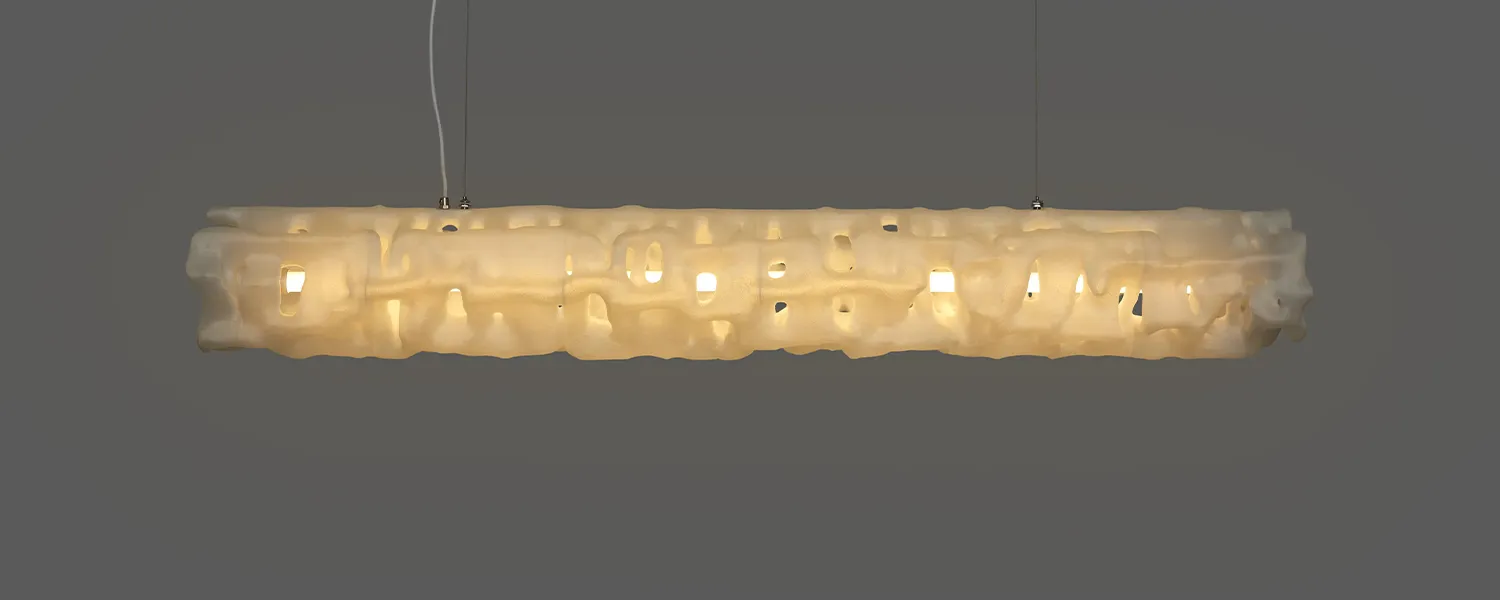
3D printed by hand and finished with careful attention to surface, the Citadel Table Light Sculpture is the compact edition of Ultramar Studio’s Citadel Collection — a series of illuminated objects drawn from Chinese palatial mythology and the thirty-three levels of the Heavenly Palace. Its gridded white body is printed in a repeating structural lattice that softens light into an even, quiet rhythm across its surface — less a lamp, more a scaled model of something sacred. Moreover, the piece is compact enough to sit on a side table or console without demanding the surrounding room shift to accommodate it, yet its architectural presence gives it a weight that most table lamps of this scale simply don’t carry.
By Ultramar Studio
€1,100 incl. tax
Alherd 3D Printed Floor Lamp by YET:FAB
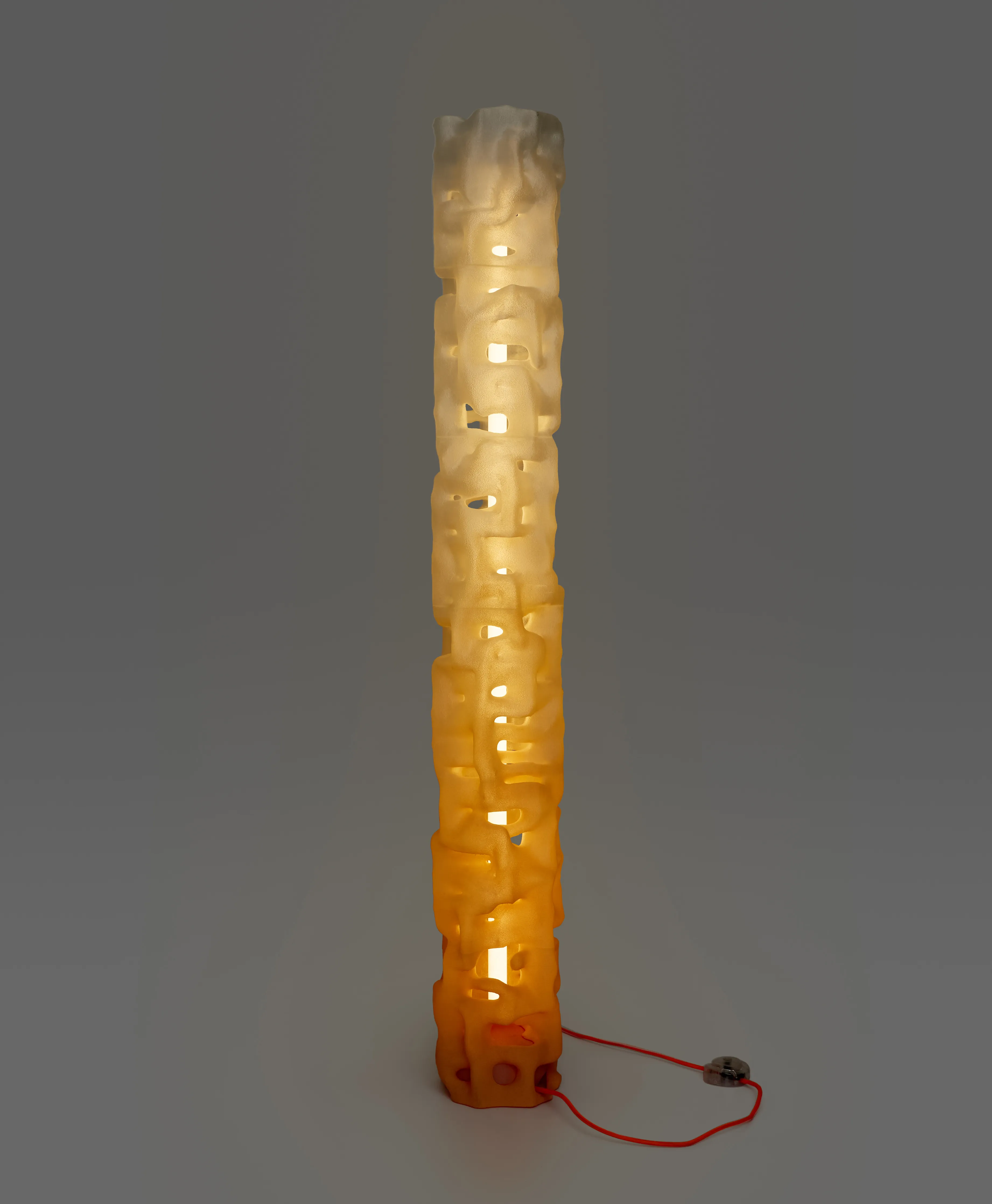
Printed from corn-based, recyclable PETG in the YET:FAB studio in Tel Aviv, the Alherd Floor Lamp is a tall, porous vertical form that glows from within — a column of diffuse light rather than a directed source. Its surface is drawn from coral and erosion patterns: the kind of structure that looks as though it accumulated rather than was designed. Indeed, the lamp is available in Gradient Pitch — shifting from deep amber to milky white along its height — or in a fully translucent finish, with an integrated T8 LED tube running its full length. As a result, it functions as an ambient light source and as a spatial object simultaneously, standing on the floor without any additional support, carrying its weight like natural architecture.
By YET:FAB
€1,695 incl. tax
Lampamodele, Blue by Béhaghel Foiny
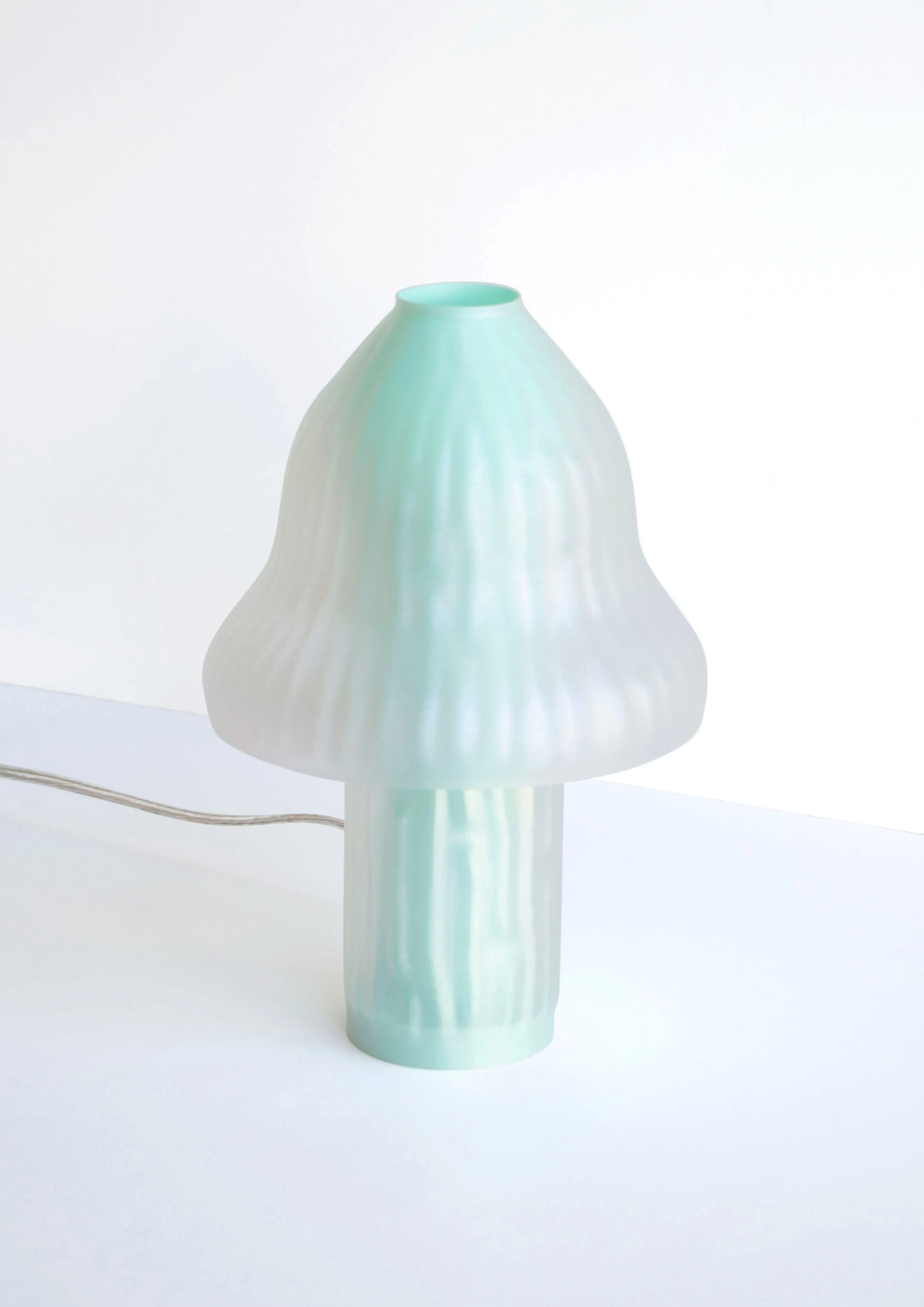
Digitally sculpted using a virtual surface-modelling interface before being printed in PLA and PVB filament, the Lampamodele by Béhaghel Foiny sits between design object and digital sculpture. Its chromatic, semi-transparent blue body holds light rather than directing it outward — the surface becomes the emitter, the shade and the source occupying the same form. The piece comes in orange and pink variants alongside the blue, but the blue reads with a particular cool clarity when unlit and shifts to something warmer when the lamp is on. Notably, at €99, the Lampamodele is one of the most accessible 3D printed table lamps on ADORNO — a strong introduction to the material language for collectors beginning to explore contemporary digital design.
By Béhaghel Foiny
€99 incl. tax
Blampa90 M Floor Lamp by Bluba Studio
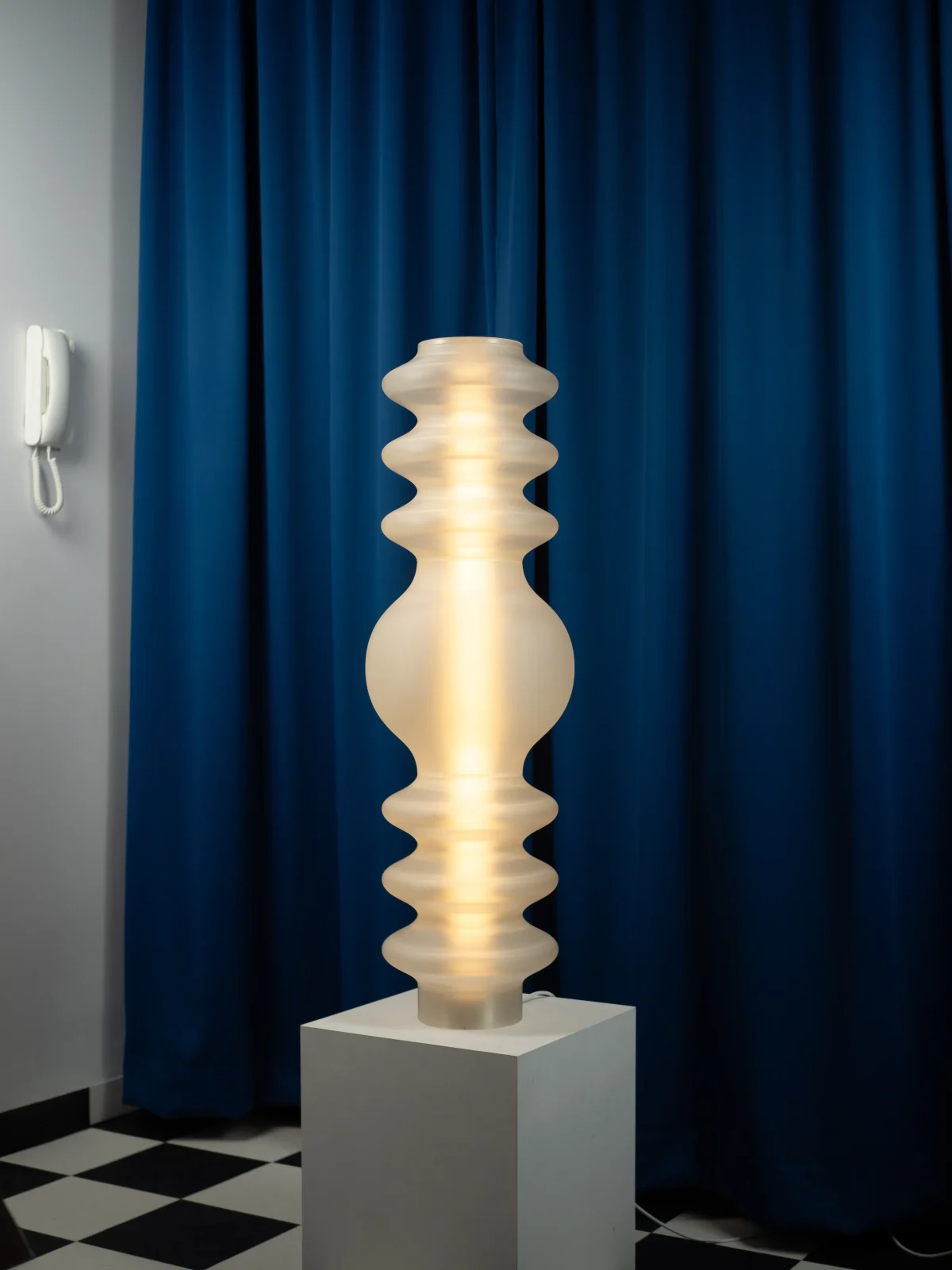
Designed and produced in Poland and printed from biodegradable PLA filament, the Blampa90 M by Bluba Studio is built from interchangeable modules that give each configuration its own visual rhythm. Its formal language draws on Memphis aesthetics — bold, graphic, pleasingly irrational — softened by the diffuse quality of light passing through the printed body. Specifically, the lamp accepts interchangeable light filters: switched off it reads as a translucent white floor lamp; switched on it can glow in pink, orange, blue, or green, or hold a clean neutral white. Furthermore, the modular build is not only a formal device but a practical one — components can be reconfigured, adapted, and in time replaced, giving the piece an unusual longevity for a lighting object in this price range. Launched as part of ADORNO’s Design Destination Poland campaign, it represents the playful, graphic edge of contemporary Polish sculptural design.
By Bluba Studio
€570 incl. tax
Sun VXS 01 — Organic Sand Wall Light by Rollo Studio
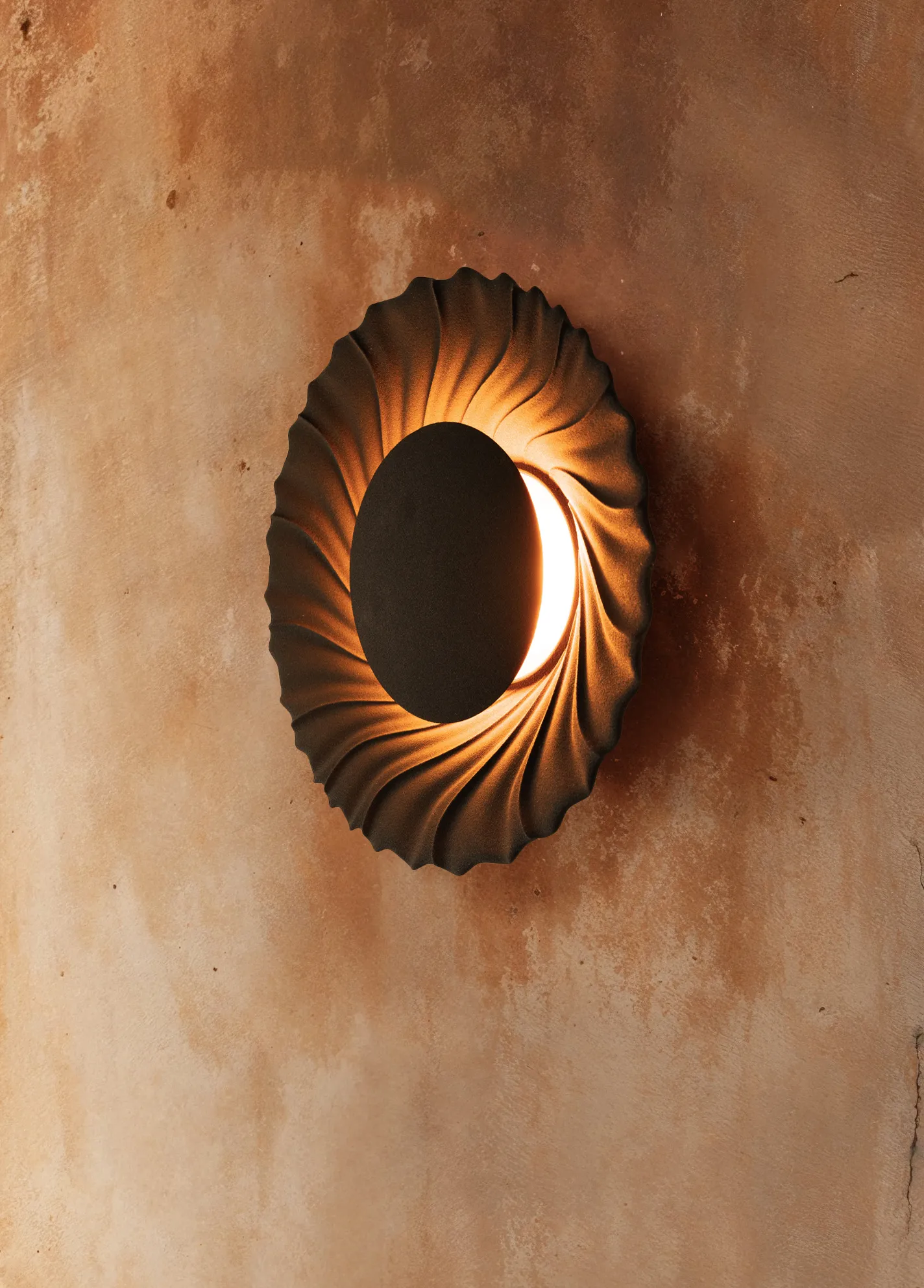
The Sun VXS 01 is made from natural quartz sand using Binder Jet Additive Manufacturing — a process categorically different from the PLA extrusion used by most studios here. Rather than melting filament layer by layer, binder jetting deposits a liquid binder onto a bed of sand granules to build the form from the raw material itself, yielding a surface texture and weight that reads closer to stone or cast ceramic than to polymer. The piece is wall-mounted, its spiral geometry drawn from the phyllotactic patterns of sunflower blooms — a form that catches raking light and casts dynamic shadows across the wall surface as the day moves. Part of Rollo Studio’s Aureole Collection, first shown at Masterly during Milan Design Week, the Sun VXS 01 operates as much as wall art as it does as light source — four G9 LEDs sit inside the shade, casting a soft, atmospheric glow behind its textured surface.
By Rollo Studio
€837 incl. tax
M 2 — Bio Polymer and Natural Sand Table Lamp by Diploria Studio
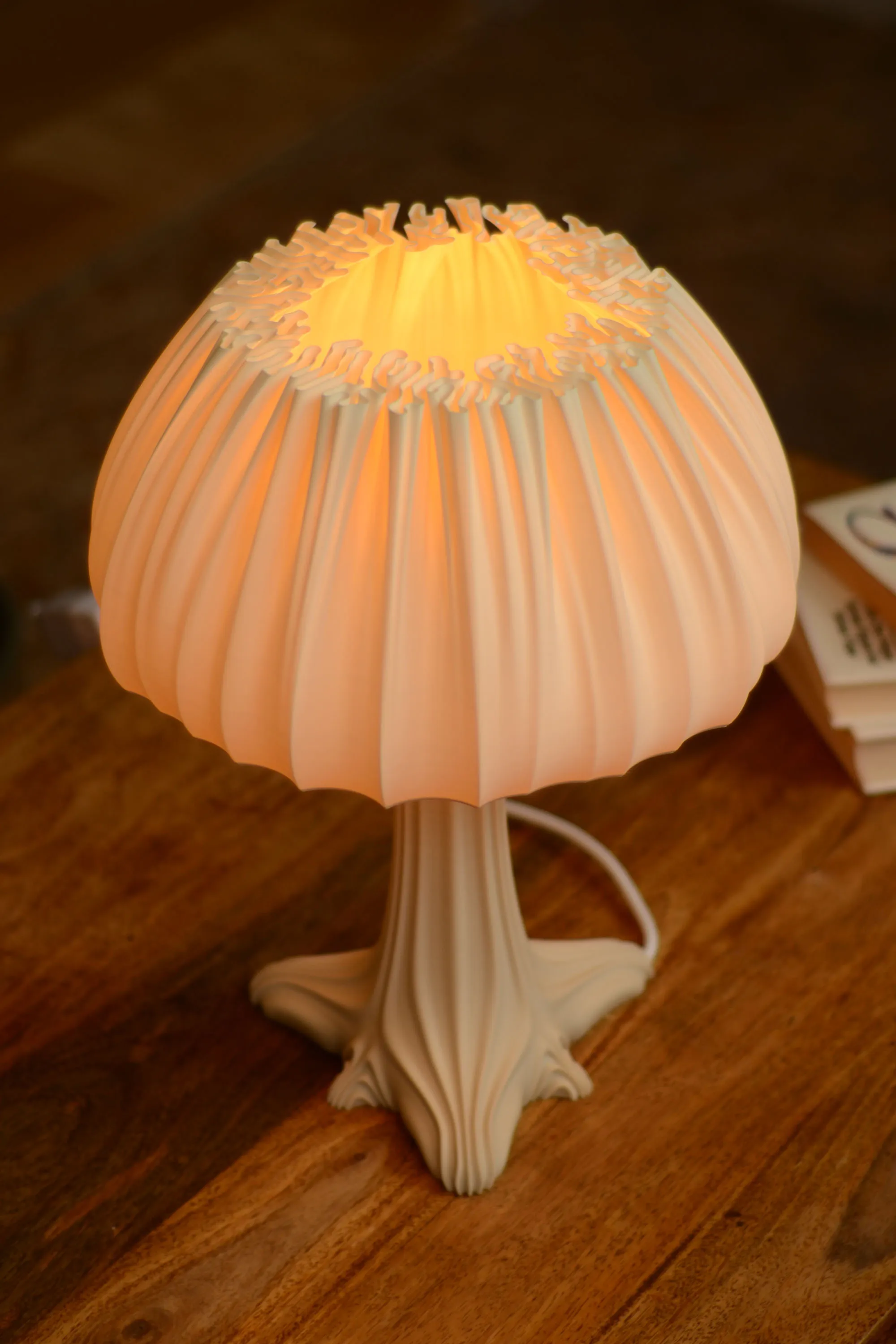
The M2 by Diploria Studio draws its formal character from brain coral and underwater vegetation — the branching, expanding logic of organic systems translated into a biopolymer shade weighted at the base with natural sand. The sand gives the piece a grounded, tactile quality that pure polymer lamps often lack; picking it up reveals an unexpected density, a sense of material honesty. Its printed shade can be detached and used as a pendant lampshade, adapting the piece to different spaces and contexts. Furthermore, a textile cable with an integrated dimmer allows the M2 to shift across a range of atmospheres — from a bedside lamp running low and warm to a desk object at full brightness — with the dimmable OSRAM LED included. As a result, its material palette — biopolymer, sand, textile, glass — reads as a conscious response to the throwaway quality of most mass-produced table lamps.
By Diploria Studio
€450 incl. tax
Mori Lamp by Julie Mallet

Printed from bio-based PLA derived from corn starch and tinted with recycled coffee grounds, the Mori by Julie Mallet is shaped after the morel mushroom — the hooded, pitted woodland species that emerges briefly in spring. Its silhouette is immediately recognisable yet quietly strange in a domestic context: a form borrowed from foraging, held in material borrowed from agriculture, lit from within. The coffee grounds give the printed surface a particular warmth and texture, a visual grain that registers as organic rather than industrial. Accordingly, Mori sits at the intersection of landscape memory and digital fabrication — the kind of table lamp that functions equally as a sculptural object on a shelf when unlit. It was added to ADORNO in June 2026 and is among the newest pieces in the collection.
By Julie Mallet
€145.83 incl. tax
Off-Form Lamp, Cube by Nao Iyama
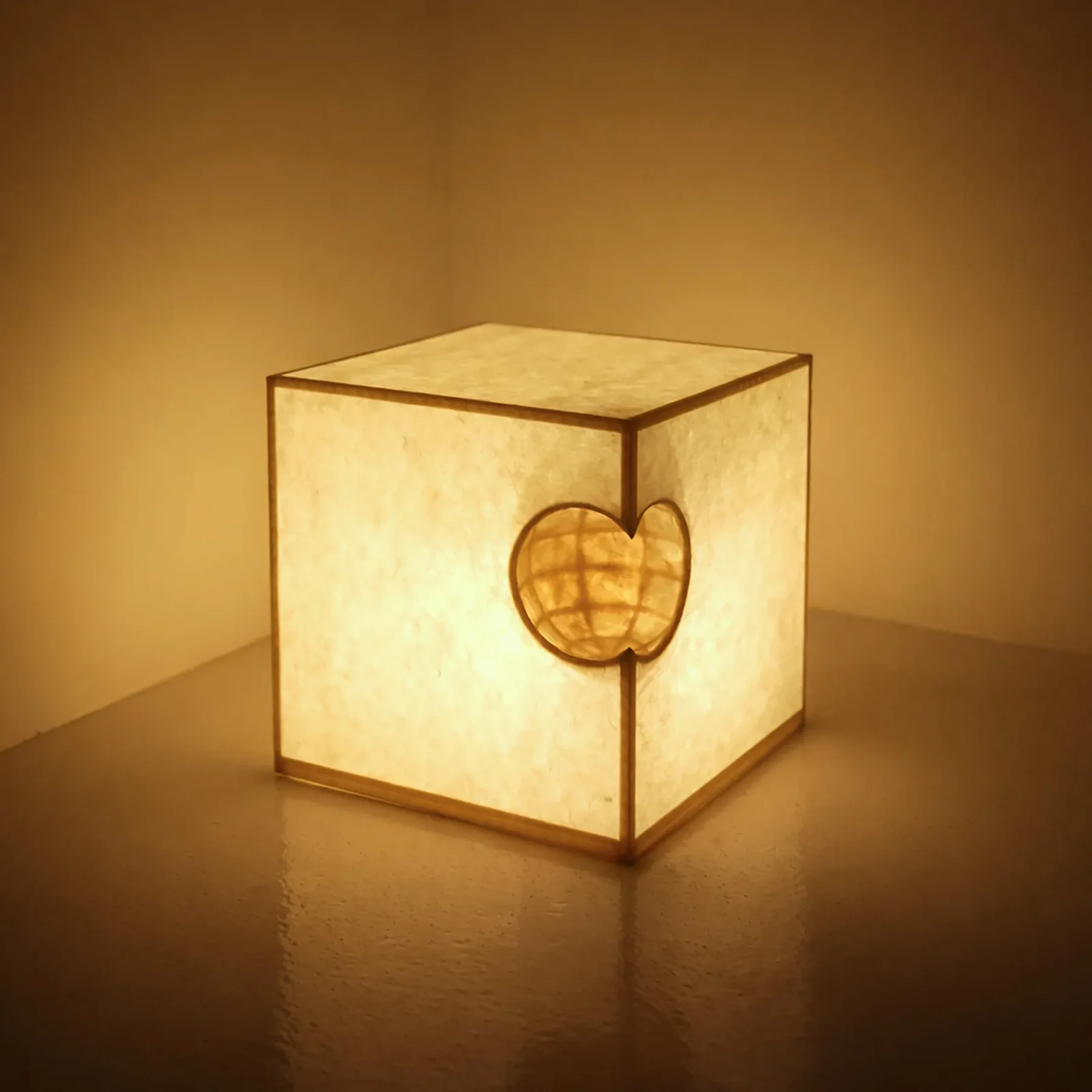
The Off-Form Lamp Cube by Nao Iyama combines handmade mulberry tree Washi paper with a 3D-printed internal structure — a response to the declining number of Washi craftsmen in Japan and a genuine attempt to extend a 1,500-year-old material’s relevance through contemporary digital fabrication. Traditionally, a Washi lamp requires a framework built from wood or bamboo, a skill that takes years to develop; by replacing that structure with a printed component, Iyama removes the technical barrier without compromising the material itself. The shade is assembled using water-soluble starch adhesive, meaning it can be repaired or replaced without discarding the whole lamp — a commitment to longevity that is rare in the lighting category. Formally, the piece challenges the restrained symmetry typically associated with Japanese design: the Cube embraces soft distortion and playful imbalance, familiar yet subtly unstable. It arrived on ADORNO in June 2026 and is one of the most conceptually considered new pieces in the collection.
By Nao Iyama
€1,350 incl. tax
Materials and construction
The material range across these eight pieces is broader than it might first appear. PLA — polylactic acid, derived from corn starch — is the most common substrate: biodegradable, available in translucent grades, and printable in a color range that spans neutral white to deep amber. PETG, used in the Alherd, is tougher and more impact-resistant, with a particular clarity when printed in translucent form that reads cleanly under light. Moreover, biopolymer composites — the M2’s sand-weighted base, Mori’s coffee-ground pigmentation — introduce natural aggregates into the printed body itself, shifting the material register away from industrial plastic toward something closer to craft ceramic or stone.
The Sun VXS 01 represents a third process entirely: binder-jet printing in quartz sand, which produces a dense, mineral surface that has more in common with cast sandstone than with extruded polymer. The resulting piece doesn’t look or feel 3D printed in any conventional sense — it looks grown from the earth. Washi paper, as used in the Off-Form Lamp, operates in yet another category: the paper shade diffuses light with a warmth that polymer cannot replicate, and the printed internal structure enables forms that the traditional bamboo frame never could. In other words, these are not variations on a single technology — they are four distinct material disciplines that happen to share the additive manufacturing label.
Construction across all these pieces is hand-finished. 3D printing produces a primary form; the studio then sands, treats, assembles, and wires the piece by hand. Accordingly, subtle surface variations are inherent to the process — not defects, but evidence of the fabrication method. This is the digital-craft character that distinguishes an independently produced printed lamp from a mass-manufactured one.
Where 3D printed lamps work best
The translucent character of most printed polymer lamps makes them particularly strong in rooms where atmosphere takes precedence over task lighting — a living room corner, a bedroom side table, a dining room sideboard. At lower light levels, the printed body itself becomes the light source, glowing softly from within rather than casting a pool of directed illumination. This is not a category for focused reading light; it is a category for presence.
Sculptural floor lamps like the Alherd and the Blampa90 work particularly well in transitional spaces — hallways, the junction between a dining and living area, large open-plan rooms that need a vertical element to hold the eye. The Sun VXS 01 works best on a wall with good raking light — a side wall in a living room, an alcove, or a hallway where the sand texture and shadows can be read clearly. Meanwhile, the more intimate table pieces — Mori, the Lampamodele, the M2 — reward placement close to a seating area, where they can be seen at the scale they were designed to be experienced. The Citadel, by contrast, earns its place on a surface that invites close attention: a study desk, a console, a shelf dedicated to collectible objects.
As Dezeen has noted in its coverage of additive manufacturing in design, the studios most successfully integrating 3D printing into lighting are those treating the technology as a material discipline rather than a production convenience — which is precisely what distinguishes the eight studios here.
Installation, placement, and care
Electrical compatibility
Most pieces on ADORNO ship with EU plugs as standard. UK and US adapters are often available on request directly from the studio — confirm before ordering if you are outside the EU. The Off-Form Lamp Cube is explicitly designed as internationally bulb-compatible. The Sun VXS 01 ships with a 3m cable and EU plug; G9 LED bulbs are included. For pieces with integrated LED tubes (the Alherd), no bulb replacement is required. For E14 socket pieces like the M2, ensure you are using a dimmable bulb if the lamp includes a dimmer switch.
Positioning and stability
Tall printed floor lamps — the Alherd in particular — are freestanding and do not require wall support, but they are best placed away from high-traffic zones where they might be knocked. The modular Blampa90 should be assembled on a stable, level surface before final positioning; its module joints are designed to hold under normal use but are not intended to bear lateral force. Table pieces with sand-weighted bases (the M2) have a notably low centre of gravity and are more stable than their visual profile suggests. The Sun VXS 01 mounts to the wall via the included mounting kit — ensure fixings are rated for the piece’s 8 kg weight, especially on plasterboard.
Cleaning and surface care
PLA and PETG surfaces should be cleaned with a dry or very slightly damp cloth — avoid solvents, alcohol-based cleaners, and abrasive materials, which can cloud or craze the surface. Translucent pieces show fingerprints readily; a microfiber cloth is the most effective tool. The Sun VXS 01’s quartz sand surface should be dusted with a soft dry brush — avoid moisture, which can penetrate the binder and weaken the surface over time. Washi paper shades (the Off-Form Lamp) should be dusted with a dry brush only — moisture will damage the paper. Keep all printed polymer pieces away from sustained direct sunlight, which can cause color shift over time.
Customization options
Several studios offer customization directly, making it possible to commission a 3D lamp personalized to specific preferences. The Alherd floor lamp can be specified in different gradient finishes, socket types, and cable colors; the Blampa90’s modular construction and interchangeable filters allow configuration at the point of order; the Lampamodele is available in orange, pink, and blue. In each case, reach out to the studio directly via the piece page — the studios listed here are independent makers who build to order and are generally responsive to specific requests.
Frequently asked questions
Are 3D printed lamps durable?
Yes, when produced from PETG or high-quality PLA and hand-finished by a studio. These are not consumer-grade filament prints — each piece is engineered for long-term use as a functional lighting object. PLA is somewhat more susceptible to heat than PETG, so avoid placing PLA pieces near radiators or in environments that regularly exceed 40°C. PETG and biopolymer composites are more thermally stable. Quartz sand pieces like the Sun VXS 01 are extremely durable — the binder-jet process produces a material closer to compressed sandstone in terms of surface hardness.
What kind of bulb does a 3D printed lamp use?
It depends on the piece. Many use standard E14 or E27 sockets and accept any compatible LED — the studio’s product page will specify. Pieces with integrated LED tubes (like the Alherd) require no separate bulb. The Sun VXS 01 uses four G9 LED bulbs, which are included. Where a dimmer is included (as with the M2), always use a dimmable LED to avoid flickering or damage to the driver.
Can I use a dimmable LED in any 3D printed lamp?
A dimmable LED will work in any lamp with a compatible socket, but it will only dim if the circuit includes a dimmer switch. If the lamp has a standard non-dimming switch, a dimmable LED will function at full brightness only. The M2 includes an integrated dimmer; other pieces listed here do not, unless specified at point of order.
Are these lamps wired for my country?
Most pieces ship from European studios with EU (Schuko) plugs. UK and US compatibility is typically available on request — confirm with the studio before ordering. The Off-Form Lamp Cube is designed to accept international bulb standards. For pieces with integrated LED drivers, voltage range (usually 220–240V) is specified on the product page.
How is a 3D printed lamp different from a mass-produced one?
The key differences are form freedom, material specificity, and production scale. Additive manufacturing allows structures that casting and injection molding cannot produce economically — open lattices, porous surfaces, gradient translucency. Pieces are built to order in small quantities, hand-finished, and in some cases fully customizable. The trade-off is lead time: most pieces here are produced on order and ship within two to eight weeks depending on the studio.
Is 3D printed PLA or PETG environmentally friendly?
PLA is bio-based and compostable under industrial conditions, though it does not biodegrade easily in a domestic context. PETG is recyclable. Several studios here go further: the Mori uses recycled coffee grounds as pigment; the Off-Form Lamp uses a repair-and-replace shade construction that extends the life of the object significantly; the Sun VXS 01 is described by Rollo Studio as sustainably made, with the quartz sand process generating minimal waste relative to subtractive methods. As a category, independently produced printed lamps generally have a smaller production footprint than equivalently priced mass-manufactured lighting, given the absence of tooling, minimum order quantities, and intercontinental logistics chains.