
-

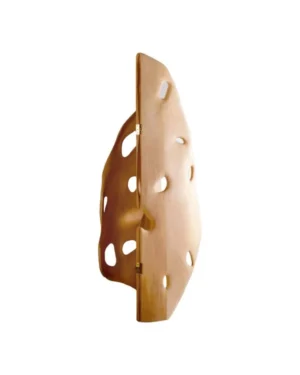
Nolastar – Room Divider And Curtain
By Pablo Octavio
€220 - €330 This product has multiple variants. The options may be chosen on the product page -
 In stock
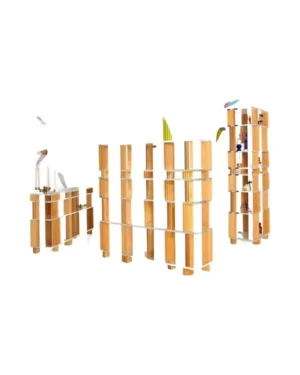
Dryft No 1 Spatial Divider
By BLUBA Studio
€3.500 -
 In stock
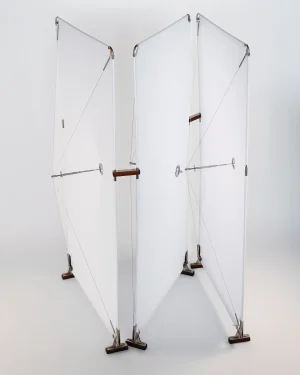
Plĭco – Folded Divider
By Atelier Nuanda
€10.588 -
 In stock
Modular Textile Room Divider
By Szostak Atelier
€5.370 -
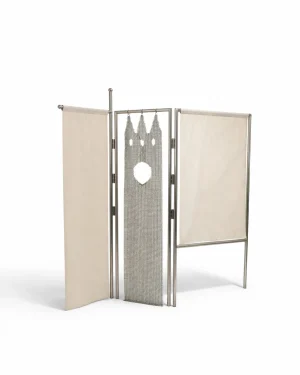
Gonfalon Paravent, Room Divider In Textile And Metal
By Panorammma Atelier
€7.400 -

Crumbled Screen
By Nitush and Aroosh
€10.500 -

Wadi Screen
By TheUrbanative
€2.200 -
 In stock
Vittoria
By M’ama edizioni
€3.000 -
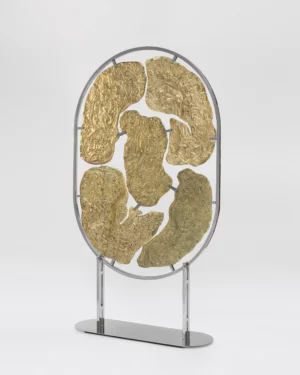
Pangea Asym, Lunar Edition Contemporary Screen
By Wanderart
€16.000 -
 In stock
Riot Shield – Stainless Steel Screen
By Around the Studio
€4.400 -
 In stock
Modern Stainless Steel Biombo Aaa – Room Divider
By Toro Manifesto
€6.720 -

B D | Room Divider
By N I S H
Price Upon Request -

Paravent, Objects Of Service – Room Divider
By Haritini Gritzali
Price Upon Request -
 In stock
Echo
By FURN OBJECT
Price Upon Request
Metal room dividers are freestanding or hinged panels built from steel, stainless steel, aluminum or brass, worked by studios through welding, powder coating or CNC milling into screens that hold their shape without a frame of wood behind them. The metal itself does the structural work, so panels can run thin, perforated or cut through with pattern while still standing upright on their own. These are pieces made to divide a room the way a wall might, but with the option to fold, slide or be lifted away.
What defines a metal room divider
Where a wood or textile screen softens a room, metal holds a harder line. Sheet steel and aluminum take sharp edges and flat planes, which is why so many of these pieces read as geometric: grids, perforated panels, sculptural cutouts that throw shadow as much as they block sight. Brass and chrome finishes catch light across a room, while powder-coated steel sits matte and absorbs it, so the metal chosen changes how a divider behaves in a space long before anyone touches it.
Welding joins panels into rigid frames that stand without extra bracing. CNC milling and digital fabrication cut repeating patterns or openwork designs with a precision that hand tools cannot match, which is part of why metal dividers tend toward the geometric and the architectural rather than the organic. Some studios work in small or limited runs, others produce unique pieces one at a time; open editions exist too, where a design is remade to order rather than fixed to a single batch.
Finishes and colors to expect
Stainless steel and chrome read cool and reflective. Powder-coated steel and aluminum come in flatter, matte colors: gray, off-white, beige, sometimes a deeper burgundy, with the coating also working as a layer of protection against scratching and corrosion. Brass starts warm and will darken or spot with handling and air unless it carries a sealed lacquer, which is worth asking about before buying. Style tends to follow the finish, so neo-industrial and futuristic designs lean toward raw or blackened steel, while mid-century modern and space-age pieces often favor brass, chrome or polished aluminum.
Choosing a metal room divider
Scale and height matter more with metal than with lighter materials, since a steel panel can be heavy enough to need two people to move. A divider should sit a head or so above eye level to read as a real partition rather than a low screen, though lower panels work well for marking a zone without fully closing it off. Check whether a piece is freestanding, hinged into folding sections, or meant to be fixed to a wall or ceiling track, since that affects both placement and how often it is meant to move.
Finish should answer to the room around it: a matte powder coat recedes against busy surroundings, while polished chrome or brass adds a reflective, almost ornamental presence to a plain room. For anyone drawn to pattern or sculptural cutwork, a CNC-milled or perforated panel gives privacy without blocking light or airflow entirely, which is useful in a room with few windows.
Where metal dividers work
They hold up well in open-plan living and dining areas, where a single panel can define a seating zone without building a permanent wall. In an entryway, a divider screens the front door from the rest of the apartment and gives arriving guests a moment of transition. In a studio apartment or home office, a folding steel screen can separate a sleeping area or a desk from the rest of the room and be moved aside when it is not needed.
Caring for metal panels
Routine care is light.
The full range of room dividers, including those built in wood rather than metal, sits within all room dividers, and every current metal piece can be seen under metals on ADORNO. For a softer alternative, wooden room dividers trade sharp edges for grain and warmth. Those after a one-off or small-batch piece can look through limited edition room dividers, and the same metalwork and finishes extend into other metal furniture across the gallery.
How do I choose a metal room divider?
Consider the gauge and finish, steel and aluminum read differently depending on whether the surface is welded, powder coated or left raw. Match the frame density to how much privacy or light flow the space needs.
Are metal room dividers hard to maintain?
Most finishes only need a wipe with a dry or slightly damp cloth. Powder coated steel and aluminum resist scratches and corrosion well, though raw steel can develop a patina over time if left untreated.
What size and height should a metal room divider be?
Panels typically run from waist height to ceiling height, depending on whether the goal is a visual cue or full separation. The maker can confirm exact dimensions through Chat with the maker on the piece's page.
Which rooms suit a metal room divider?
Open-plan living rooms, studio apartments and entryways all benefit, since metal frames define zones without fully closing them off. Their slim profiles also suit offices where floor space stays limited.
Can metal room dividers be freestanding or fixed to a wall?
Most are freestanding, built with a stable base or hinged panels that let them move or fold as needed. Wall-mounted or fixed versions exist too; the maker can confirm the setup for a specific piece.
How does shipping, returns and authenticity work when buying through ADORNO?
Shipping is insured and worldwide. Returns are accepted within 14 days, though made-to-order pieces are excluded, and every piece arrives with a certificate of authenticity alongside a lowest-price guarantee.