
Modular Furniture Design: How to Decorate With It
Updated on: August 28, 2026
Modular furniture solves a specific problem: you cannot know now what a room will need to do in three years. A loveseat becomes a four-seat sofa when the family grows, a shelf unit extends when the books outgrow it, and a set of boxes becomes a table, a bench or a record store depending on the week.
What follows is how to actually decorate with it — the rules that make a modular room read as designed rather than assembled — then seventeen pieces from independent studios, priced.
How to decorate with modular furniture
Modular pieces fail in rooms for predictable reasons, and all of them are avoidable.
1. Commit to one modular system per room
Two modular systems in the same space read as indecision, because each announces its own grid and the two grids will not agree. Pick one — the sofa or the shelving — and let everything else be fixed furniture. The exception is when both come from the same studio and share a module size.
2. Anchor the arrangement to something immovable
A reconfigurable piece floating in the middle of a room looks temporary. Set it against a wall, a window line or a rug edge so the composition has a fixed reference. This is the single most common mistake: modular furniture needs a boundary precisely because it can move.
3. Break the grid deliberately, once
Modules produce repetition, and unbroken repetition reads as storage rather than furniture. Leave one bay empty, turn one box on its side, or place a single non-modular object — a vase, a lamp, a stack of books — where the pattern would otherwise continue. One interruption is enough; three looks accidental.
4. Buy the expansion you might want now
The practical warning. Independent studios run short production batches, and finishes drift between them — a walnut module bought two years later may not match, and a fabric may be discontinued outright. If you think you will extend, buy the extra module with the original order or confirm in writing how long the finish will be available.
5. Check how it actually connects
Bolted, clicked, stacked or free-standing — this determines whether you will ever reconfigure it. A system needing tools and two people gets set up once and never touched again. The pieces below that click or stack without fixings are the ones that genuinely get rearranged.
Modular storage and shelving
Mara No. 2 – Oak Wood Shelving Unit by Guillaume Thireau
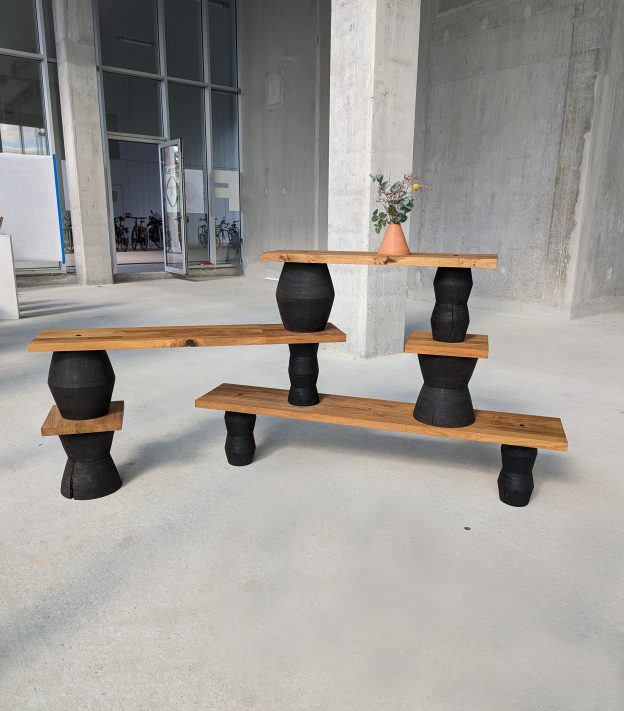
A modular shelving system by French designer Guillaume Thireau, with structural and sculptural components turned on a wood lathe. The detail that matters: shelves are pre-drilled at several points, so the composition can be changed after assembly rather than being fixed at build. Rustic with a mid-century modern edge.
Pixel – Modular Storage System by Bogdan Kryvosheya

A box system joined with bolts and nuts, simple enough that children can reconfigure it. Originally designed for vinyl records, which explains the proportions — and means it holds LPs properly, something most cube storage does not. Stack for shelving, spread for a low table, or use single units as drawers. Almost any colour finish on request.
Stack 021 – Raw Aluminium by studio MOTO

By Ghent architects studio MOTO — a family of stackable furniture built from a small number of aluminium components that make cabinets, shelves, totems or coffee tables. It clicks together with no screws or fasteners at all, which is why this is one of the few systems here that genuinely gets rearranged rather than assembled once.
Pin – Modular Shelf System by hermhaus
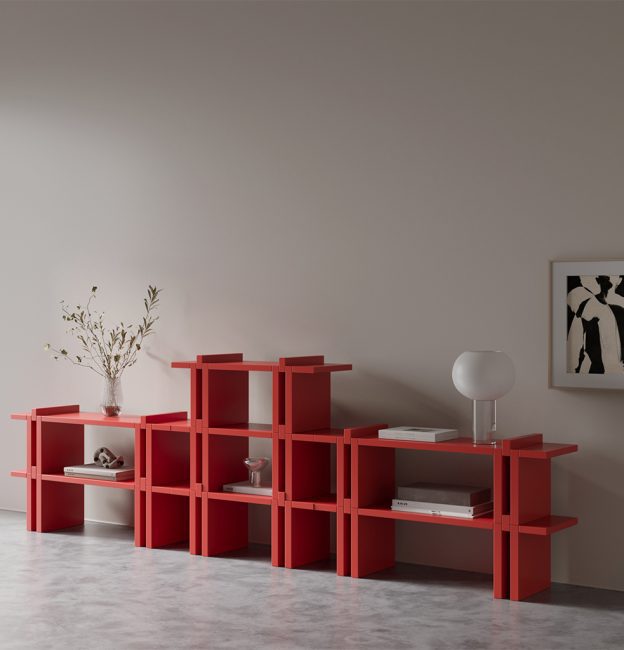
Vertical supports and horizontal surfaces in two length options, multiplied vertically or side by side. The name comes from the pin connection, which removes assembly and disassembly entirely — no tools, no fixings. Practically, that is what separates a system you will reconfigure from one you will not. More in wooden shelf design.
Modular Spruce Shelf by Frau Caze – Carolin Zeyher

The simplest construction here, and the cleverest: elements stack on each other with squared timber acting as both spacer and connector. No hardware at all. Set the modules vertically, or side by side as a sideboard that doubles as a bench. Using a taller timber connector turns two-dimensional shelves into flat compartments.
NOPPER – A Functional Toy for Adults by Bram Kerkhofs Design Studio

A cupboard or desk system that came out of research into children’s plastic building blocks. Studded parts attach to each other, and varying the diameters and grid positions produces results ranging from minimal to almost baroque. The most literal expression of the modular idea on this list.
Living Sculpture – Modular Furniture Set by SKNYPL
[IMAGE TO REPLACE — Living Sculpture Modular Furniture Set: https://adorno.design/pieces/living-sculpture-modular-furniture-set/]
Built from 200-year-old pine salvaged from a Georgian railway sawmill — timber that had already served one purpose for two centuries. The modules work as seating, surface or storage depending on arrangement, and because each is cut from reclaimed stock the grain differs between them, which breaks the repetition modular systems usually suffer from. More on the material in thrifted design.
Modular seating and sofas
Kanz – Sofa in Green & White Stripes by hermhaus
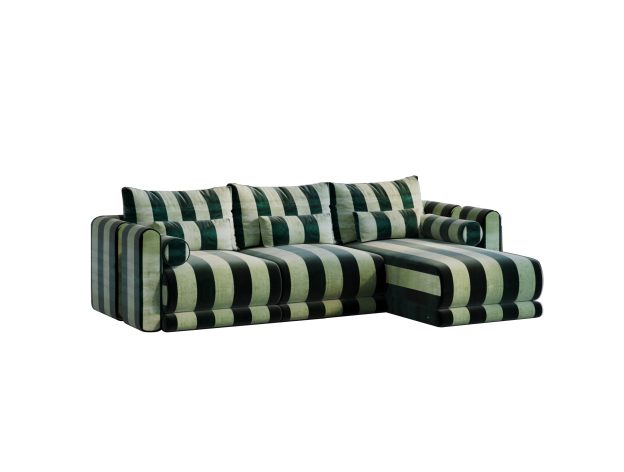
A modular sofa with simple lines and several module options. The striped upholstery is worth thinking about before ordering: pattern across a modular sofa either aligns between units or it does not, and a stripe makes any misalignment obvious in a way plain fabric hides.
Meta Chair – Upholstered Modular Chair by Jaclyn Pappalardo
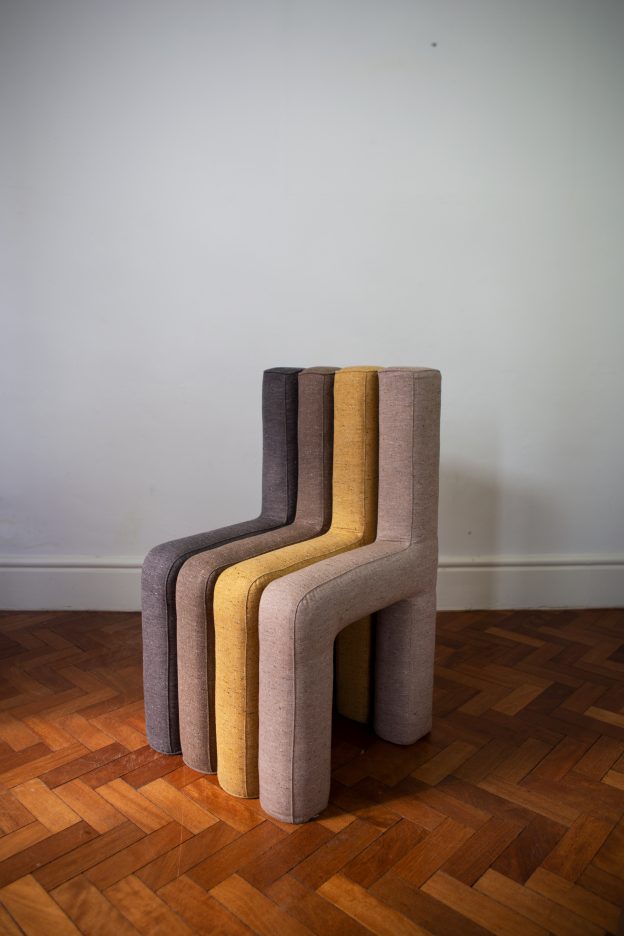
An interlocking system that joins sections together, extending into four parts, five or more. Colour is specified per section, so the piece can be built as a single tone or as a deliberate sequence — which makes it one of the few modular seats where extending later is a design decision rather than a matching problem.
Porto Sofa Set 1 by Project 213A

Modules that arrange and combine to fit the space, finished in mirror-effect faux metallic leather. The reflective surface does something useful in a small room — it reads as less bulky than its footprint, because you see through the reflection rather than at a solid mass.
Come As You Are, And Stay Together! – Three-Piece Bench Ensemble by Lyk Carpet
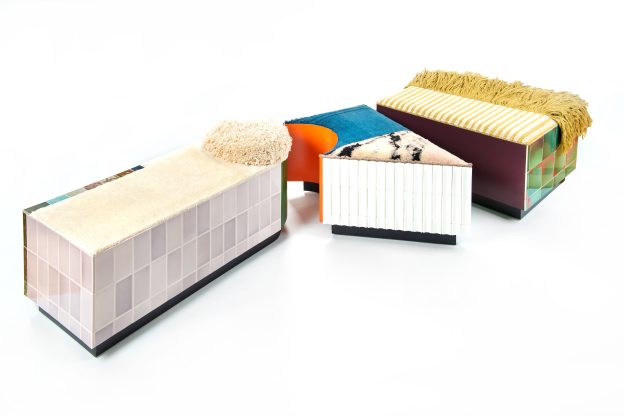
A three-piece bench ensemble by Berlin’s Lyk Carpet, pairing carpet with handmade tiles from the Golem brand. Wool against fired clay is an unusual combination for seating — one absorbs sound and the other reflects it, so the pieces change the acoustics of a room as much as its layout.
Magma – Modular Sofa by ray barn

Mounted on an ash base, with a gradual rise and fall through the backing that produces both backed and backless seating positions in one run. An attached side table is part of the structure rather than an accessory — which solves the usual modular problem of nowhere to put a drink.
Modular tables and desks
Ash Table System by ray barn

Gui – Modular Desk by PROSA
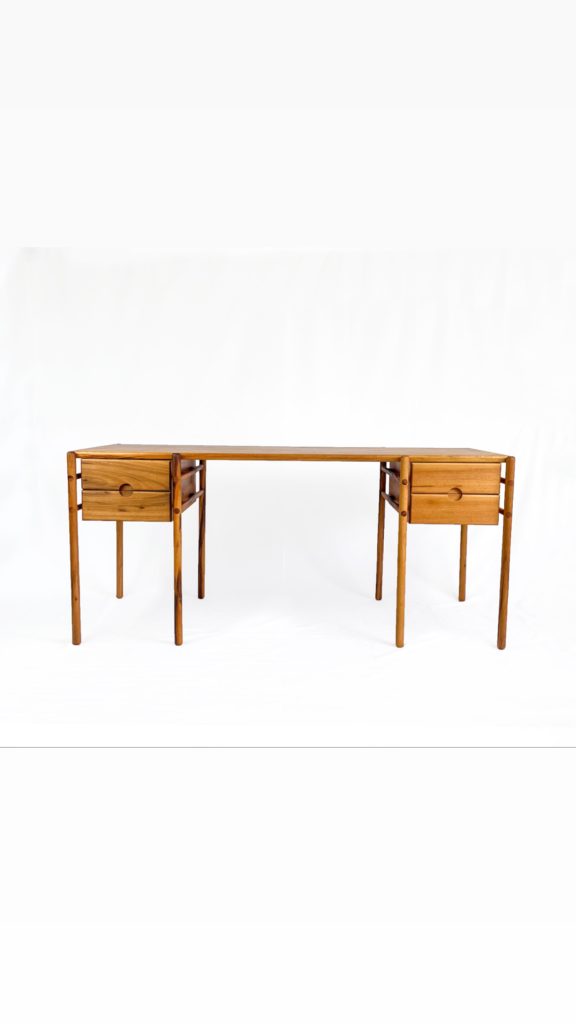
A desk that takes up to two modules of two drawers each, fitted horizontally along the legs. Mounting the storage on the leg line rather than under the top is what keeps the piece looking light — the space beneath stays open. Solid wood with traditional joinery.
“Reidi” Modular Tables by Studio Lél

Named for the Persian word for poppy. The motif combines two techniques: sixteenth-century Italian Pietra Dura stone inlay, and Chinese silver cloisonné outlining with metal strips — a signature the Lél workshop has developed over two decades. Sold as a set of three, so the modularity is in how you group them.
Modular lighting and decor
The Emotional Lab Light – Beige by Hania Jneid
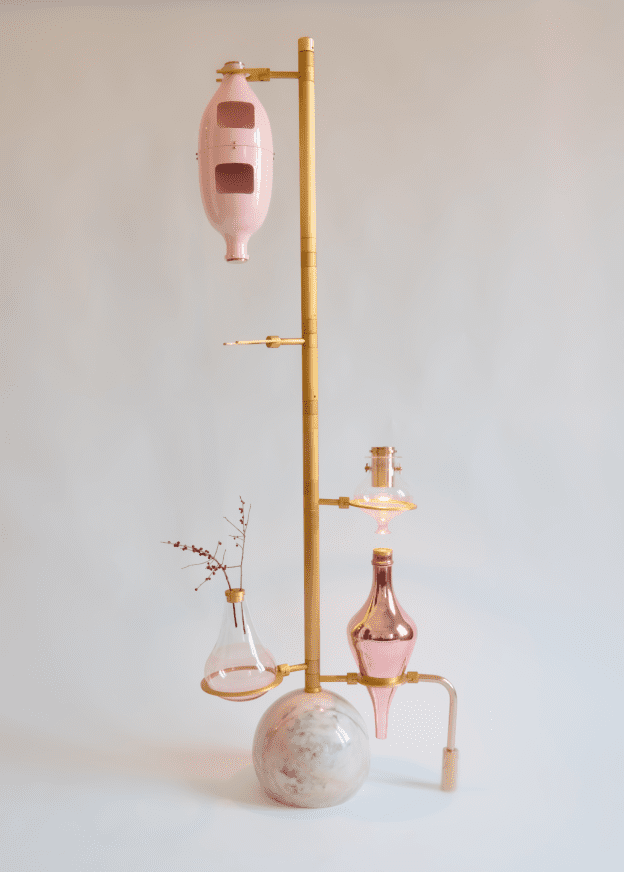
A slender metal stand carrying beaker-like glass vessels, drawn from the look of a chemistry set. Optional metal modules — a vase, a small storage unit — clip on to change what the piece does, so the same floor lamp can be a side table with a light attached. Modularity applied to lighting is rare, and this is the clearest example of it here.
Modular Textile Room Divider by Szostak Atelier
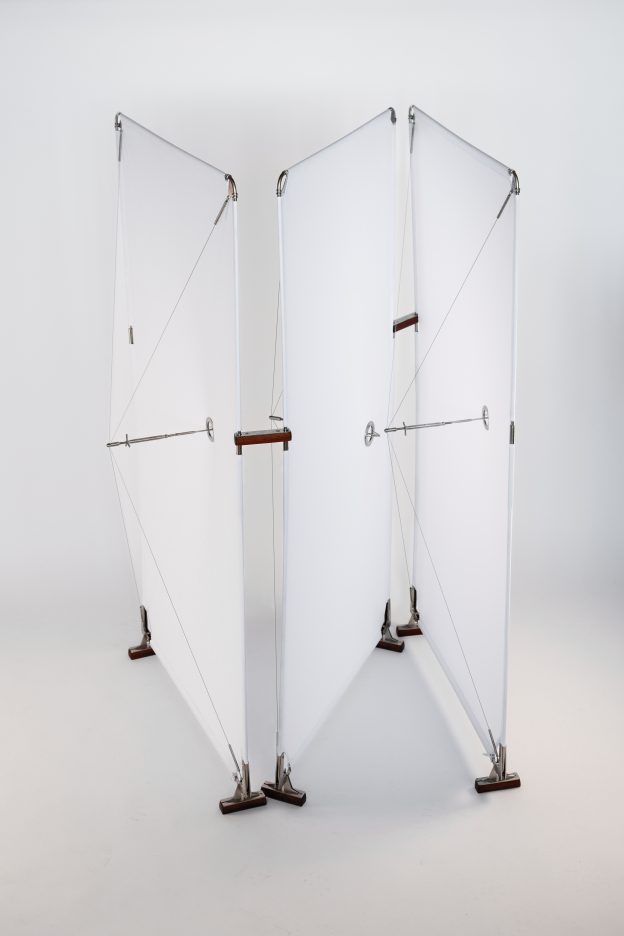
Lightweight materials held by a tension system borrowed from yacht rigging — the frame stays rigid through tension rather than mass, which is why it can be this slender. Modules adjust to different spatial needs, making it the most genuinely reconfigurable piece here: a room divider that changes shape as the room’s use changes.
Frequently asked questions
What is modular furniture?
Furniture built from repeatable units that combine in more than one arrangement, and can usually be added to later. The defining feature is that the configuration is chosen by the owner rather than fixed by the maker.
How do you decorate with modular furniture without it looking like storage?
Break the grid once — leave a bay empty, turn one unit, or place a single non-modular object where the pattern would continue. Unbroken repetition is what makes modular systems read as shelving rather than furniture. One interruption reads as deliberate; several read as accidental.
Can you mix two modular systems in one room?
Better not to. Each system establishes its own module size and grid, and two competing grids read as indecision rather than variety. Choose one to be modular and let the rest of the room be fixed furniture — unless both systems come from the same studio and share dimensions.
Will I be able to buy matching modules later?
Ask before you buy. Independent studios work in short batches, so timber finishes drift between production runs and fabrics get discontinued. If you expect to extend, order the extra module at the same time or get written confirmation of how long the finish will be available.
Is modular furniture more sustainable?
It can be, for two reasons: a piece that adapts is less likely to be replaced, and one that disassembles can be repaired part by part rather than discarded whole. The caveat is that a system relying on proprietary connectors becomes unrepairable if the studio stops trading — so simple mechanical joints age better than clever ones.
Does modular furniture suit small spaces?
Particularly well, since you buy only the modules the room fits and extend if you move somewhere larger. Systems that stack vertically or click apart without tools are the most useful in a small flat, because the arrangement can change with the season rather than staying fixed for years.
Modular design for flexible futures
Modular furniture lets a home change shape around its occupants — reconfiguring for a growing family, a new working pattern or simply a different season. The trade-off is that it asks something of you in return: a decision about arrangement that fixed furniture makes on your behalf. The pieces above are the ones worth making that decision for.
