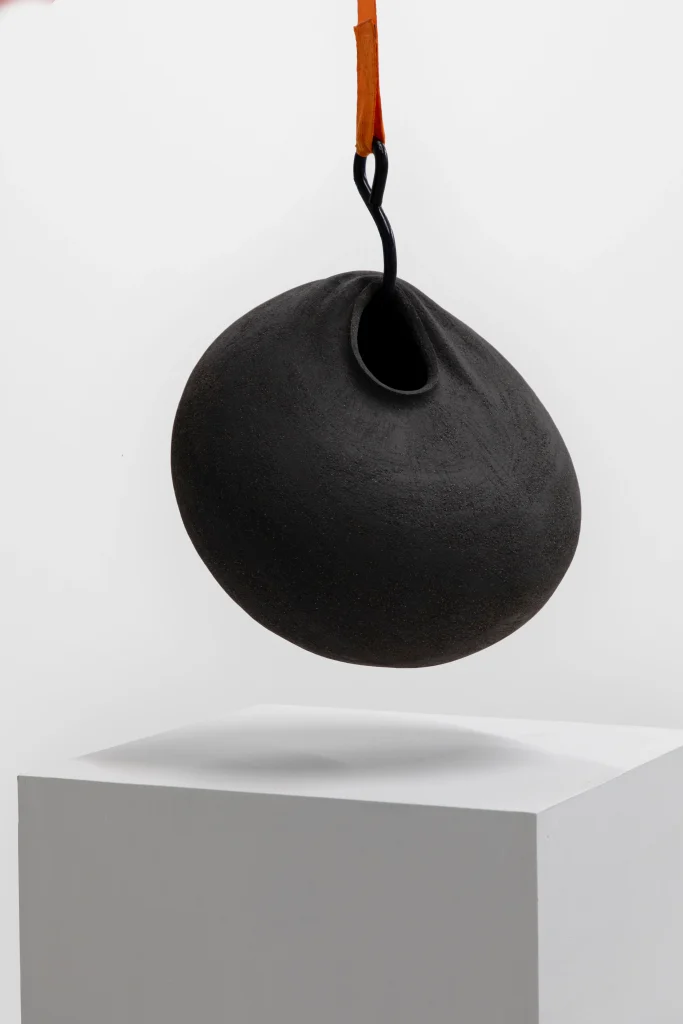
Clay remembers every touch, and ceramic sculpture is the art of letting it.
Updated on: October 26, 2026
Ceramic sculpture turns one of the oldest materials we know into objects that hold both weight and fragility. Soft enough to record a fingerprint and hard enough, once fired, to last thousands of years, clay invites a dialogue between the maker and the material that few other mediums allow.
This guide explains what ceramic sculpture is, how it is made, and what Montreal artist Pascale Girardin has learned from three decades of working with clay. It then presents eight ceramic sculptures by independent studios, with advice on displaying and caring for them.
What is ceramic sculpture?
Ceramic sculpture is three-dimensional art made from clay and hardened by firing in a kiln. Unlike pottery, which is usually made for use, a ceramic sculpture exists first for its form, surface and presence, although many contemporary pieces, from candle holders to wall reliefs, sit between the two. Indeed, the line between vessel and sculpture is where much of today’s most interesting ceramic work happens. For a wider view of the field, Wallpaper* profiles the ceramic artists pushing the medium today, and ADORNO’s own list of contemporary ceramicists to watch follows several of them.
Clays, techniques and glazes
Clay bodies
- Earthenware and terracotta: fired at lower temperatures, around 1,830–2,100°F (1,000–1,150°C), warm in color and slightly porous.
- Stoneware: fired at around 2,190–2,370°F (1,200–1,300°C), dense, strong and the most common choice for sculpture; black stoneware gives a deep, matte surface.
- Porcelain: fine, white and translucent when thin, fired highest of all but less forgiving to shape.
Making techniques
Most ceramic sculpture is hand-built. Coiling stacks ropes of clay into walls, pinching shapes a form between the fingers, and slab building joins flat sheets. Wheel throwing creates round forms that can be cut, stacked or altered, and carving removes clay once it has stiffened to leather-hard. Larger pieces are often built in sections, because kilns limit size and wet clay can sag or crack under its own weight. In addition, slow, even drying is essential before the first firing.
Glazes and surfaces
A glaze is a thin layer of glass fused to the clay in the kiln. It can be glossy, matte, crackled or textured, and its final color depends on the clay underneath, the thickness of the coat and the firing. Many sculptors also leave the clay raw, or use slips and oxides to keep a mineral, stone-like surface. Read more in ADORNO’s guide to ceramics and stoneware.
Case study: Pascale Girardin and clay as a teacher
Montreal-based Pascale Girardin came to ceramics after studying biology, visual art and design, and her work still moves between art and science. “Curiosity has always been a driving force in my life as it opens doors to the unexpected,” she says. “Biology, art, and design rely on this common principle.”
For Girardin, clay is less a material than a partner. “I often say that clay is my teacher, mirroring my intentions, my focus as well as my distractions,” she explains. She has come to see hardness as a source of vulnerability, and softness as “a form of playful readiness to engage with the hand.” Glaze, too, demands patience: a new recipe behaves differently on textured, flat, convex or concave surfaces, so “one needs to have low expectations, plenty of time and an open mind.”
That approach scales up to architecture. For Nobu Downtown in New York, commissioned by David Rockwell, she translated the Japanese ink-painting tradition of sumi-e into two large murals of small, charcoal-like ceramic strokes, and lined a sake room divider with hand-glazed bottles inspired by historic sake vessels from Seto, Japan. Her installations also appear at the Four Seasons in Las Vegas and Montreal, Saks Fifth Avenue and Printemps Paris.


Girardin’s pieces are no longer available on ADORNO, but her way of working, attentive to the clay and open to accident, runs through the sculptures below.
8 ceramic sculptures to collect
These pieces are all available on ADORNO and each comes from a different studio. They range from a €217 oyster shell to a large ceramic and oak wall sculpture, and cover black and white stoneware, glazed ceramic and mixed materials.
Movement Phase 2 – Black Sculptural Ceramic Vessel by Catalin Filip

Romanian-British designer Catalin Filip shapes black vulcan stoneware so it seems to sag under its own weight, as if the clay were still soft. The folds and bends record gravity at work. With checkouts this season and a sale behind it, it is the most-ordered ceramic sculpture in this list.
By Catalin Filip
€1.030 incl. tax
Kho Sculpture No. 4 by Od Studio

Turkish studio Od Studio stacks rounded stoneware forms into a balancing column, each one open like a breath held. The name comes from the last syllable of psykhē, the ancient Greek word for soul and breath. Notably, the whole KHO series has drawn checkouts on ADORNO this season.
By Od Studio
€1.280 incl. tax
Oyster Shell – Medium by Sugoi Studio

Danish ceramic studio Sugoi Studio shapes and glazes each oyster by hand, so no two shells are alike. Use it as a bowl or centerpiece, or hang it on the wall as a sculpture. At 40 cm (15.7 in) across, it is the most accessible piece here.
By Sugoi Studio
€217 incl. tax
Sui Cappelli/ About Hats – Ceramic Sculpture by Federica Paglia

Italian artist Federica Paglia covers a vase with a flat, hat-like lid, so it loses its everyday use and becomes a symbol instead. The soft pink-to-green gradient makes the idea feel light. It has already found a collector on ADORNO.
By Federica Paglia
€550 incl. tax
Pose N°7 Black – Sculpture by Marie-Marie Defour

French designer Marie-Marie Defour makes Pose as a sculpture and a low-tech hand warmer: place small candles beneath the stoneware dome and the clay absorbs the heat and slowly releases it. Its textured surface recalls a sun-warmed stone. New in 2026, it has already sold on ADORNO.
By Marie-Marie Defour
€320 incl. tax
El Joyero De Odette Table Lamp In Stoneware by Mina Wright
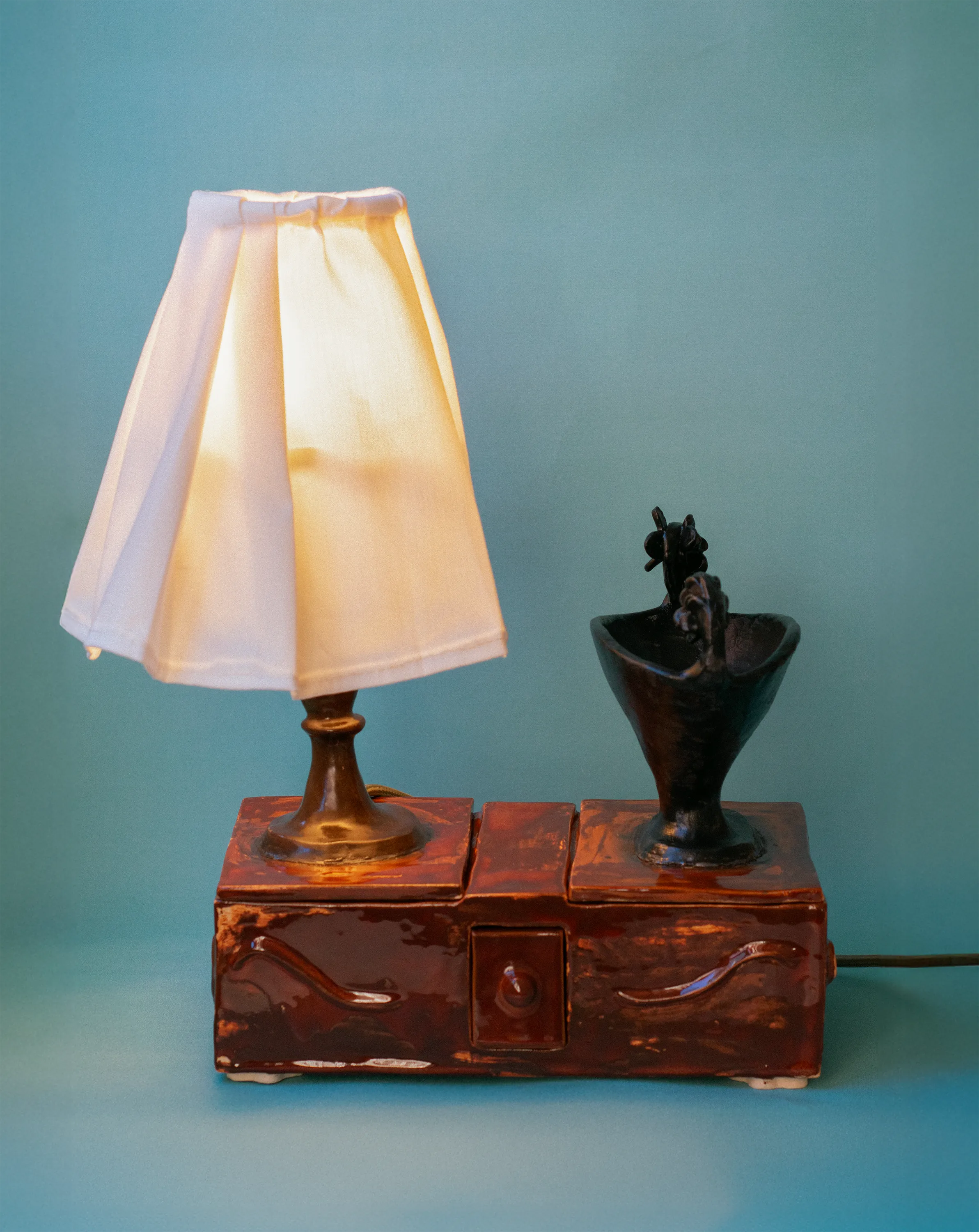
Spain-based Mina Wright reworks an 18th-century French jewelry box in stoneware, with two lids: one opens onto a tiny vase, the other onto a small lamp. It is part sculpture, part dressing-table object, and new this year with a sale and checkout already.
By Mina Wright
€810 incl. tax
Aisha Totem – Stoneware Sculpture by Lucia Mondadori

French artist Lucia Mondadori coils and carves white stoneware, fired to 1,280°C (2,336°F), into a totem of curves, sharp edges and one open void. Its raw, mineral texture invites a closer look, and the piece is one of a kind.
By Lucia Mondadori
€1.395 incl. tax
Abundance Wall Sculpture | Toffee · Studio Series · by Studio Ēeme
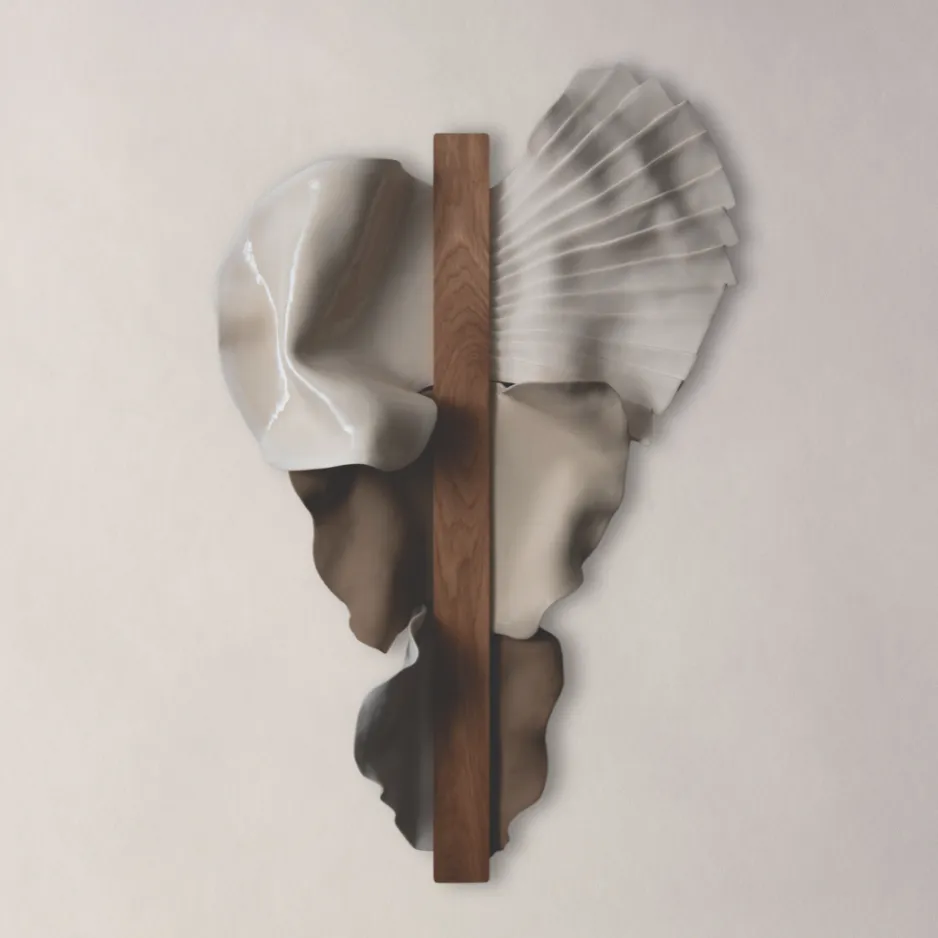
Portuguese Studio Ēeme sets folded ceramic forms against a vertical oak spine, so the clay seems to unfurl from the wood. At 100 × 85 cm (39.4 × 33.5 in), it works like a painting in relief above a bench or console.
By Studio Ēeme
€3.565 incl. tax
How to display ceramic sculpture
Give a ceramic sculpture a stable, level surface at eye level or just below, such as a plinth, console or deep shelf, away from busy walkways. Side light from a window or a low lamp brings out texture and glaze, while flat overhead light tends to hide it. Group smaller pieces in odd numbers and vary their heights, or let a single larger sculpture stand alone with space around it. For wall pieces, use fixings rated for the full weight and anchor into a stud or solid wall. For more ideas, see ADORNO’s selection of sculptures for the home and the guide to stone sculpture.
How to care for ceramic sculpture
Dust with a soft, dry brush or microfiber cloth. Glazed surfaces can be wiped with a damp cloth and mild soap, while raw, unglazed clay is porous and should be kept dry. Avoid sudden temperature changes and direct heat, and lift pieces from the base with both hands, never by a rim or handle. Outdoors, only high-fired, frost-resistant stoneware should stay out through winter.
Frequently asked questions about ceramic sculpture
What is the difference between ceramic sculpture and pottery?
Pottery is usually made for use, such as bowls and vases, while ceramic sculpture is made first for its form and expression.
Which clay is best for sculpture?
Stoneware is the most popular, because it is strong, workable and fires dense. Grogged clays, which contain fired particles, resist cracking in larger pieces.
Is ceramic sculpture fragile?
Fired ceramic is hard and durable but can chip or break if dropped, so place it on a stable surface away from traffic.
Can ceramic sculpture go outdoors?
Only high-fired stoneware or porcelain rated as frost-resistant. Porous earthenware can crack when water inside it freezes.
How do you clean ceramic sculpture?
Dust it regularly and wipe glazed areas with a damp cloth; keep unglazed clay dry.
Who is Pascale Girardin?
A Montreal-based ceramic artist and designer known for large architectural installations, including murals for Nobu Downtown in New York and Four Seasons hotels.
Shaped by hand and fire
Every ceramic sculpture records a conversation between a maker, a material and a kiln. Consequently, no two pieces are quite alike, and the best ones keep revealing new details the longer they stay in a room.