
“I don’t want you to pass by that object daily and just say, ‘Ah yes, that’s just my lamp.’ I want it to make you feel something.” – Vanessa Singenzia
Updated on: November 12, 2026
Romanian ceramic artist Vanessa Singenzia founded UAU after training as an architect, and her studio’s pieces are anything but quiet. Bright glazes, neon light and playful, slightly strange shapes turn lamps, carafes and vases into objects you notice every day. Her approach is intuitive: she lets each piece find its form in the making, so the hand of the maker stays visible.
This interview, first published in 2021, is updated with UAU’s pieces available today. Singenzia talks about why she chose clay, the weirdness she looks for on purpose, and the balance between expression and function.
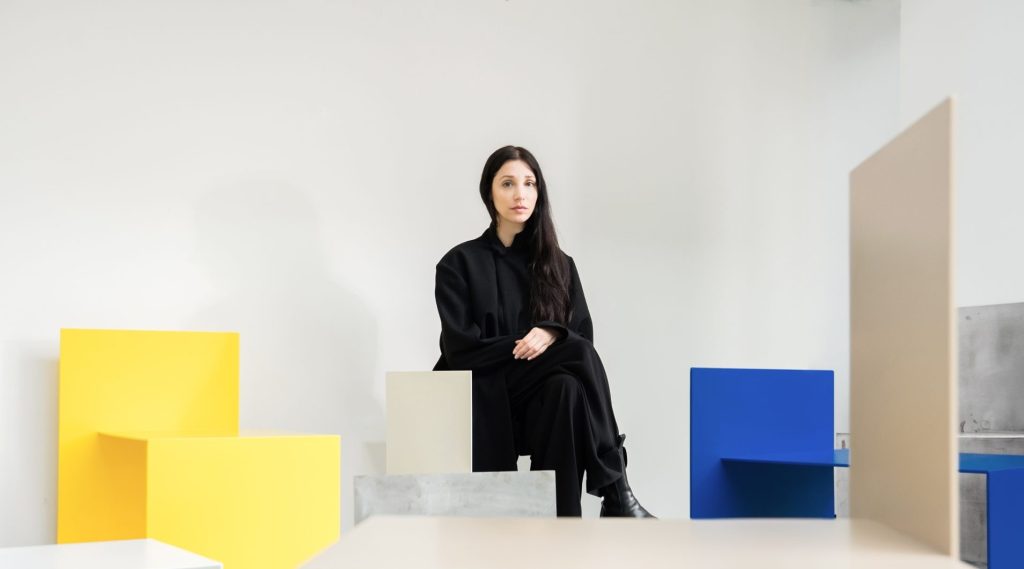
Vanessa Singenzia and UAU

UAU’s pieces are full of color and tactility, and the studio’s process shows the attentive craftsmanship behind them, where the sculptural and conceptual meet the functional. Ceramics offers a hands-on dialogue between maker and material, with forms, patterns and textures evolving from practice. Through UAU, Singenzia communicates sculptural gestures and abstract ideas through bold colors and simple shapes.
There is an ephemeral quality to the way her pieces come together. The Chanka-Hanka mobile chandelier, for instance, was built piece by piece until a balanced form was reached, growing until it found its playful final shape. SYNKRO, by contrast, is conceptual: two light objects with glowing neon on ceramic bodies represent masculine and feminine energies and the human need to communicate. Meanwhile, the Jetsons lamp sets a yellow and blue ceramic form between waves of orange neon, as much a mood as a light.
Interview With Ceramic Artist Vanessa Singenzia
What drew you to ceramics as a medium?
To me, ceramics came as a more organic alternative of expression to the technical environment in which I was first trained. At first it was an intuitive impulse. I knew nothing about the field when I started, and it was just an exploratory state of mind that stayed with me throughout my artistic development.
Why ceramics? Because it seems to me that this field allows you to do pretty much anything. Clay is a very versatile material, and you have a lot of freedom. You can easily turn a 2D drawing into a 3D object, and that is one of the things that first sparked my interest. It is marvelous to have an idea, sketch it out, and later have the actual object in your home, whether it is functional or purely decorative.
I studied architecture before, and one thing that frustrated me was how long it took to see an actual result of your work. In our fast-paced era, we feel the need to have something done as quickly as possible, and ceramics allows you to do just that. By simply bringing water and earth together, you can make something pretty amazing.


You showed in the Time for Change collection at Virtual Design Destination 2020. How does your practice relate to the Romanian design scene?
I work somewhere between art, design and craftsmanship. My work includes home products, decorative art and sculpture, and I don’t necessarily consider myself a designer or an artist, but rather a craftsman. I know my work has a certain weirdness to it, and I do that on purpose: I look for that weird side, and for something that grabs attention.
The impression people take away from my work matters to me, because it fuels my imagination. Everybody understands something different, and that makes the process personal. So I try to put a part of myself into everything I do. Bright, bold and colorful, with a touch of playfulness, is what I am. More than anything, I want my pieces to set a mood and convey a feeling.
As for the Romanian design scene, it is still an ongoing process, and I don’t feel it is up to me to set opinions about it. But I know for sure that we still have to learn and grow at the same time. For me, “Time for Change” becomes “time to learn and acknowledge everything much more deeply.” For a wider view of the scene, Wallpaper* covered Romanian Design Week as a country in creative flux.
Pieces like Fingerprint and the Chanka-Hanka chandelier show your intuitive approach. What is the greatest outcome of working this way?
This intuitive approach doesn’t only show in the Fingerprint vases and the Chanka-Hanka chandelier; it runs through my whole practice and my way of being. I don’t force any object into its final form. I allow space for intuitive decisions while making. That way, it almost becomes ephemeral, and each object becomes personal to its user as well. It can influence the physical and emotional atmosphere around it.


What is the greatest challenge?
Probably helping people understand that they don’t actually need a trendy object that everybody has, but rather something personal that reflects their own needs.
How do you balance expressive aesthetics and function?
Functionality sits a little in the background of my work. It is not that I don’t want to offer a good experience; for me, functionality is not only ergonomics or rationality, but something beyond those limits. An object can influence the physical and emotional state of the people around it, and that creates a whole range of sensations and emotions it can convey.
My work is a sculptural gesture presented in a product context, a conceptual statement in which a functional object communicates an abstract idea through bold colors and simple shapes.


UAU Today: Three Lamps to Collect
Since this interview, UAU has grown into lighting with even more color and scale, from flower-like pendants to totemic floor lamps made with a weaver. These three show where Singenzia’s intuitive approach has gone next.
Amaryllis Ceiling Lamp in Glazed Ceramic by UAU Studio

Hand-sculpted ceramic petals in bold, blending glazes open around the bulb like the flower it is named after. Indeed, it is UAU at its most maximalist, a pendant that reads as a bouquet. At 40 x 60 x 45 cm (16 x 24 x 18 in), it hangs above a dining table or in a bright entryway.
By UAU Studio
€1,300 incl. tax
Badru Floor Lamp in Ceramic and Rattan by UAU Studio

Badru belongs to The Ancestors, three limited-edition totems that UAU made with weaver Denise Berekmeri after two years of research into clay, metal and wicker. Coil-built ceramic cylinders stack into a goddess-like figure, woven through with rattan and left uncoated so it ages naturally. At 50 x 50 x 210 cm (20 x 20 x 83 in), it holds a corner of a living room like a sculpture.
By UAU Studio
€3,400 incl. tax
AnKa Colors of Dawn Table Lamp in Ceramic by UAU Studio

AnKa pairs a hand-painted ceramic body with a blown-glass neon light, the same pairing of clay and glowing tube that first appeared in SYNKRO. Moreover, every part is made by hand, so no two lamps are alike. At 10 x 15 x 40 cm (4 x 6 x 16 in), it brings color and a soft glow to a desk or a shelf.
By UAU Studio
€1,500 incl. tax
About UAU

UAU is the result of approaching ceramics intuitively: exploring different ceramic materials while asking what an object is for, where functionality is not only ergonomics or rationality but something that goes beyond them. It is a sculptural gesture presented in a product context, a conceptual statement in which a functional object communicates an abstract idea through bold colors and simple shapes.
Frequently Asked Questions
Who is the ceramic artist behind UAU?
Vanessa Singenzia, a Romanian ceramic artist who trained as an architect before turning to clay. She founded UAU to make sculptural, colorful ceramic pieces that sit between art, design and craft.
What does UAU make?
Lighting above all, from neon-and-ceramic table lamps to chandeliers and tall floor lamps, along with carafes, vases, mirrors and side tables, all made by hand.
Are UAU pieces handmade?
Yes. Every piece is shaped and glazed by hand, and the neon and blown-glass elements are made individually, so no two pieces are exactly alike.




Responses