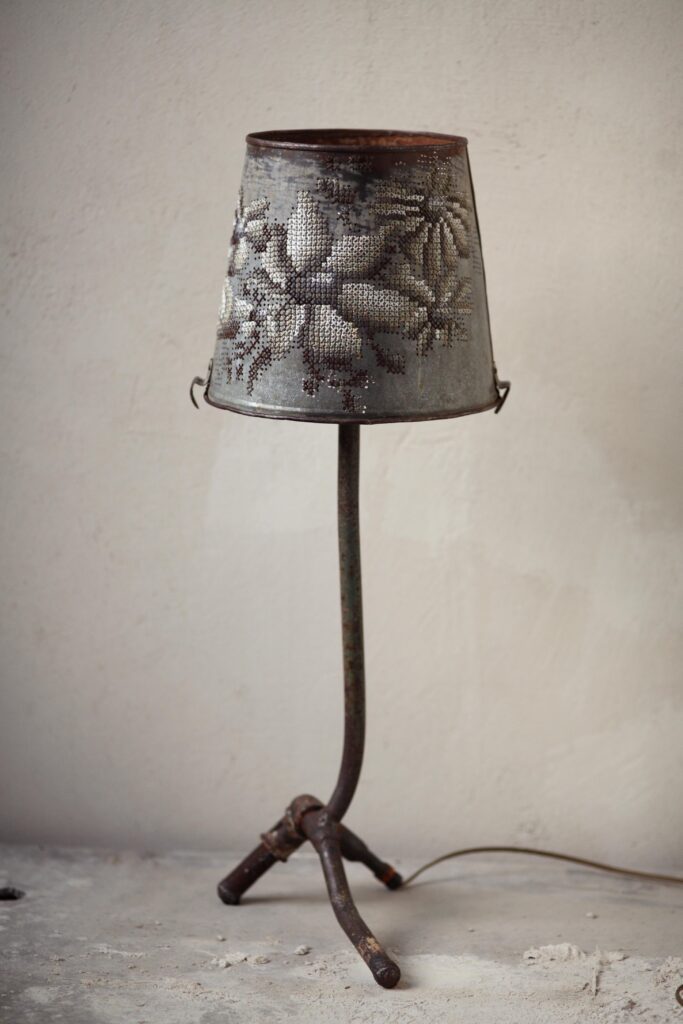
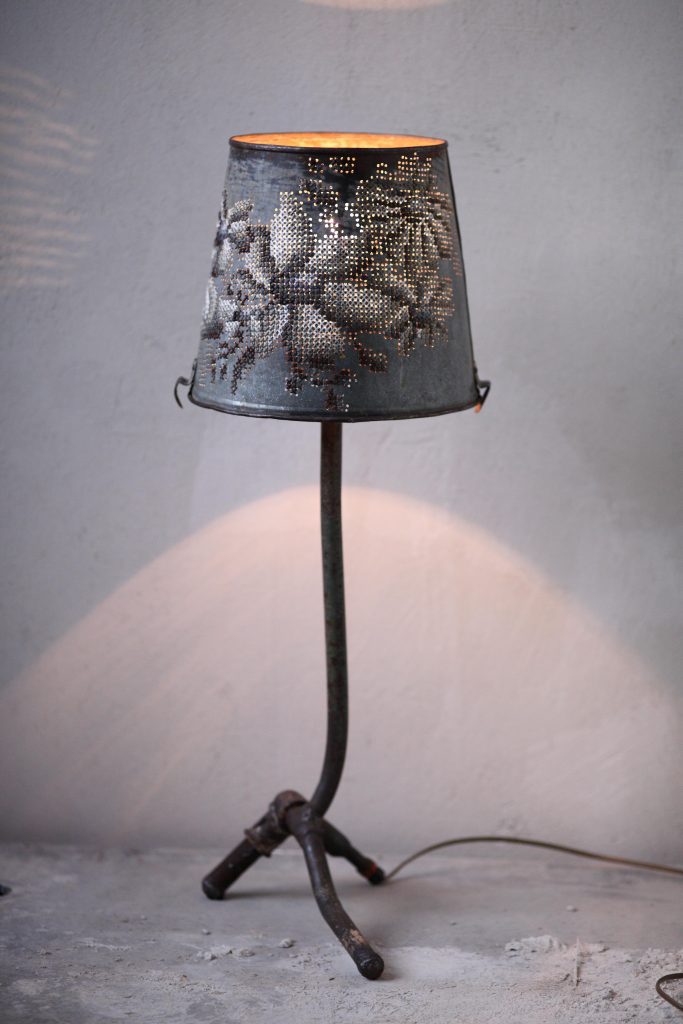
Is this lamp made to order?
Yes, this piece is made to order by the studio, so production takes some time before it ships — check this page for the current estimate.
Can I customize this piece?
Yes, the maker offers customization upon request — use Chat with the maker on this page to discuss options.
What is the lamp made from?
It is assembled from a discarded metal bucket and radiator parts, then hand embroidered with cotton thread stitched directly through the metal.
Does it come with a light bulb or wiring details?
That is not specified in the listing — the maker can confirm, use Chat with the maker on this page.
What are the dimensions and weight of the lamp?
The lamp measures 45 x 40 x 80 cm and weighs 4 kg.
Can I return this lamp if it does not work for me?
Made-to-order pieces like this one are excluded from the standard 14-day return policy.
Is shipping insured, and does it ship internationally?
Yes, all ADORNO shipments are insured and delivered worldwide.
What is a floor lamp?
A floor lamp is a freestanding light that rests on the floor, tall enough to light a room or a seating area from above surface level. Unlike a table lamp it needs no furniture to stand on, and unlike a ceiling fixture it needs no installation — which makes it the easiest way to add a permanent light source to a room you cannot rewire.
How tall should a floor lamp be?
Between 150 and 180 cm for most positions. The number matters less than the shade height: seated beside the lamp, the bottom edge of the shade should fall at or just below your eye level, roughly 100–130 cm from the floor, so the bulb stays hidden. Uplights and torchieres can be taller because they throw light upward, away from your eyeline.
Where should a floor lamp go in a living room?
Three positions do most of the work: in a corner, where an uplight lifts the darkest part of the room; beside or slightly behind a chair, for reading; and behind or over the sofa, where an arc lamp substitutes for a ceiling fixture. Avoid placing one directly in a walkway or where its cable crosses a route people take.
What is an arc floor lamp for?
An arc or arched lamp has a long curved arm that extends the light source away from the base, so it can hang over a sofa, a coffee table or a chair without anything mounted overhead. It is the standard solution in rented flats and rooms with no central fixture. Check two things before buying: how far the arm reaches, and how heavy the counterweighted base is.
What is a torchiere, and when should I use one?
A torchiere directs light upward into the ceiling rather than down into the room. The ceiling reflects it back as soft, even, glare-free light, which makes a low or dark room feel considerably larger. It works best against pale matte ceilings; dark or heavily textured surfaces absorb much of the effect.
Which floor lamp is best for reading?
ne with directed light and an adjustable or downward-facing shade — a swing-arm or tripod lamp rather than an uplight. Aim for 400–800 lumens landing on the page, position the lamp slightly behind and to the side of your shoulder, and choose a shade deep or opaque enough that you never see the bulb from your reading position.
Do you have floor lamps with an integrated table or shelf?
Yes — there is a dedicated selection of lamp-and-table pieces, and it is one of the more interesting corners of the catalogue. These are not the shelf-tower lamps sold by furniture chains but single designed objects in which the light and the surface are one thing: illuminated side and coffee tables, lamps whose base doubles as a tabletop, and sculptural pieces that read as furniture with a light source built into them. They are made in ash and plywood, steel, brass, stoneware, marble and natural fiber, and several are held in stock rather than made to order. They earn their place beside a sofa or an armchair where there is only floor space for one object instead of two.
Are the shades replaceable, and can I change them?
It depends entirely on the piece. Where a lamp uses a conventional frame and a standard fitting, a shade can usually be swapped. Many pieces here, though, are designed as a single form — a blown glass diffuser, a paper shade sized to its frame, a ceramic body — where the shade is the lamp and is not intended to be changed. Product pages describe the construction; ask us if you need certainty.
How stable are they, and are they safe with children or pets?
Stability comes from base weight and footprint, both listed on product pages. Tall slim lamps and long arc arms need a substantial counterweight, and a heavy handmade lamp is not a piece you want knocked over. In a home with small children or large dogs, favor a low center of gravity, a wide base, and a position out of traffic routes — and route the cable along a wall rather than across a floor.
Which materials work best for a floor lamp?
Brass, steel and aluminum for slim arms and arcs that need structural strength; solid wood for tripods and columns with visible joinery; ceramic, stone and concrete for weight and a low center of gravity; woven rattan and natural fiber for texture and broad, dappled light; handmade and rice paper for the soft, screen-like glow associated with Japanese lighting. All of them show wear as patina rather than damage.