“The theme of self-reflection, as a pause in times of trouble, is central to this collection.” – Paola Bjäringer
Updated on: October 31, 2026
Swedish design is often reduced to pale wood and quiet restraint. In 2020, curator Paola Bjäringer set out to show another side. For ADORNO’s Virtual Design Destination at the London Design Festival, she gathered mirrors by six Swedish women designers and one man, placed them in a virtual Swedish forest and called the collection Mirror Mirror Off the Wall.
This article is kept as a record of that collection and of Bjäringer’s interview, in which she describes Swedish design as feminist, sustainable and punk. Most of the designers have since left ADORNO; the Swedish mirrors available today, including David Taylor’s piece from the collection, are at the end.
Mirror Mirror Off the Wall: Swedish Design and the Female Gaze
Entering the clearing, the visitor is surrounded by the Swedish forest and forced to reflect, physically through mirrored surfaces and mentally on the moment. The mirror invites self-reflection, as we meet ourselves and our society in its surface. Woven into this is the theme of the gaze, a notion historically tied to the male gaze, the image of women within it, and the “ideals” that come with that image. How do we perceive ourselves? Our place in the world? How do we present our true selves?
The collection set out to shift that gaze and strengthen the female gaze by giving the stage to leading Swedish women designers and one male designer. Each piece, from the traditional mirror-making behind Jenny Nordberg’s Acid Green Mirror to Wang & Söderström’s morphing, digital Mutant Mirror, carries its maker’s view of themselves and the world. Together they reflect a Swedish collectible design scene that challenges tradition and tells its own stories openly.
Mirror Mirror Off the Wall featured David Taylor, Farvash, Frida Fjellman, Jenny Nordberg, Kajsa Willner, Sara Szyber and Wang & Söderström. It was supported by the Embassy of Sweden in London and Nordic Culture Point, and shown in person in Stockholm at MISSCHIEFS, Bjäringer’s feminist design collective, which Wallpaper* picked out at Stockholm Design Week 2020.
Interview With Curator Paola Bjäringer
What are the main themes presented across the works in this collection?
Mirror Mirror Off the Wall stands for the excellence of Swedish craft and design today. Each designer was selected for their individual way of blurring what is considered art and what is considered design. Through highly personal research into the materials of their specially made mirror, each designer makes a statement about who they are in this world, and who you are as you look into their world looking back at you.
The theme of self-reflection, as a pause in times of trouble, is central to this collection. It calls for a deep breath in, a time for meditation, a pause for bouncing off wiser and more connected to our roots.

Which three words would you use to describe the contemporary design scene in Sweden?
Feminist. The strongest voices in the Swedish art scene at the moment are female and non-binary. Sustainable. The forest symbolizes the powerful connection of Swedes to nature in their everyday life. They respect her, they take care of her, and self-care is therefore central to the Swedish way of life. Punk. Underneath Swedish discipline there is a strong, art-driven underground force led by the young generation. Alternative ways of living are gaining ground.
Why have you chosen the Swedish forest as the setting for this collection?
The forest symbolizes the powerful connection of Swedes to nature in their everyday life. They respect her, they take care of her.
The collection is a series of mirrors that addresses the need to reclaim the power of the gaze. Why bring together feminism and the mirror?
The mirror stands as the ultimate symbol of womanhood and the beauty standards associated with it. Throughout history and art, women have found in the mirror the reflection of the man they are supposed to love and serve, setting their own identity aside and accepting, subconsciously, patriarchal needs. This collection turns the rules of the game on their head by inviting a majority of women designers and one chosen male designer. It’s about time the art and design world turned the cards the other way around.

What role do representation and inclusivity play in contemporary and future design in Sweden?
Sweden, like all countries, has mountains to climb before we can claim to represent all voices fairly. The gaze of the mirror stands for who is looking at what, and in which context. As a forward-thinking country, Sweden has a duty to lead the way toward a more inclusive global society. Including the voices of the unheard is a new chapter already in motion in Swedish society; it’s time to make it official, public and the new norm.
How does this collection respond to the so-called new reality?
The new reality of this collection is plural, multi-dimensional and caring.

Has the uncertainty in the world affected your approach to curating this collection?
As the world came to a standstill, we all came to terms with what is truly necessary and what is not. Do we need more chairs and tables at this moment in history? Or more self-reflective knowledge about who we are, where we stand, and whom we are really addressing?
This collection of mirrors calls for a pause in the hyper-consumption of unnecessary objects. Where are the objects of everyday life made? By whom, and for what purpose? This crisis is a meditation, reflected in this walk under the gaze of nature, the forest.
Meet Paola Bjäringer

Born in Sweden in 1980, Paola Bjäringer grew up in France. After an MA in Gender Studies at the London School of Economics, she opened Gallery Slott in Paris in 2009, focusing on collectible contemporary design, and produced collections with matali crasset, Arik Levy and Mathieu Lehanneur while launching young designers.
Now based in Stockholm, she manages international design projects from branding to interior architecture and curation, with a focus on limited-edition crafted objects and furniture. She is particularly drawn to design that moves beyond the ornamental into the social and political, and looks at it through a sociological lens with gender at its core.
What surprised you about curating for a virtual exhibition?
ADORNO is at the forefront of experimenting with what virtual consumption means. Rather than recreating a real-life setting, it takes us somewhere new, invented by each curator from a different cultural perspective. It is truly stimulating to curate for people who dare to step into what the future holds.
What are you most excited to share with the audience?
I have deliberately chosen pieces that are strikingly strong in their design process, from idea to finished object, and in the individual style of each designer, all in the magical setting of the forest. Farvash’s Deep Deep Voice is my personal favorite, with its ego and voice amplifier effect and its mystical rainbow neon light. Frida Fjellman’s Piss Off mirrors are fabulous too. I love them all.
Swedish Mirrors to Collect Today
The conversation Bjäringer started continues in Swedish studios on ADORNO. Here are three mirrors that carry its spirit of reflection, craft and a little defiance, beginning with the one piece from the original collection still available. For more, browse all mirrors or our guide to Scandinavian designers.
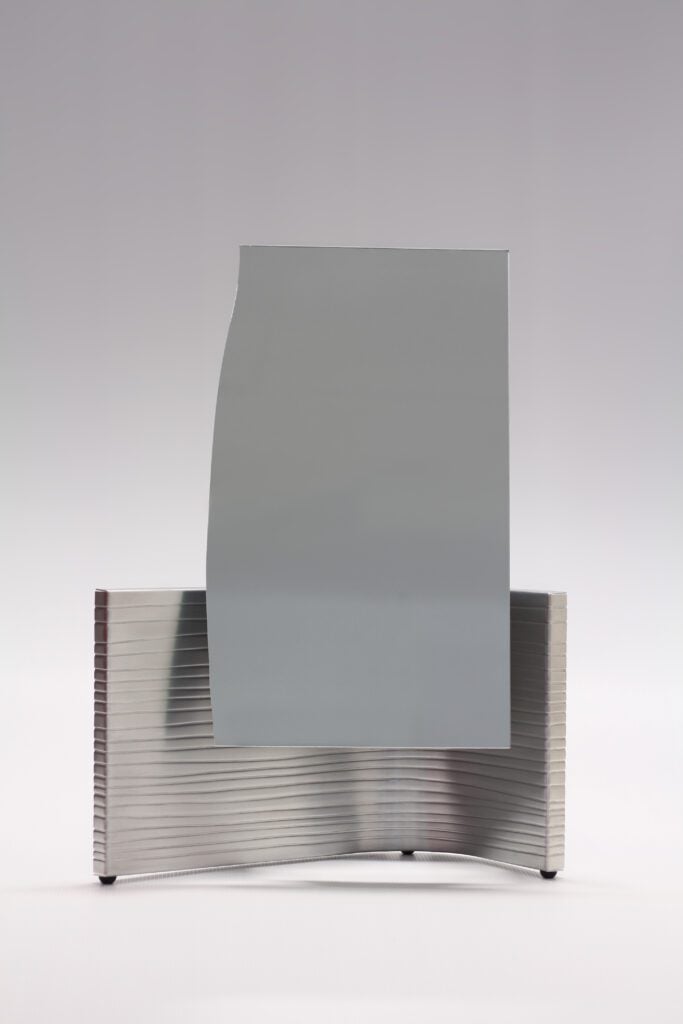
“TABLE TOP” Mirror by David Taylor

David Taylor reworks the classic cameo tabletop mirror as two separate shapes: a large shard of broken mirror floating in a curved aluminum stand. Notably, it was the one piece by a man in Paola Bjäringer’s collection, and each of its six editions is made to order, similar but never identical. At 15 x 40 x 60 cm (6 x 16 x 24 in), it stands on a dresser or a console.
By David Taylor
€1,650 incl. tax
Succession mirror by FARG & BLANCHE

The Stockholm studio FARG & BLANCHE wraps the frame in textile and leather, ties it with rope and bakes it, so the cut rope leaves soft, quilted ridges. As a result, the mirror reads like a piece of upholstery as much as glass. At 60 x 40 x 6 cm (24 x 16 x 2 in), it suits a hallway or a dressing table.
By FARG & BLANCHE
€1,520 incl. tax
“Portal”, Mirrors by Sara Lundkvist

Sara Lundkvist blows and mirrors each Portal in glass, drawing on New Age, science fiction and the idea of a stargate. Moreover, the convex surface bends the room as it reflects it, a fitting heir to the collection’s theme of self-reflection. In two sizes, 20 x 20 x 4 cm (8 x 8 x 2 in) and 40 x 30 x 5 cm (16 x 12 x 2 in), they work alone or hung as a group.
By Sara Lundkvist
€650 – €970 incl. tax
Frequently Asked Questions
What is the female gaze in design?
The female gaze describes work made from women’s own perspective rather than through the way women have traditionally been looked at. In Mirror Mirror Off the Wall, the mirror, long tied to beauty standards, became a tool for women designers to present themselves on their own terms.
What defines contemporary Swedish design?
Beyond the familiar pale wood and restraint, curator Paola Bjäringer describes the scene as feminist, sustainable and punk: led by women and non-binary voices, rooted in a close bond with nature, and pushed by an underground generation.
Who is Paola Bjäringer?
A Swedish curator born in 1980, raised in France, who ran Gallery Slott in Paris and now works in Stockholm, where she founded the feminist design collective MISSCHIEFS.