Is a light bulb included?
No, the light bulb is not included. It takes an E27 compact fluorescent or LED bulb.
Is this lamp suitable for outdoor use?
Yes, it is rated IP44, which means it is resistant to moisture and rain, so it works well on terraces and in gardens.
How does the lamp arrive and how is it set up?
It is delivered flat and self-inflates once unpacked, since it is built from TPU filled with air.
Can I customize the cord length or the piece itself?
Yes, the cable length can be customized, and the piece can be customized further upon request — use Chat with the maker on this page to discuss details.
How long is the cord and what are the frame and ceiling rose made of?
The cord is 150 cm long in black, with a black internal frame and ceiling rose.
Is this lamp dimmable?
The maker can confirm — use Chat with the maker on this page.
How long does it take to receive this piece?
This piece is made to order and usually ships in 1-2 weeks; note that made-to-order items are excluded from the 14-day return policy.
What is the lamp made of and how do I care for it?
It is made of thermoplastic polyurethane (TPU) filled with air, in a cream white matte finish, and is recyclable.
What makes a light an outdoor light?
Not where you put it, but how it is built. Outdoor fixtures use sealed housings, gasketed joints, corrosion-resistant hardware and cable rated for exposure, and they carry a rating that states how much water and dust they can withstand. A fixture without that rating may work outside for a season and then fail — usually at the cable entry or the socket, where water collects.
What IP rating do I need?
It depends on exposure. For a covered porch, a loggia or a deep balcony where rain does not land directly, IP44 or above is generally appropriate. For an open terrace, a garden wall or anywhere fully exposed, look for IP65 or above. For in-ground fixtures and anything near a pool or pond, higher ratings up to submersion are required. When in doubt, specify one level higher than you think you need.
What is the difference between damp-rated and wet-rated?
They are the North American equivalents of the same idea. Damp-rated fixtures suit sheltered positions with humidity and occasional splashing — covered porches, soffits, bathrooms. Wet-rated fixtures withstand direct rain and can be used in fully exposed positions. If you are buying internationally, match the IP number rather than the label, since terminology differs by market.
Can I use an indoor lamp outside if the spot is sheltered?
Generally no, and we would rather say so than sell you something that fails. Indoor fixtures lack the seals, gaskets and cable protection that outdoor conditions require, and humidity alone will corrode contacts over time. A covered balcony in a mild climate is the most forgiving case, but it is still a risk with a handmade piece. Portable, battery-powered or candle-lit objects are the safe way to bring an indoor aesthetic outside.
Can I use outdoor lighting on a covered porch or in a pergola?
Yes, and this is where most decorative outdoor lighting belongs. A roof over the fixture takes most of the load off it, which widens what you can use. Two cautions: condensation still forms under cover, and wind-driven rain reaches further into a porch than people expect, so a piece on the outer edge needs a higher rating than one against the house wall.
Do you have solar outdoor lights?
Solar is common in mass-market garden lighting and rare in collectible design, since panels, batteries and the light quality they produce sit awkwardly with handmade objects. Where we can offer an off-grid solution it is usually a rechargeable or battery-powered piece rather than a solar one. Ask our curation team what is currently available if that is a requirement.
Do you have portable or rechargeable outdoor lamps?
This is the most practical route for balconies, terraces and rented properties, and the selection here grows as more studios make them. A rechargeable piece needs no wiring, no electrician and no permanent position, and can be brought indoors in bad weather — which also extends its life considerably. Check the stated run time and whether the piece is rated for occasional rain or only for dry evenings.
How is permanent outdoor lighting installed?
By a qualified electrician, using weatherproof connections, appropriate cable and residual current protection, with rules that differ by country. Many garden schemes use a 12V low-voltage system fed by a transformer, which is safer, easier to extend and does not require the same depth of buried cable as mains wiring. Plan positions before any paving or planting goes in — retrofitting cable is the expensive part.
How high should an outdoor wall light be beside a door?
Around 165–175 cm from the ground to the center of the fixture, which puts the light above eye level for most people approaching. Where a pair flanks a door, keep them symmetrical and scaled to the opening — a useful rule is a fixture roughly a quarter to a third the height of the door. Choose a design that directs light downward so nobody arrives with the source in their eyes.
How high should a pendant hang over an outdoor table?
75–90 cm between the tabletop and the lowest point of the fixture, as indoors. Outside, add two considerations: wind, which rules out anything that swings freely in an exposed position, and mounting, since a pergola beam or a loggia ceiling has to take the weight securely.
How bright should outdoor lighting be?
Much dimmer than indoors. Eyes adapt to darkness, so 100–300 lumens per fixture is usually enough to light a table or a seating area, and several low sources beat one bright one. Excess brightness flattens a garden, creates glare and destroys the contrast that makes planting and architecture look interesting after dark.
Which color temperature is best outside?
Warm — 2200–2700 K. Warm light flatters stone, timber, brick and planting, reads as welcoming rather than institutional, and attracts noticeably fewer insects than cool white light. Cooler temperatures belong in security and task lighting, which is a different product category and a different intent.
Which materials last best outdoors?
Brass, copper and bronze, which patina rather than corrode; marine-grade stainless steel and powder-coated aluminum, especially near the coast; dense hardwoods such as teak and iroko; and glass, concrete and glazed stoneware where frost is not a factor. Natural fiber, paper, textile and untreated softwood should be kept under cover or brought inside. Ask us about a specific piece — makers know their materials best.
Will outdoor pieces survive winter?
Rated fixtures will handle rain and cold; the risk is freezing. Water that gets into a ceramic body, a hairline glaze crack or an unsealed joint expands when it freezes and splits the material. In a climate with hard frosts, treat unsheltered ceramic, stone and glass pieces as seasonal, and store portable and candle-lit objects indoors over winter. Two seasons out and two seasons in will roughly double the life of most pieces.
 Comet Floor Lamp in Brass and Marble - White
 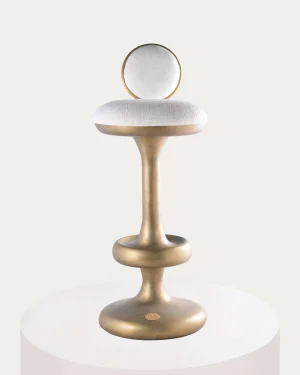 Atom Barstool