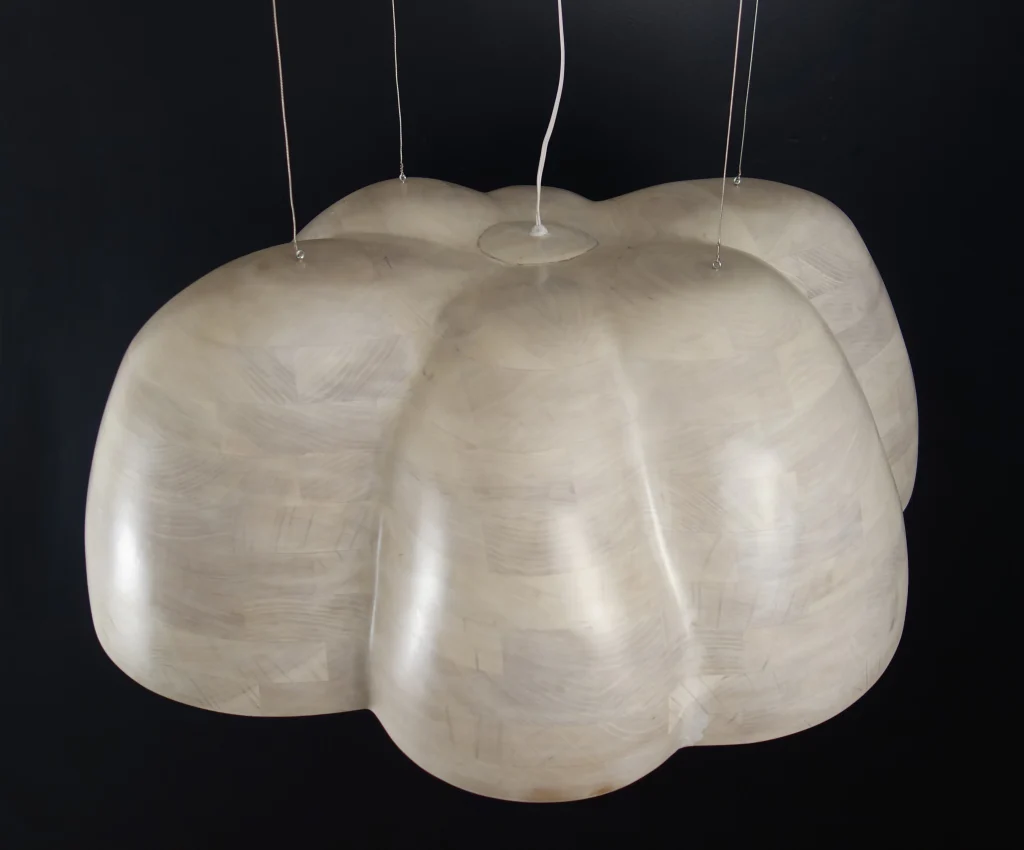
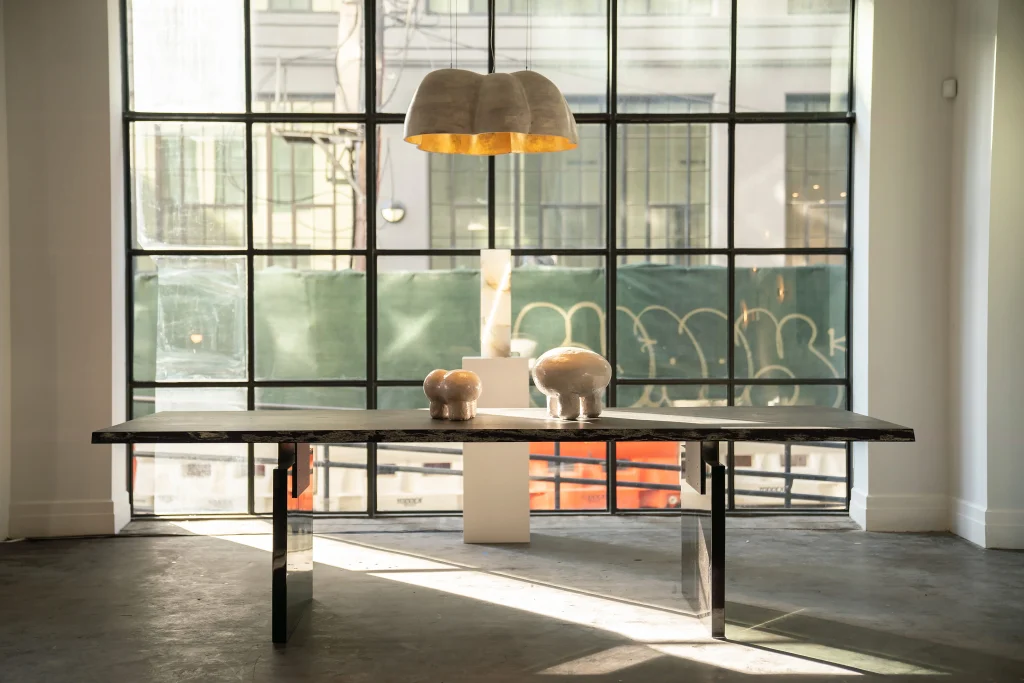
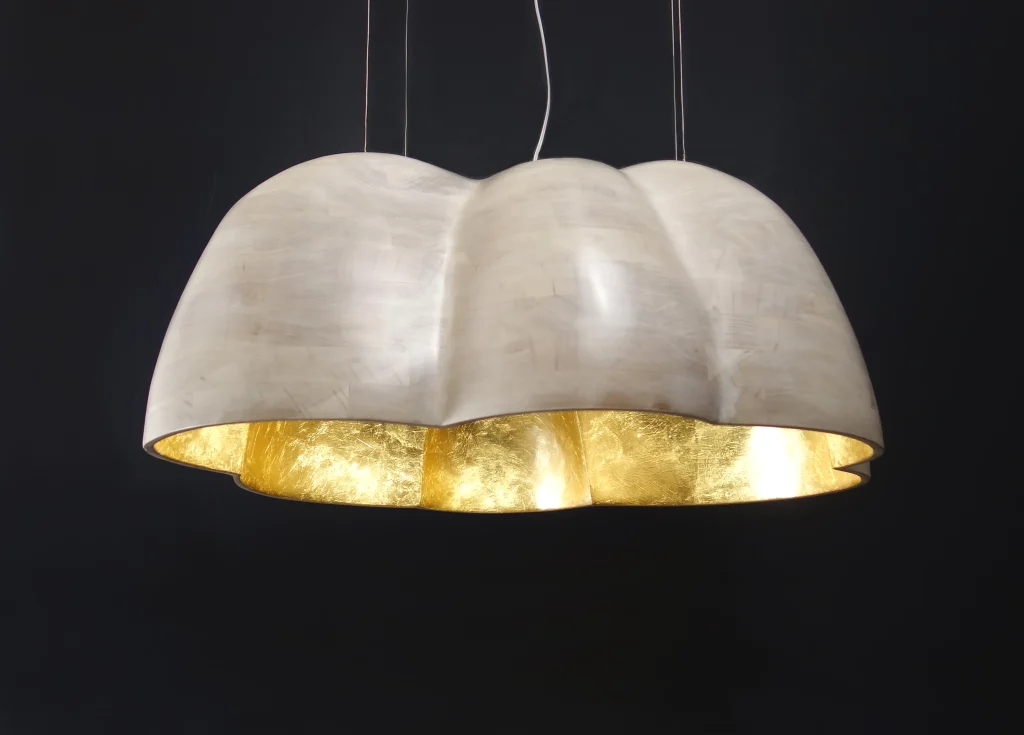
N2 Cloud Ceiling Lamp in Cherry Wood and Gold Leaf
by Aaron Scott · Brooklyn, United States

79x79x20cm (31x31x8")Cherry WoodGold-leaf
The N2 series by Aaron Scott uses stacked-laminate construction and hand carving to explore complex geometrical relationships. The… Read more
1 other is viewing this
Certificate of authenticityAll pieces on ADORNO are authentic and studio-made. To verify that, a certificate, signed by the maker, is always included in the box.

Only 1 left in stock
Put a hold on this piece

10.300
Shipping to your location
Import duties may applyWe declare all pieces as original duty-free works, however, your local customs office makes the final decision. Learn moreAll taxes includedWhat you see is what you pay. No hidden costs.
-
+
Open Edition
Ongoing series by the maker. Slight variations may apply.
Only one in stock
Get it before it's gone. Return it within 14 days.
Delivered between7 – 21 Oct
We arrange insured delivery from door to door.
Buyers protection
  • Certificate of Authenticity A signed certificate from the maker is always included in the box.

  • Lowest price guaranteed Find a lower price from the seller, we'll match it.

  • Secure online transactions All personal information that you send to us is encrypted and cannot be viewed by others.

  • 100% insured global deliveries We arrange worldwide delivery, and every shipment no matter the price is fully insured against damages.

  • 14 days return policy In the rare event, you receive a piece that you are not fully satisfied with, you can return it within 14 days of receipt for a full refund except return shipping costs. Made-to-order items are not eligible for return.

Shipping and delivery
Ships fromBrooklyn, United States
Delivery toyour location
Estimated delivery dateOctober 7 - October 21
Cardboard91x91x25cm, 9kg
  • Tracked from studio to doorstepYou receive a tracking link as soon as the piece leaves the studio, and can follow it through every carrier hand-off until it reaches your door.
  • 100% insured, door to doorEvery shipment is fully insured from pickup to delivery. If anything happens in transit, you are covered for the full purchase price.
  • 14 days return policy from the day it arrivesNot the right fit? Return it within 14 days of receipt for a full refund, excluding return shipping costs.
  • Duties and taxes may applyWe declare all pieces as original duty-free works, however, your local customs office makes the final decision. Learn more
Specifications
Dimensions LxWxH
Piece Weight (kg)

4.0

Production Year

Material

,

Discipline

Color

Design Class

FAQ
What is a pendant light?

A pendant is a single light fixture suspended from the ceiling on a cord, chain or rod, usually with one shade and one light source. The defining characteristic is that it is designed to be repeated: pendants are commonly hung in twos and threes over a surface, where a chandelier is a single composed fixture intended to work alone.

What is the difference between a pendant light and a chandelier?

Count the fixtures rather than the bulbs. A chandelier is one object with multiple arms, elements or lamps built into it, hung centrally as the focal point. Pendants are individual fixtures, often identical, positioned in a line or a cluster — the composition is created by how you arrange them, not by the piece itself. Pendants are also easier to scale to an awkward room, since you can add, remove or space them as needed.

How high should pendant lights hang above a kitchen island or dining table?

75–90 cm from the surface to the lowest point of the shade in both cases, on a standard 2.4 m ceiling, adding a little for each additional 30 cm of ceiling height. The check differs by position: at an island you are usually standing, so the light source should be hidden from standing eye level and the shade should not block the sightline of anyone seated on the other side. At a table you are seated, so sit down and look across it — you should see the person opposite, not the fixture. Taller households generally want the upper end of the range.

How many pendant lights do I need over an island?

One for an island up to roughly 1.2 m, two up to 2.4 m, three for anything longer. Larger shades mean fewer of them. If you are choosing between two medium pendants and three small ones, the smaller row usually looks more deliberate over a long island, and a single generous piece is often the best answer over a short one.

How far apart should pendant lights be?

Divide the island or table length by the number of pendants plus one, and set the centers at those points — typically 60–80 cm apart. Keep the outer pendants at least 15 cm inside the ends of the surface. Even spacing matters more than any particular figure; an off-center row is the most visible mistake in this category.

What size pendants should I choose for an island?

Keep the total combined width of the pendants to about half or two thirds of the island length. Mini pendants under 30 cm work in rows of three; 30–45 cm is the standard range for a pair. A single pendant over a short island can go considerably larger, since it has nothing to compete with.

Should pendants be centered on the island?

Centered across the width, yes, and spaced evenly along the length. Two complications come up in practice: existing ceiling boxes rarely sit where you want them, and joists limit where a new one can go. Establish the wiring positions before ordering, since a handmade pendant cannot be nudged 20 cm after installation.

Can the cord length be adjusted?

Usually. Most studios supply extra cable that an electrician shortens on site, and many will make a specific drop length to order — useful for stairwells, double-height kitchens and low ceilings alike. Send us the ceiling height and the position you have in mind and we will confirm what the maker can do.

Do you have plug-in pendant lights?

Rarely. Almost everything in this collection is hardwired, since that is how designers intend these pieces to be installed. A plug-in conversion or swag kit fitted by an electrician is sometimes possible, but it changes the look and is not something we can promise for a given piece — ask us before buying if a plug-in solution is your only option.

Can I use a pendant in a bathroom or outdoors?

Not from this collection. Bathroom and exterior positions require rated, sealed fixtures appropriate to the zone, and the requirements differ by country. These are handmade decorative pieces for dry interior use — including in covered porches, where condensation and temperature swings will affect ceramic glazes, paper, fiber and untreated metal.

Can I mix different pendants over the same surface?

Yes, and it often works better than a matched row. The reliable approach is to keep one variable constant — the same maker, the same material or the same silhouette — and vary the rest. Hanging three unrelated pendants together tends to read as indecision rather than curation.

Which pendant materials suit a kitchen?

Glazed ceramic, glass, brass, copper and steel wipe clean and tolerate the heat and humidity of a working kitchen. Woven natural fibre, paper and textile shades are beautiful over a dining table but absorb cooking grease, so avoid hanging them directly above a hob. Ask us for the maker's cleaning guidance for any specific piece.

Description

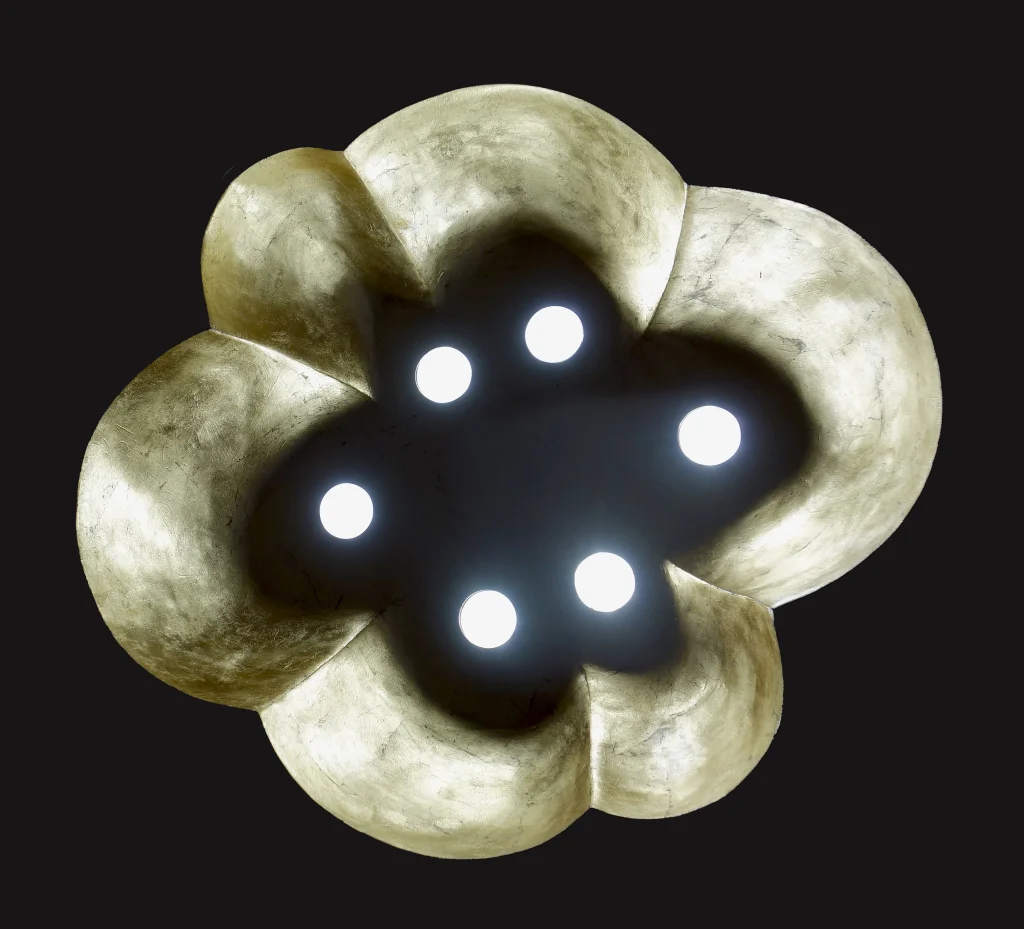
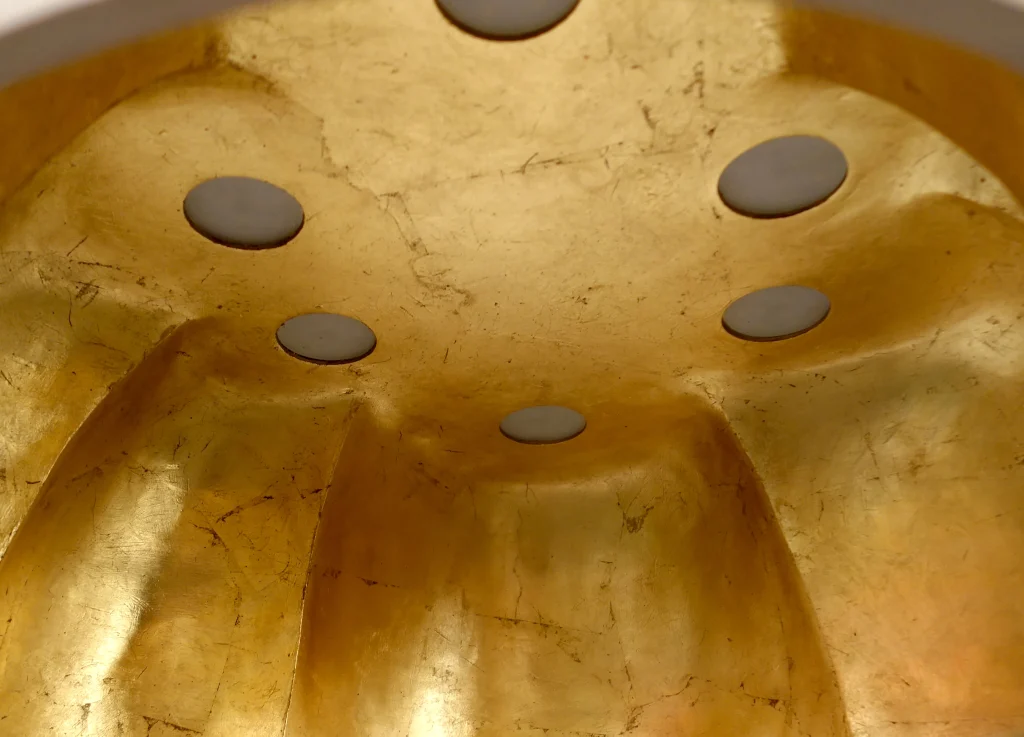
The N2 series by Aaron Scott uses stacked-laminate construction and hand carving to explore complex geometrical relationships. The N2 Cloud Chandelier features a puffy, cloud-like form carved in solid cherry to within 3/8″ wall thickness. The stacked-laminate, solid wood fabrication ensures the strength and stability of the wood over time. Six dimmable LED lamps are set within a gold-leafed housing, which gives the light a lush, warm quality. The chandelier hangs by airplane wire and can be mounted via a canopy (included) to any junction box.

Dimensions LxWxH
Piece Weight (kg)

4.0

Production Year

Material

,

Discipline

Color

Design Class

About Aaron Scott Visit Showroom →

Brooklyn-based designer Aaron Scott was raised in the mountains and forests of Southwest Oregon. He studied philosophy at the University of Colorado, Boulder, followed by fine art at the San Francisco Art Institute. Since moving to NYC in the late 90s Scott has worked in a variety of mediums – film, sculpture, writing and furniture design. Drawing inspiration from nature, science and mathematics, Scott’s work explores relationships of space, light and movement. Using a meticulous, labor-intensive process that relies on the hand and the eye, improvisation and experimentation, Scott has developed a body of sculptural furniture characterized by complex geometries, rotational symmetry and unconventional engineering. Since the early 2000s Scott’s furniture has been built using the stacked-laminate method – a technique that relies on the careful laying-out of alternating grain patterns on parallel pieces of wood, overlapped in successive layers. The process is both additive and subtractive. In the first stage the rough form is built by stacking glued-up layers, each corresponding to a given point on the x, y or z axes. These layers, laminated together in a stair-like or topographical form, are then sculpted with handheld power tools to obtain the final, smooth surface. With each new piece Scott attempts to push the boundaries of the medium of wood and his own imagination, posing and re-posing the question to himself: Which parts of the form are essential and which can be removed?
Question for the maker?
Aaron Scott
Photo Aaron Scott
· Brooklyn, United States
We are here to make sure you get the answers you need - in time.
Member since 2024 · Expect a reply within 24 hoursReply in 24 hours
More Ways To Browse
Art Deco Atmosphere Chandelier Dining Room Eclectic Design Entryway Handmade Radical Minimalism Sakura Season Sculptural Treasures from the Deep Whimsical