-
 In stock
Pill600-70 Floor Lamp in Stainless Steel
By MLK Furniture
€1.490 -

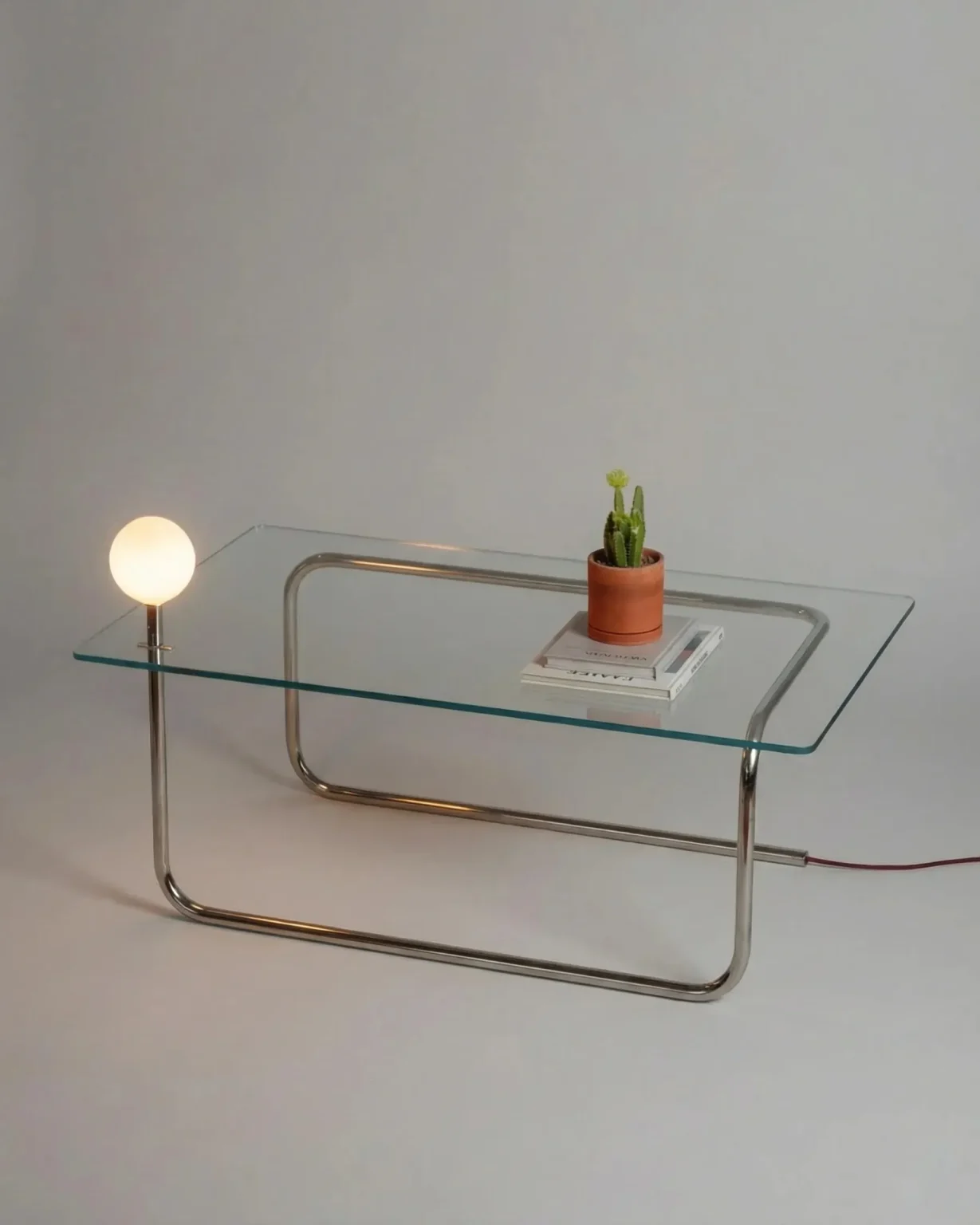
Bright Side Table Floor Lamp in Glass and Stainless Steel
By Ziroru Studio
€1.485 This product has multiple variants. The options may be chosen on the product page -
 In stock
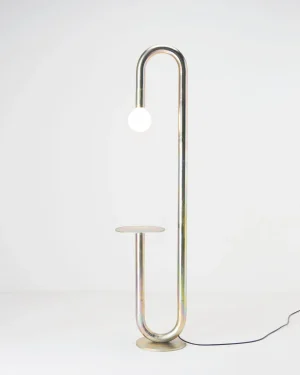
Zinc Floor Lamp Curva
By Cultivado em Casa
€1.700 This product has multiple variants. The options may be chosen on the product page -

Glow Side Table Floor Lamp in Glass and Stainless Steel
By Ziroru Studio
€1.275 This product has multiple variants. The options may be chosen on the product page -

Glow Coffee Table Floor Lamp in Glass and Stainless Steel
By Ziroru Studio
€2.320 -
 In stock
Ic-6 Floor Lamp in Resin, Gold-leaf and Natural Fibers
By Studio Josha
€9.500 -
 In stock
BY–Lamp Floor Lamp in Glass and Stainless Steel
By Studio Kuhlmann
€2.760 -
 In stock
Y–Lamp Table Lamp in Glass and Stainless Steel
By Studio Kuhlmann
€2.260
Floor Lamps with a Table
Most rooms have one good spot beside the sofa and two things that want it: somewhere to set a glass down, and something to read by. A piece that does both is not a compromise — it is the more elegant answer, and it is a format independent designers have taken far more seriously than the furniture trade.
What you will not find here is the shelf-tower lamp: a standard pole with three glass discs bolted to it. The pieces in this collection are single designed objects in which the light and the surface are the same idea. Some are tables that glow — a top or a body in resin, glass or stone lit from within. Others are lamps whose base opens into a usable tabletop, built in ash, beech and plywood, steel, brass and aluminum, stoneware and natural fiber. Several are unique or limited-edition pieces, and an unusual number are ready to ship rather than made to order.
Two Kinds of Hybrid
Knowing which one you are looking for makes the decision quick.
- Lamp-first pieces put the light at conventional lamp height and treat the surface as a shelf or tray near the base. Choose these when you mainly need a reading light and would like somewhere for a book — the light does the heavy lifting.
- Table-first pieces are side or coffee tables that happen to be luminous, throwing a low, ambient glow upward and outward rather than a directed beam. Choose these when the room already has reading light and what it lacks is atmosphere at floor level.
The second group behaves quite differently from a normal lamp: light sits below eye level, which is restful rather than functional. In practice a table-first piece pairs well with a table lamp or a wall lamp elsewhere in the room.
Sizing and Placement
- Surface height: 45–60 cm puts the top level with a sofa or armchair seat, which is where you want a drink. Around 35–45 cm reads as a coffee table and works in front of seating rather than beside it.
- Light height: on lamp-first designs, check that the bottom of the shade sits at or just below eye level when you are seated — roughly 100–130 cm from the floor — so the source stays hidden.
- Footprint: these pieces occupy the floor area of a small table, not of a lamp. Measure the space beside the sofa properly, including the cable run.
- Where it goes: beside a sofa or armchair, in the corner of a reading nook, at the end of a bed, or beside a bed where it clears the nightstand entirely. In a small apartment, one hybrid piece frees the space two objects would take.
- Cable: route it along the wall or under the piece, not across the walkway. Because the plug now feeds a piece of furniture rather than a lamp, position is harder to change later.
Light, Bulbs and Everyday Use
- Reading: 400–800 lumens directed downward on lamp-first designs.
- Ambient glow: 150–400 lumens is plenty for a luminous table, and dimming matters more than output.
- Color temperature: 2700 K keeps a low light source warm and comfortable.
- Bulbs: standard E14 or E27 sockets let you re-lamp for the life of the piece; integrated LED allows cleaner forms but cannot be replaced.
- Using the surface: treat it as a table but a considered one. Check the listed load, use a coaster or tray for drinks, and keep liquid away from any illuminated or electrical part.
- Electrical fit: pieces ship internationally from designers' studios — confirm plug type and voltage before ordering.
For upright and arced formats, browse the full floor lamps collection; for the surfaces on their own, side tables and coffee tables. Explore the full collectible lighting collection, or tell our curation team the height and footprint you need and we will suggest pieces that fit.
What is a floor lamp with a table?
A single freestanding piece that combines a light source with a usable surface — either a floor lamp whose base extends into a tabletop, or a side or coffee table with light built into it. It occupies one footprint instead of two, which is why it suits small rooms and any spot beside a sofa where there is space for one object rather than a pair.
How is this different from the shelf or tray floor lamps sold by furniture chains?
Those are standard lamp poles with shelves or a tray attached, designed to add a feature to a low-cost product. The pieces here are designed as one object from the start, usually by a single studio, in solid wood, steel, brass, stoneware, stone or cast resin. The difference shows in the join between light and surface: on a hybrid designed as one thing, there isn't one.
What is the difference between a lamp-first and a table-first piece?
A lamp-first piece puts light at normal lamp height and gives you a shelf or tray near the base — it works as a reading light. A table-first piece is a luminous table: the light sits low, spreads softly upward and is atmospheric rather than functional. If you need to read by it, choose the former; if the room already has reading light, the latter adds something no ordinary lamp will.
How high should the surface be?
45–60 cm to sit level with a sofa or armchair seat, which is the right height for a glass, a book or a phone. Around 35–45 cm behaves like a coffee table and belongs in front of seating rather than beside it. Check the listed surface height rather than the overall height, since the two are unrelated on these pieces.
Can I actually use the tabletop, or is it decorative?
? It is a working surface, within limits set by the maker. Check the stated load capacity, use a tray or coaster for anything wet, and avoid putting weight on cantilevered or glass elements. On illuminated pieces, keep liquid away from lit and electrical parts entirely — a spill on a lamp is inconvenient, a spill into one is not.
Does the light get hot near the surface?
With LED bulbs, barely — which is why this format has become viable. Where a piece takes a standard socket, fit an LED rather than a halogen or incandescent bulb, particularly if the light sits close to a wooden top or under a shade you will be reaching past.
Are these catalogued as lamps or as tables?
Both, depending on the piece — some are named as tables and some as lamps, and a few are named as both. If you are browsing furniture rather than lighting, it is worth checking this category as well as side and coffee tables, since a luminous table can easily be missed in either place.
Do they work as a bedside solution?
Very well. A hybrid piece beside a bed gives you a surface and a light in one footprint and removes a cable from the nightstand top. Look for a surface around 55–65 cm to sit level with a standard mattress, a light source that is shielded from a lying position, and a switch you can reach without sitting up.
How bright are the illuminated tables?
Modest by design — typically enough for ambient light rather than reading, in the range of a low table lamp. That is the point: light at knee or hip height reads as glow, not illumination. Treat one as a second or third light source in a room, and make sure it dims.
Are they dimmable?
It depends on the piece. Designs using standard E14 or E27 sockets can usually be dimmed with a compatible bulb and dimmer, which is worth doing on a low light source. Integrated LED pieces dim only where the designer built it in — confirm before ordering, especially on table-first designs where the whole effect depends on level.
How stable are they?
Generally more stable than a floor lamp of similar height, because the base is a table rather than a stem. The things to check are the footprint against your floor type, whether any part of the top overhangs the base, and the listed weight — several of these pieces are heavy, which is good for stability and worth knowing before you plan to move one alone.
Which materials are in this selection, and how do I care for them?
Ash, beech and plywood, steel, brass and aluminum, stoneware, marble and other stone, natural fiber and cast resin. Wipe wood and stone with a barely damp cloth and no solvents; brass will patina unless polished, which most designers intend; dust illuminated resin and glass dry to avoid marking the surface. Ask us for the maker's own care notes on a specific piece.