What is collectible design lighting, and how is it different from designer lighting?
Collectible design means pieces made in small numbers — unique works, limited editions and small-batch production — usually by the studio that designed them, and often by hand. "Designer lighting" in the wider market generally means a recognized name applied to industrial production. The practical differences are that no two collectible pieces are exactly alike, that quantities are finite, and that the maker's material choices are visible in the object rather than optimized out of it.
What are the three types of lighting?
Ambient, task and accent. Ambient light sets the overall level of a room; task light serves a specific activity and is brighter and directed; accent light picks out an object, a texture or a wall and is what makes a room look intentional. A well-lit room uses all three from separate fixtures, rather than asking one bright source to do everything.
What is ambient light?
The general, diffused light that fills a space and lets you move around it comfortably — daylight during the day, and after dark a ceiling fixture, an uplight, or several lamps working together. It sets the baseline; task and accent light are layered on top. Ambient light should be the dimmest layer you can comfortably live with, not the brightest.
How many light sources does a room need?
More than most rooms have. Five to seven separate sources in a living room, three or four in a bedroom, and at least two in a hallway. The number matters less than the distribution: light at several heights, in several corners, on dimmers, so the room can be bright at breakfast and low in the evening without rearranging anything.
How many lumens do I need?
Think in lumens rather than watts, since LED has severed the link between the two. Roughly: 150–450 lumens for an accent or bedside lamp, 400–800 for reading or task light, and 800–1,500 for a ceiling fixture serving as a room's main light. Kitchens and open-plan spaces need more, spread across several fixtures rather than concentrated in one.
Which color temperature should I choose?
2700 K for most domestic rooms — warm, comfortable and flattering to skin, timber, brick and textiles. Go warmer, 2200–2400 K, for bedrooms and late evening. Go cooler, 3000–4000 K, only where accuracy matters: kitchens, studios, workshops, make-up mirrors. The most important rule is consistency, because two different temperatures in one room read as a mistake even when each is correct on its own.
Are all light fixtures dimmable?
No, and this is worth checking before buying. Fixtures with standard sockets are usually dimmable provided the bulb and the dimmer are compatible — many LED bulbs are not. Integrated LED pieces dim only where the designer specified it, and may need a particular driver. Where a piece has a simple on/off switch, an inline or plug-in dimmer often solves it.
What bulbs do your pieces use?
Most take standard screw or bayonet sockets, commonly E14 and E27 in Europe, which means you choose the warmth, brightness and appearance yourself and can re-lamp indefinitely. Some designs use integrated LED modules for a slimmer form; these cannot be re-lamped, so the module's rated life is effectively the life of the fixture. Product pages state which, and we can confirm with the studio if it is unclear.
How long do LED bulbs last, and do they get hot?
Quality LED bulbs are typically rated between 15,000 and 50,000 hours, which is years of normal domestic use, though performance degrades gradually rather than failing outright. They run far cooler than incandescent or halogen bulbs, which is precisely why they can be used inside paper, textile, wood and resin shades where a hot bulb would be a hazard — but they are not cold, and the driver electronics do warm up.
Do warm lights attract fewer insects?
Yes, noticeably. Insects respond most strongly to short-wavelength light, so cool white and blue-heavy sources attract far more than warm, amber-leaning ones. For terraces, porches and open windows in summer, 2200–2700 K makes a real difference — a rare case where the aesthetically better choice is also the practical one.
What is the difference between a lamp and a light fixture?
In everyday use, a lamp is portable and plugs in — table, floor and cordless pieces — while a light fixture is mounted to the building and usually hardwired, including ceiling and wall pieces. Confusingly, "lamp" also means the bulb itself in trade usage. On this site we use lamp for the object, and organize everything by where it goes rather than by how it is powered.
Where should I start if I don't know which format I need?
Start with the constraint rather than the look. If the ceiling is under about 2.4 m, that points to flush mounts. If there is no ceiling point where light is needed, floor lamps — arc pieces especially — or plug-in wall lighting. If there is no socket at all, cordless. If surface space is scarce, wall lamps. Once the constraint has chosen the format, the lamps section covers sizing, shades and materials in detail.
Which pieces need an electrician?
Anything hardwired: ceiling fixtures of every kind, and most wall lights. Table lamps, floor lamps, cordless pieces and any design supplied with a plug need nothing but a socket. Weight matters for ceiling installations in particular, since these are stoneware, glass, brass and stone objects rather than pressed steel — product pages list weight and dimensions.
Are pieces made to order, and how long do they take?
Most are. Because these are small studios, many pieces are produced after you order, with lead times shown on each product page; others are held in stock and ship quickly. Unique pieces exist in a single example, so once sold they are not repeated. If you have a fixed deadline — a renovation, an opening, a delivery date — tell us before ordering and we will confirm it with the maker.
Do you ship internationally, and will the piece work in my country?
Yes, worldwide, directly from the designers' studios. Because of that, plug type and voltage follow the maker's location, so check the listing and ask us if you need a specific plug or a voltage confirmation. Pieces using standard sockets are straightforward to adapt; integrated-LED designs are worth confirming before ordering to a different electrical region.
Can I commission a piece, or order several matching ones?
Frequently, yes. Many studios adapt dimensions, finishes, drop lengths and configurations, and can produce sets for a dining room, a hotel or a restaurant. Order multiples in a single batch so glazes, glass color and grain match across the pieces. Architects and specifiers should use the trade programme; private clients can brief the curation team directly.
Do you sell bulbs, shades, lamp parts, string lights or ceiling fans?
No. Bulbs, replacement shades, rewiring kits, recessed and track lighting, LED strip, string and festoon lights, and ceiling fans are hardware and consumables rather than design objects, and are better bought from an electrical supplier. Everything in this collection is made to be looked at as well as switched on.
 Arco Massiva — Ebony Wood, Cast Aluminum And Velvet Chair
 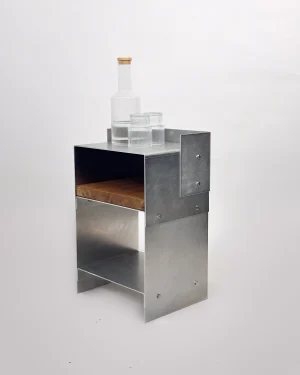 Matted Aluminium - Natural Oak Wood Night Table